
Larissa Castle
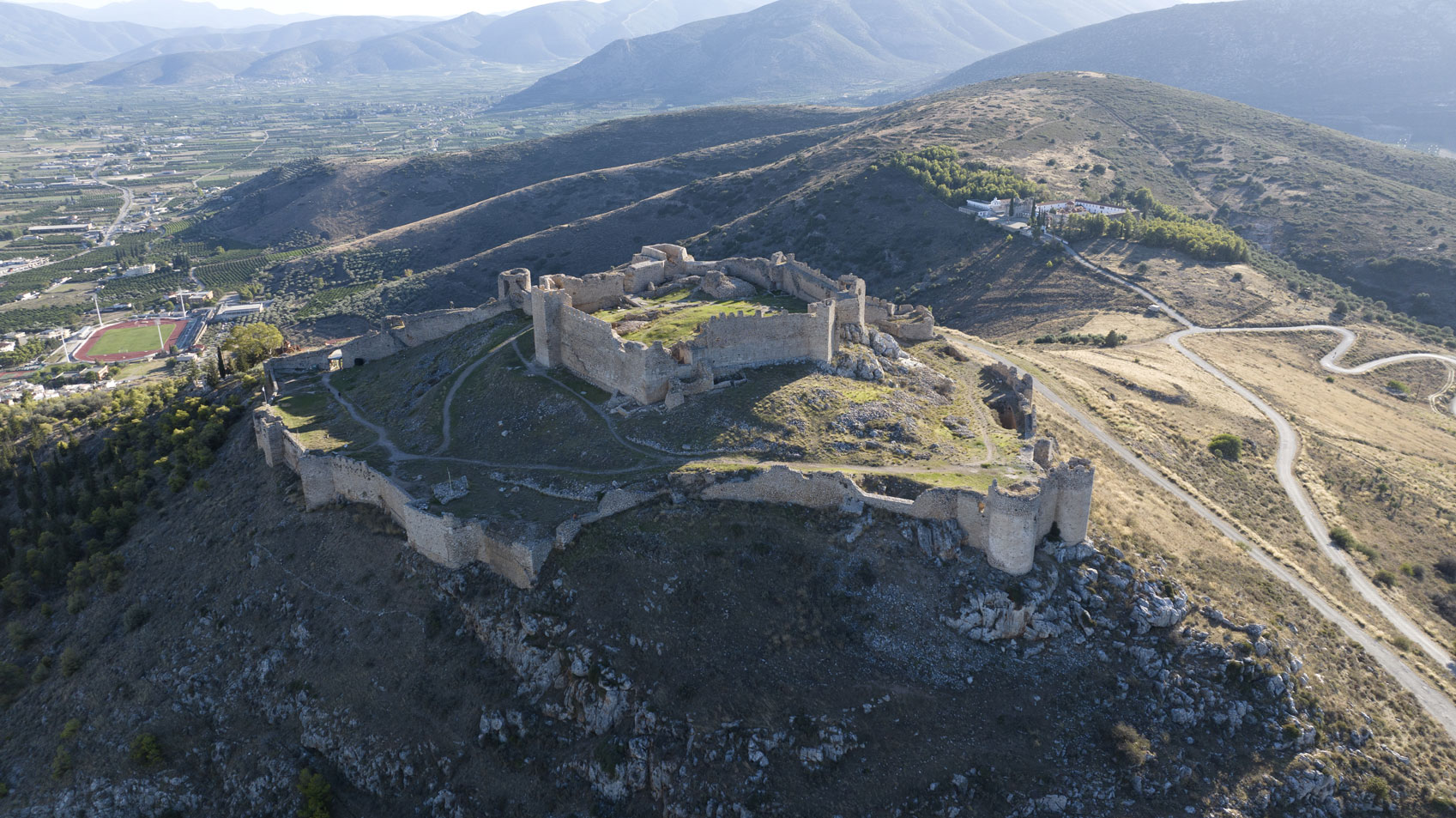
Larissa Castle stands prominently atop the hill of the same name, overlooking the modern city of Argos. This strategic location with a commanding view enabled it to control the plain around the Argolic Gulf as well as the sea and land routes connecting the southeastern Peloponnese with Attica and the Aegean islands. The castle’s name is associated with Larissa, the daughter of the mythical founder of the Pelasgians.
ΑΠΟ ΤΟ ΠΑΡΕΛΘΟΝ ΣΤΟ ΠΑΡΟΝ
Larissa Hill has been inhabited since prehistoric times, when it was first fortified, and, following the long history of the city of Argos, it remained in use until the Greek Revolution of 1821. In antiquity, it was incorporated into the city’s fortifications, with the acropolis located where the castle now stands.
The first mention of the medieval castle dates to its conquest by the Byzantine ruler Leon Sgouros in 1203. After his death in 1209, it was ruled by Theodore Angelos, brother of the despot of Epirus, who soon handed it over to the Franks. Thus, until 1212, it was in the hands of Geoffrey of Villehardouin before transferring to the de la Roche dukes of Athens. Around a century later, in 1309 it passed to the houses of Brienne and Enghien.
For a brief period, from 1389 to 1394, the castle was controlled by Theodore I Palaiologos, the despot of the Morea, and Nerio Acciaiuoli, the Florentine duke of Athens. In 1394, Argos passed to the Venetians, who worked on its fortifications. A few years later, in 1397, the Ottomans briefly occupied it, leaving destruction and desolation in their wake. When the Venetians returned, they reinforced the castle. However, the governor of the wider area was now based in Nafplio and it was not until just before the mid-15th century that a separate governor was again appointed to the castle in Argos, likely in response to the growing Ottoman threat.
In 1463, Argos surrendered to the Ottomans, who soon undertook works on the castle. The account of the Ottoman traveller Evliya Çelebi, who visited Argos in the late 17th century, provides valuable insight into the first Ottoman period (1463–1685). He describes an impressive tall tower, a mosque and 150 houses within the citadel, as well as 80 Ottoman and Greek houses surrounding the castle.
In 1686, Argos was conquered by the Venetians under Francesco Morosini, ushering in the second period of Venetian rule. In 1715, like the rest of the Peloponnese, it was recaptured by the Ottomans and remained under their rule until the Greek Revolution of 1821.
The local Ephorate of Antiquities has consolidated and enhanced the castle, making it accessible to visitors.
THE CASTLE
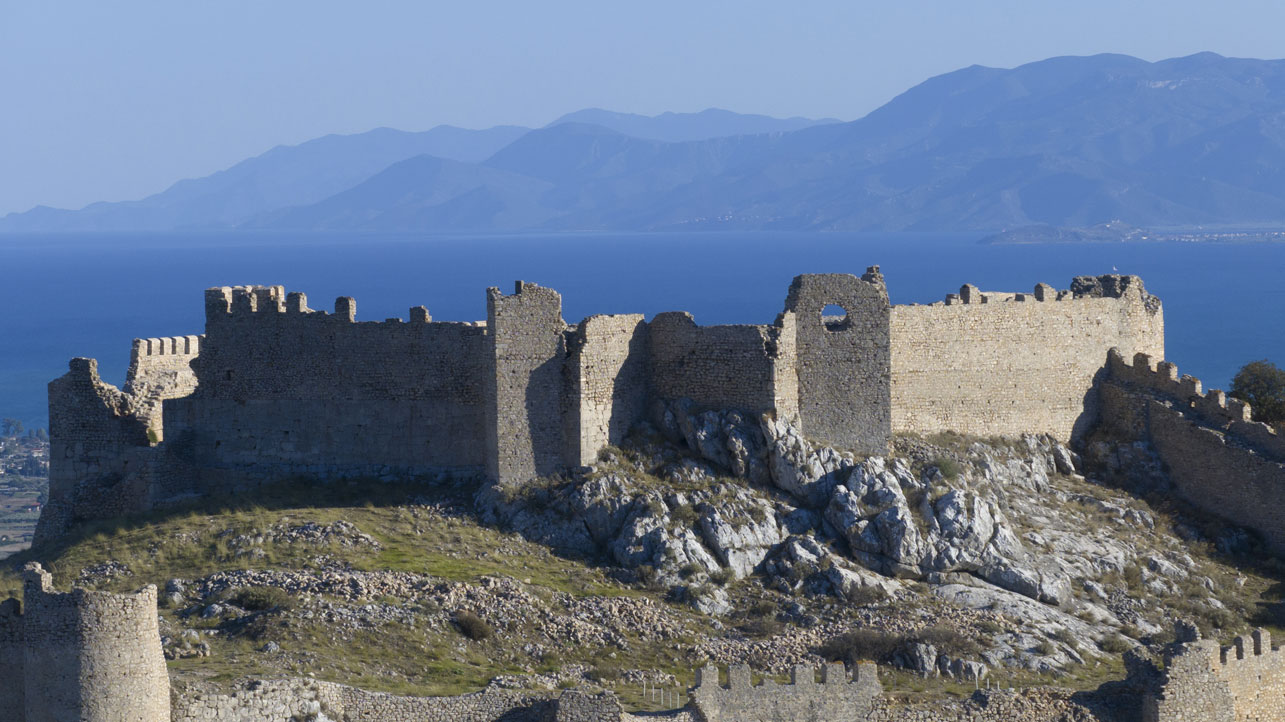
The castle reflects different construction phases, beginning in the Mycenaean era (13th c. BC) and continuing through to the second period of Ottoman rule (1715–1821). Its current form, along with the ruins within, primarily dates from the Byzantine period (12th c.) onwards. Only a few sections of the ancient fortification remain, incorporated into later fortifications. Necessary repairs were made after a large explosion in 1700, which caused extensive damage, mainly on the southern side of the fortification.
The castle consists of two enclosures, a wide outer one and, at the top of the hill, an inner one. Its towers, originally square in Byzantine times, have undergone numerous alterations over the centuries.
The inner enclosure, the castle citadel, is roughly hexagonal in layout and occupies the top of the hill. It preserves architectural elements from various construction phases, reflecting its continuous use over time, such as parts of ancient architectural members and sculptures reused in its walls, remains of Hellenistic walls and buildings of the Byzantine, Frankish and Ottoman periods.
The wide outer enclosure, built during the Byzantine period, followed the course of the ancient one. During the first period of Venetian rule (1394–1463), it was reduced by about half in size with the construction of two cross-walls linking the citadel to the eastern and western outer walls, respectively. The more vulnerable (southern) section of the outer wall was gradually abandoned and left to deteriorate. The western wall was reinforced with two towers at its ends, while the eastern wall featured three towers. A twin-tower complex was added to the northern part of the outer Byzantine wall.
During both periods of Ottoman rule (1463–1685, 1715–1821), as well as the second period of Venetian rule (1686–1715), the castle’s defences were reinforced. In 1467, the Ottomans built the large cylindrical tower that dominated the castle until 1700. The entrance to the castle was also reinforced: a new wall in the form of a bulwark was erected to the south, creating a closed antechamber that protected both gates of the castle, that is, the gate of the outer enclosure and that of the citadel.
THE GATES
Access to the castle is through the gate located in the bulwark on the southern side of the walls. It is a vaulted cobbled passageway.
The main gate of the citadel is located roughly in the middle of the southern side, slightly east of the now-blocked gate of the Byzantine period. A second gate existed south of the western wall.
THE INTERIOR
Within the citadel, the surviving architectural remains reflect the castle’s long history of habitation. To the south, a large monolithic threshold and parts of pilasters are thought to belong to the initial Mycenaean gate. In the northern part of the citadel, the remains of the temple of Athena Polias are still visible. Nearby, to the northeast, are the ruins of a large Christian church from the 6th to the 10th centuries. In 1174, a small aisleless church dedicated to the Virgin Mary was built at this site, according to a surviving dedicatory inscription. On the eastern side of the citadel, the large, elongated two-storey building, dating to the Frankish period (1209–1389), served a public function, probably as the residence of the Frankish castellan.
In the southwestern corner of the walls lie the remains of the large cylindrical tower built by the Ottomans in 1467 to reinforce the castle’s defences and project its power to neighbouring Venetian possessions. According to the description of the Ottoman traveller Evliya Çelebi (1668), this tower had eight floors and a stone dome covered with lead, with a height rivalling that of the Galata Tower in Constantinople. A great explosion in 1700 destroyed the tower – which was used as a gunpowder storeroom – and a little later, the bastion that survives today was erected in its place.
A large cistern at the centre of the citadel, along with others in the outer enclosure, ensured the castle’s water supply. A residential area probably developed in the outer enclosure, as suggested by travellers’ accounts. However, this has not been located by archaeological excavations.