
Zakynthos
Built on the hill overlooking the island’s capital, on the eastern side facing the Peloponnese, Zakynthos Castle commanded the harbour and the coastal settlement of Aigialos. Archaeological evidence and written sources indicate that the hill was fortified as early as the 5th century BCE. However, later successive phases of fortification have almost completely destroyed the remains of the ancient acropolis and settlement.
ΑΠΟ ΤΟ ΠΑΡΕΛΘΟΝ ΣΤΟ ΠΑΡΟΝ
Nothing is known about the fortification of the hill during the Byzantine and Frankish periods. The oldest reference to the castle dates to the 15th century, specifically to 1478, when, according to a codex of the monastery of Agios Ioannis Prodromos, “Lady Kleopi Kopsidou” built a monastery “in the Castle of the present city of Zakynthos”. The following year (1479), the Ottomans captured and destroyed the castle, ceding it a few years later to Venice on the condition that the city, then located on the site of the present castle, would not be fortified. Nevertheless, the Venetian administration soon realised the need to strengthen the castle to secure the presence of the administrative and ecclesiastical authorities, maintain the military garrison and protect the inhabitants during raids and invasions. The oldest surviving section of durable fortification dates to 1503, of which only a part remains today, featuring immured reliefs depicting coats of arms and the winged Lion of Saint Mark. During the 16th and 17th centuries, the castle underwent successive reconstructions, both of its fortifications and its buildings, often necessitated by devastating earthquakes or failed Ottoman sieges. Meanwhile, the coastal settlement began to develop at the foot of the hill, where the current town of Zakynthos now stands.
After the fall of the Venetian Republic, the island successively passed into the hands of the French Republic (1797) and the Russo-Ottomans (1798) until the establishment of the Septinsular Republic (1800–1807). Then the French returned, and in 1812, the British, who had established a garrison there, carried out significant repairs to the walls and buildings of the castle. From 1815, Zakynthos formed part of the United States of the Ionian Islands under British protection until 21 May 1864, when the Ionian Islands were united with Greece. During World War II, the Italian and German occupation forces constructed fortifications within the castle. In the 1950s, the castle’s buildings were destroyed, and material from them was used for public works projects in the city and the harbour.
THE CASTLE
The construction of the walls and fortifications, as they are preserved today, was completed in 1646 under the design and supervision of Venetian engineers, using the forced labour of the local population. They constitute a typical example of fortification architecture of the time. The walls, carefully built with rectangular stones and lime mortar as bonding material, feature a tall sloping batter and a semicircular cordon, while their parapet contains gun slits and embrasures. Inside the parapet, a wall-walk allowed for the movement of soldiers along the eastern side of the enclosure. Another characteristic feature of Zakynthos Castle was the circular guerites, some of which survived until the earthquake of 1953. At key points, the defence is reinforced with bastions, which vary in form and size, adapted to the terrain and the defensive needs they were intended to meet. The bastions of the castle are depicted on two almost identical maps of Vincenzo Coronelli (1687 and 1708), while another map by Francesco Alberti (mid-17th c.) also records their names.
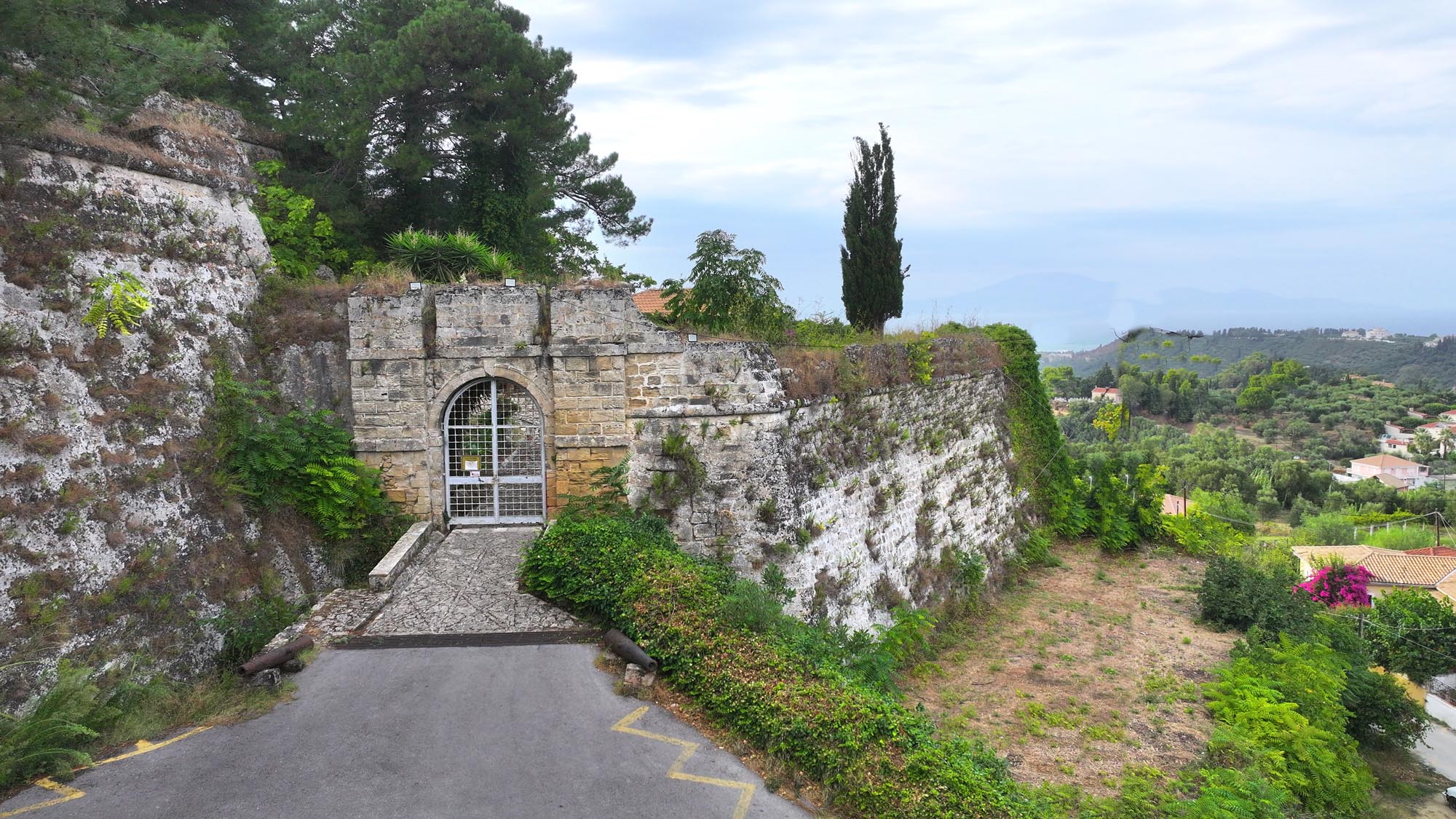
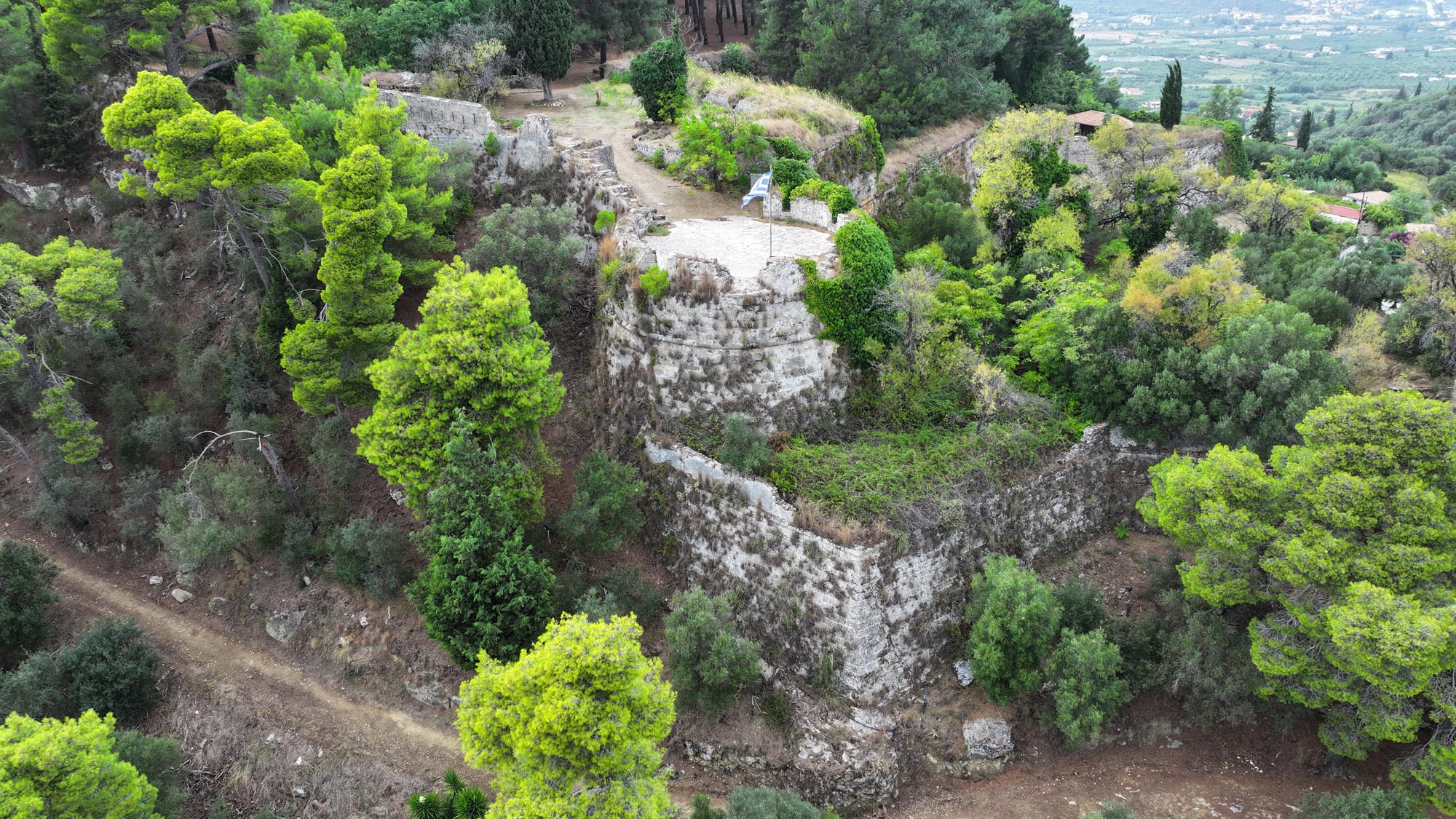
Most of the bastions are located on the northern and eastern sides of the enclosure, which were the most vulnerable to enemy attack. On the eastern side is the large Grimani bastion, while to the north, at the Tre Porte bastion, is the current entrance to the castle. Further north is the large Minotto bastion, and in the northwest corner is the Posto dell’Pozzeto bastion. On the western side, a later circular tower survives today, probably replacing the large Venetian dell’Aquila bastion. On the south side was the circular San Marco bastion, destroyed by an earthquake in 1953, while on the southeast stands the Bembo bastion.
THE GATES
The current entrance to the castle is located in the Tre Porte bastion, from where the cobbled road leading to Aigialos, the Strada Giustiniana (or Sartzada, as it became known in modern times), begins. In front of the gate, there was a wooden movable bridge, which was later replaced by a stone one.
A second, imposing gate, which also led to Aigialos, was located to the southeast, at the Bembo bastion. This gate was sealed in 1738, but its upper part still preserves relief coats of arms and inscriptions with the names of the Venetian proveditore of the time, the responsible engineers and the year 1646.
To the east, in the square of the Grimani bastion, there is a third, small gate.
THE INTERIOR
Excavations carried out to date have uncovered archaeological material dating from prehistoric to post-Byzantine times, proving that the castle is the longest-inhabited settlement on Zakynthos. As for the public and private buildings inside the castle from the 16th century onwards, what little information is known is drawn from the study of surviving written sources, maps and archaeological research. The settlement was divided into six districts, with 12 Orthodox and five Catholic churches built between the 12th and 17th centuries.
Among the remaining Orthodox churches is that of Agios Ioannis Theologos, located on the northern side of the fortress near the Tre Porte bastion. It was founded by the Makris family in 1486, but was fundamentally reconstructed in 1662 after falling into ruin. On the northwestern side is the church of Panagia Laurentaina, known to have existed by the late 15th century. It was fundamentally renovated after the earthquake of 1636 and later, under British rule, it served as a gunpowder storeroom. To the east is the church of Agios Ioannis Prodromos, whose initial phase dates back to the late 15th century. In 1603, the church was granted to the community of Zakynthos and operated as a convent. In the early 19th century it was used as an English school and later as a warehouse, before suffering severe damage in an earthquake in 1893.
The most important church uncovered within the castle is the 12th-century Byzantine church of the Saviour (San Salvatore), which was later converted into a Catholic cathedral. It stands on the northwestern side of the castle. Today it preserves the niche in the diaconicon of the sanctuary and the southern niche of the main nave, while in the area of the sanctuary, the base of the central semicircular apse with two layers of wall paintings, the steps, and small fragments of the original mosaic floor have been uncovered. In the northeastern corner of the castle lies the ruins of the church of Saint Barbara, a small aisleless basilica. Towards the southern end of the castle, the church of Saint Francis, a large basilica that served as the katholikon of a monastery, has been identified. It was probably built in the early 14th century and renovated in the late 15th or early 16th century.
Among the surviving structures of the town that existed within the fortress are, east of the entrance, a small gunpowder magazine and a complex of two buildings that functioned as prisons during the Venetian period. Near the Bembo bastion stand barracks dating from the time of British rule. Further south lies the Venetian command post, which was the residence of the proveditore and the administrative headquarters, along with another gunpowder storeroom. On the northwestern side of the castle, near the Posto dell’Pozzetto bastion, is a stadium from the British period. Little information survives about private buildings, though it appears the residents were often forced to rebuild due to successive destructive earthquakes and low-quality construction materials. According to travellers’ accounts, most houses were small, two-storeyed structures that had a garden.
Numerous cisterns and wells are also preserved within the castle, while excavations have revealed a particularly elaborate rainwater collection system, featuring pipelines and vaulted reservoirs.