
Vonitsa
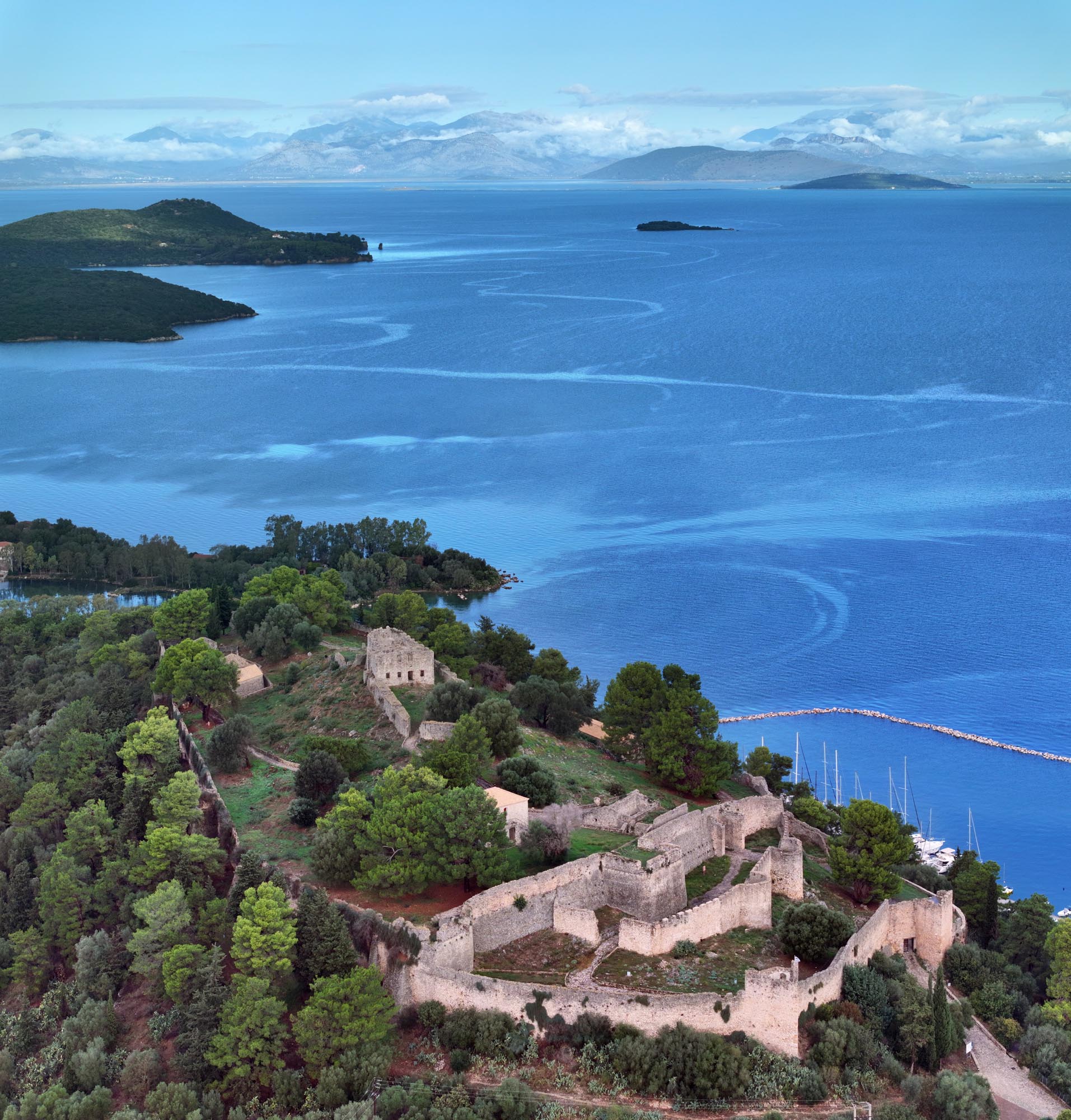
Vonitsa Castle, with its well-preserved walls, dominates the town of the same name on the southern coast of the Ambracian Gulf. Built atop a rocky, tree-covered hill, it offered excellent oversight of the gulf while protecting Vonitsa’s natural harbour. Together with Agia Mavra Castle on Lefkada and the castles of Preveza, it constituted a key strategic stronghold in western Greece and a hub of communication with the Ionian islands. Naturally fortified and surrounded by a fertile hinterland, the area produced goods that were transported from Vonitsa harbour.
ΑΠΟ ΤΟ ΠΑΡΕΛΘΟΝ ΣΤΟ ΠΑΡΟΝ
The settlement of Vonditza or Vounditza first appears in written sources in the early 10th century as the seat of a diocese under the Metropolis of Nafpaktos, indicating that it was a small regional residential centre. In the 11th century, it was besieged and looted by the Normans. At the same time, Vonitsa was among the important urban centres of the Byzantine Empire where Venetian merchants were granted privileges (tax exemptions) by Emperor Alexios I Komnenos. In the 12th century, the Arab-Sicilian geographer Muhammad al-Idrisi describes Vonitsa as a small fortified commercial city.
In 1204, after the dissolution of the Byzantine Empire by the knights of the Fourth Crusade, the city became part of the state of Epirus (commonly known today as the Despotate of Epirus). In 1294, the castle passed to the Angevin rulers of Naples, as part of the dowry of Thamar, daughter of Nikephoros, the despot of Epirus, upon her marriage to Philip, son of Charles II of Naples. Over the following centuries, Vonitsa changed rulers several times, falling under the control of the Orsini family, the house of Brienne and, finally, the Tocco family, who remained its rulers for a period, except briefly from 1378 to 1379, when they ceded it to the Knights Hospitallers of Rhodes.
In 1479, the Ottomans conquered Vonitsa, the last Tocco stronghold on the mainland. Two centuries later, during the Sixth Venetian-Turkish War in 1684, the Venetians, led by the Kefalonian officer Angelos Delladetsimas, captured the castle. Vonitsa remained under Venetian rule until the abolition of the Republic of Venice by the French in 1797, except for a brief period from 1714 to 1717 when it was temporarily held by the Ottomans.
In 1798, after a brief French occupation, Vonitsa was captured by Ali Pasha of Ioannina. Under the Treaty of Constantinople of 1800, it was granted, along with Parga and Preveza, special autonomous status within the Ottoman Empire and was excluded from Ali Pasha’s control. However, in 1806, Ali Pasha returned and captured the castle once again. In 1828, Greek troops, led by the Irish-born philhellene Sir Richard Church, and supported by a small fleet, conquered the city once and for all after a battle. The Ottoman garrison, besieged in the castle, surrendered in March 1829. In 1832, after the Treaty of Constantinople, Vonitsa, along with the rest of Aetolia-Acarnania, was officially incorporated into the newly established Greek state.
THE CASTLE
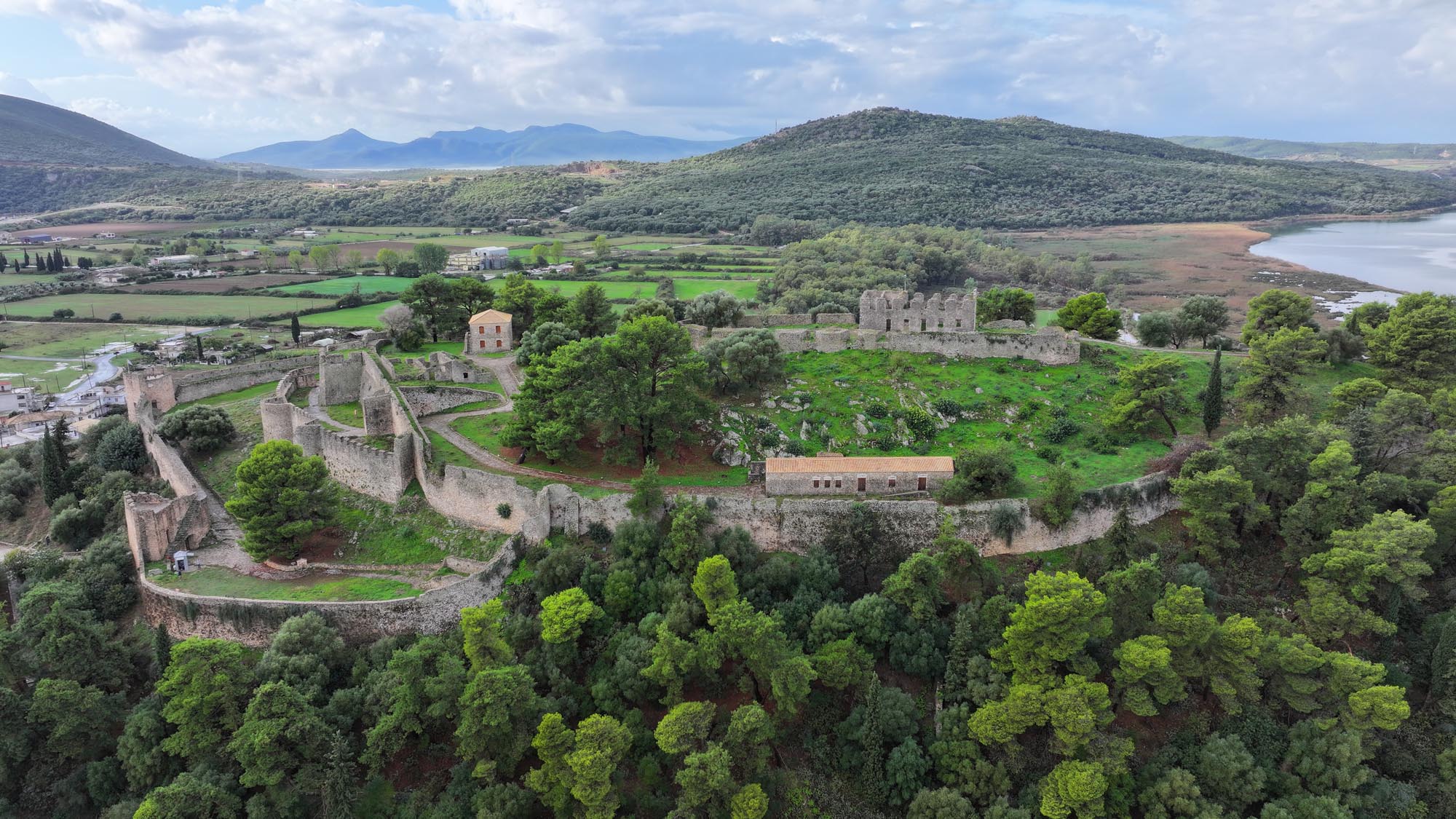
The initial construction phase of the castle dates to the Middle Byzantine period. However, its current form largely reflects modifications and reinforcements made during the Venetian period. The fortification, which encloses about 8 hectares, is organised into four distinct zones. The two lower ones, among the oldest parts of the fortification, defended the gentler slope of the hill, facing the modern settlement. The first, eastern zone is marked by a small, vertical, battlemented wall reinforced with two triangular towers. The gate, which remains the entrance to the castle, is located in this wall. The second fortification zone enclosed a small area – a bulwark – before the entrance to the main fortress and was reinforced by two U-shaped towers.
The third fortification zone, the main fortress, underwent the most extensive interventions under Venetian rule (1684–1797). It enclosed the largest space within the fortress and most of the castle’s buildings are preserved here. The enclosure was reinforced with three artillery towers or bastions, strong battered walls and cannon embrasures. On the southern side of the walls, three square towers still stand, the lower levels of which have been attributed to the castle’s initial Byzantine phase.
The fourth and last fortification zone, located at the hill’s highest point, functioned as the castle’s citadel and is dated to the early 19th century, during the final years of Ottoman rule. Its construction is likely associated with the fortification programme of Ali Pasha of Ioannina. It consists of a low enclosure with gun slits built into the walls.
THE GATES
Easily accessible from the settlement of Vonitsa, the current main entrance gate, located to the southeast of the outer wall, leads into the lower fortification zone. The inner gate to the third fortification zone, the main part of the castle at the top of the hill, is also preserved.
Another gate, located towards the western end of the north wall, led directly from the harbour to inside the third fortification zone. It probably served as a main gate to the castle during the Venetian period.
THE INTERIOR
Most buildings preserved within the castle date to the Venetian era, with the exception of the church of Agia Sophia, whose initial construction dates to the Middle Byzantine period. Within the citadel stands a rectangular structure known as the Kazarma (“Barracks”), which was likely originally a Catholic church. In 1806, the Ottomans used it either as the residence for the castle’s commander or as a barracks.
Among the buildings inside the castle, the so-called Ali Pasha Residence stands out. Constructed during the late Ottoman period to accommodate the Albanian garrison, it is situated in the southeastern part of the third main fortification enclosure, a short distance from its gate. As part of a co-funded programme, the building was restored and now houses a digital exhibition that provides information about the castle, its history and structures, as well as the Byzantine and post-Byzantine castles of Aetolia-Acarnania. The castle’s enhancement programme, which included restoration works in the third enclosure, was implemented by the Ephorate of Antiquities of Aetolia-Acarnania and Lefkada.