
Rio
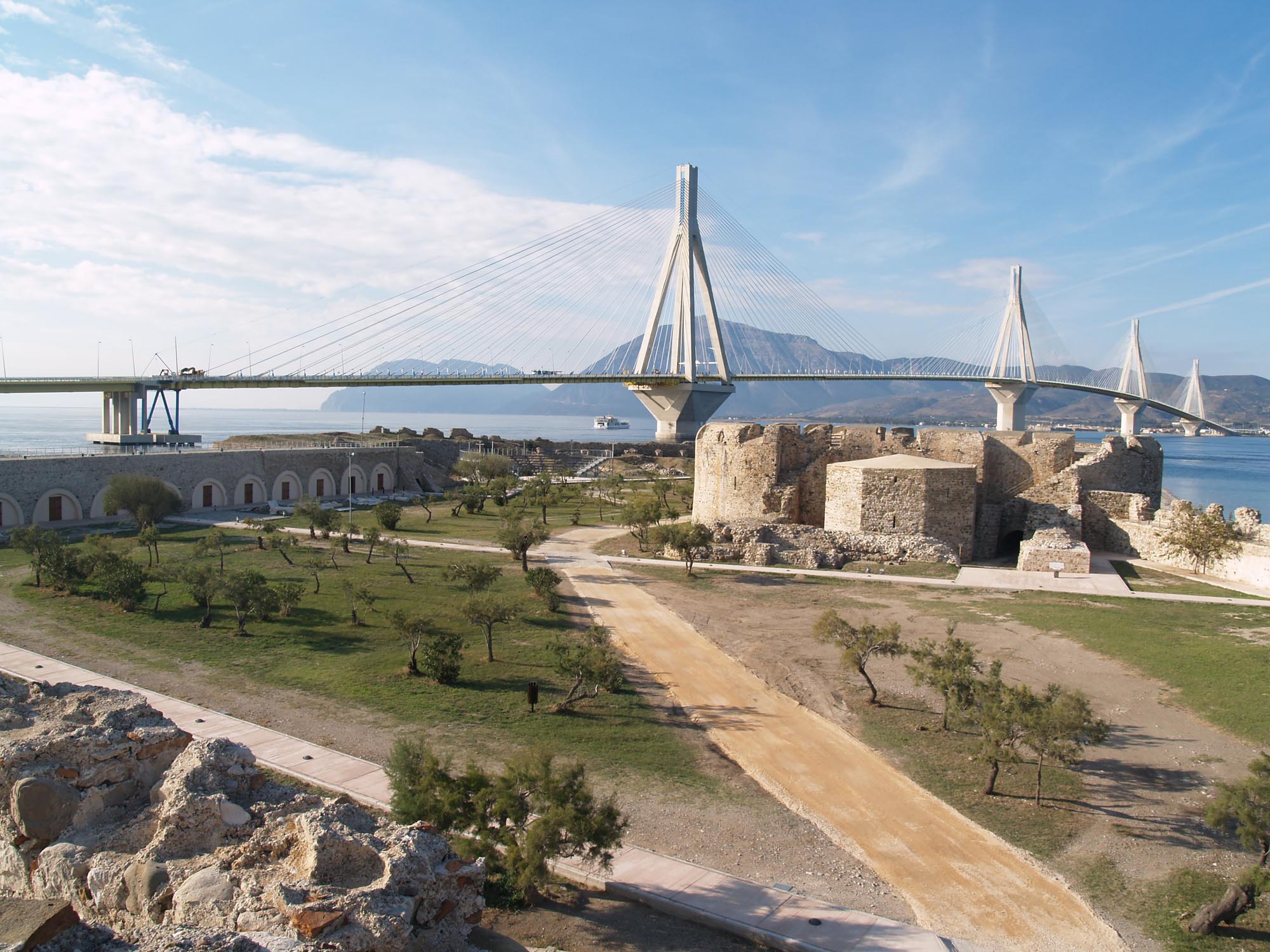
The fortress, known in the sources as Castello della Morea, is located next to the modern Rio–Antirrio Bridge, on the cape of the same name in the northern Peloponnese, which in antiquity was called Achaean Rion. The history of the fortress dates to 1499, when Sultan Bayezid II, after the Ottoman conquest of Nafpaktos, decided to fortify the narrow sea passage from the Ionian Sea to the Corinthian Gulf with the construction of the fortresses of Rio and Antirrio, following the model of the two fortresses built by Mehmed the Conqueror in the Bosporus just before the conquest of Constantinople, and those in the Dardanelles Strait built after the conquest. The main goal was to protect Nafpaktos and the strait by preventing the passage of enemy ships with firepower from each side. Thus, the two fortresses, referred to in historical sources as the Small Dardanelles or Dardanelles of Nafpaktos, were constructed on a modest scale with minimal internal facilities.
ΑΠΟ ΤΟ ΠΑΡΕΛΘΟΝ ΣΤΟ ΠΑΡΟΝ
The construction of Rio Fortress was completed within three months under the supervision of the beylerbey of the east, Sinan Pasha. A few years later, in 1532, it was occupied by Spanish troops under Admiral Andrea Doria while in the same year it was recaptured by the Ottomans, who, in 1537/38, carried out new work on the fortress (the second Ottoman construction phase). In 1603, the Knights of Malta besieged it, inflicting significant damage but failing to capture it.
On 25 July 1687, five days after the seizure of the neighbouring city of Patras, the fortress was occupied by Francesco Morosini and passed to the Venetians. Under Venetian rule (1687–1715), the new masters of the fortress carried out extensive interventions, extending its fortifications to the north and giving it the form it has today. In 1715, the Turks recaptured the fortress, which they held until 1828, when, after a siege, they surrendered it to the French expeditionary force under General Maison, who in turn handed it over it to the Greeks. It subsequently functioned for some years as a prison, while during the world wars it was used again as a fortress. It came under the jurisdiction of the Greek army and was used as a camp until 1975, when it was transferred to the Ministry of Culture. The fortress has undergone extensive enhancement and restoration works in recent years by the local ephorate of antiquities.
THE FORTRESS
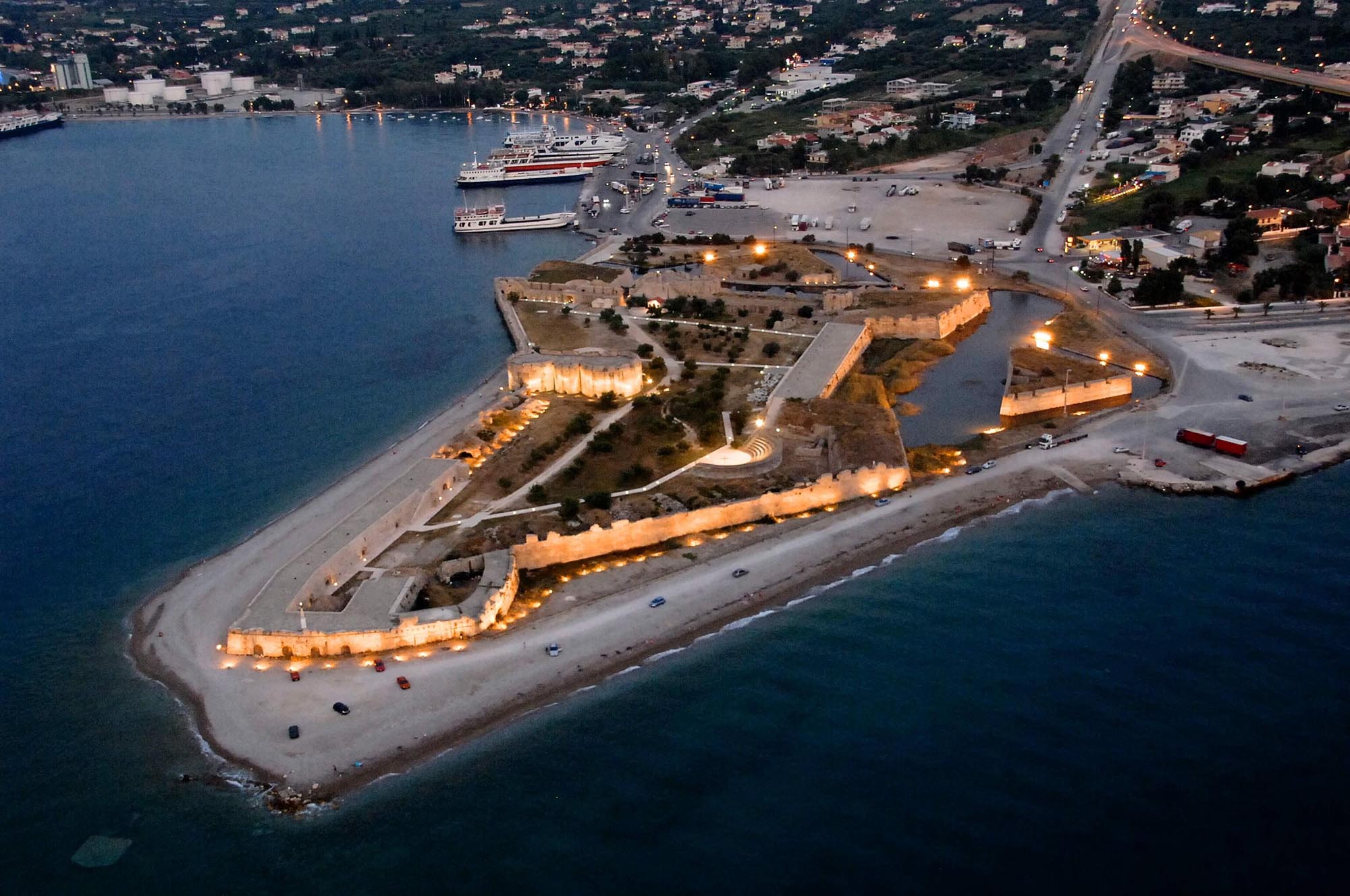
The fortress of Ottoman times was small in size. It had a trapezoidal ground plan, with the short side to the north consisting of a complex of three consecutive (or treble) circular towers. Correspondingly, on the opposite side of the trapezoid, in the middle of the southern wall, there are two consecutive (or twin) circular towers. Two more towers are formed at the ends of the south wall, a triangular one to the east and a circular one to the west, while on this side, where the entrance of the fortress was located, the fortification was reinforced with a wide moat. Of the two other long sides of the Ottoman fortification, only the eastern side is preserved, while the western side was demolished under Venetian rule during the expansion of the fortress.
According to written testimonies, the work of the Venetians took place in the early 18th century, between 1708 and 1714. The fortress was expanded and reconstructed according to the bastion system to fully adapt to defensive architectural developments. The fortifications extended north and west, incorporating the old Ottoman fortress. Two lozenge-shaped bastions (rivellini) were added to the ends of the southern Ottoman wall. The moat took a star shape, and on two islets left inside two low triangular bulwarks (tenaglie) were erected. In the northern and western extension of the fortress, two more polygonal bastions were constructed, connected by a wall, on the inner side of which stand continuous vaulted rooms. Between the bastions, at least four tunnels led from inside the enclosure to the moat, while a large cistern was constructed under the southwestern bastion.
THE GATES
The entrance to the fortress was located in the eastern part of the southern side of the walls. As archaeological research has shown, in its initial form it was a simple vaulted passage that ran through the wall. It was reinforced and took its current shape during the second Ottoman construction phase (1537/38). It was then formed as an almost U-shaped space with two openings (one on the north and one on the west side) in an L-shaped arrangement, covered by a vault projecting like a tower from the wall. Later, during the Venetian period, the gate was incorporated into the southeast bastion built in this area.
During the same period, a secondary gate to the sea was opened in the north bastion, preserving an immured Latin inscription bearing the date 1713.
THE INTERIOR
The Ottoman traveller Evliya Çelebi, who visited the fortress in the 17th century, reports a mosque, a bath, 50 houses and a fountain with clean, drinkable water inside. Of these, only the Ottoman bath is preserved today. There is also an octagonal building (gunpowder storeroom) just south of the treble tower. The largest of the twin towers on the south side was converted into a church dedicated to the Virgin Zoodochos Pigi (“Life-giving Spring”).
Within the fortress, an open-air theatre hosts performances and concerts in the summer. In addition, two information halls featuring video projection and bilingual information boards have been established in the northern Venetian bastion.