
Paralio Astros
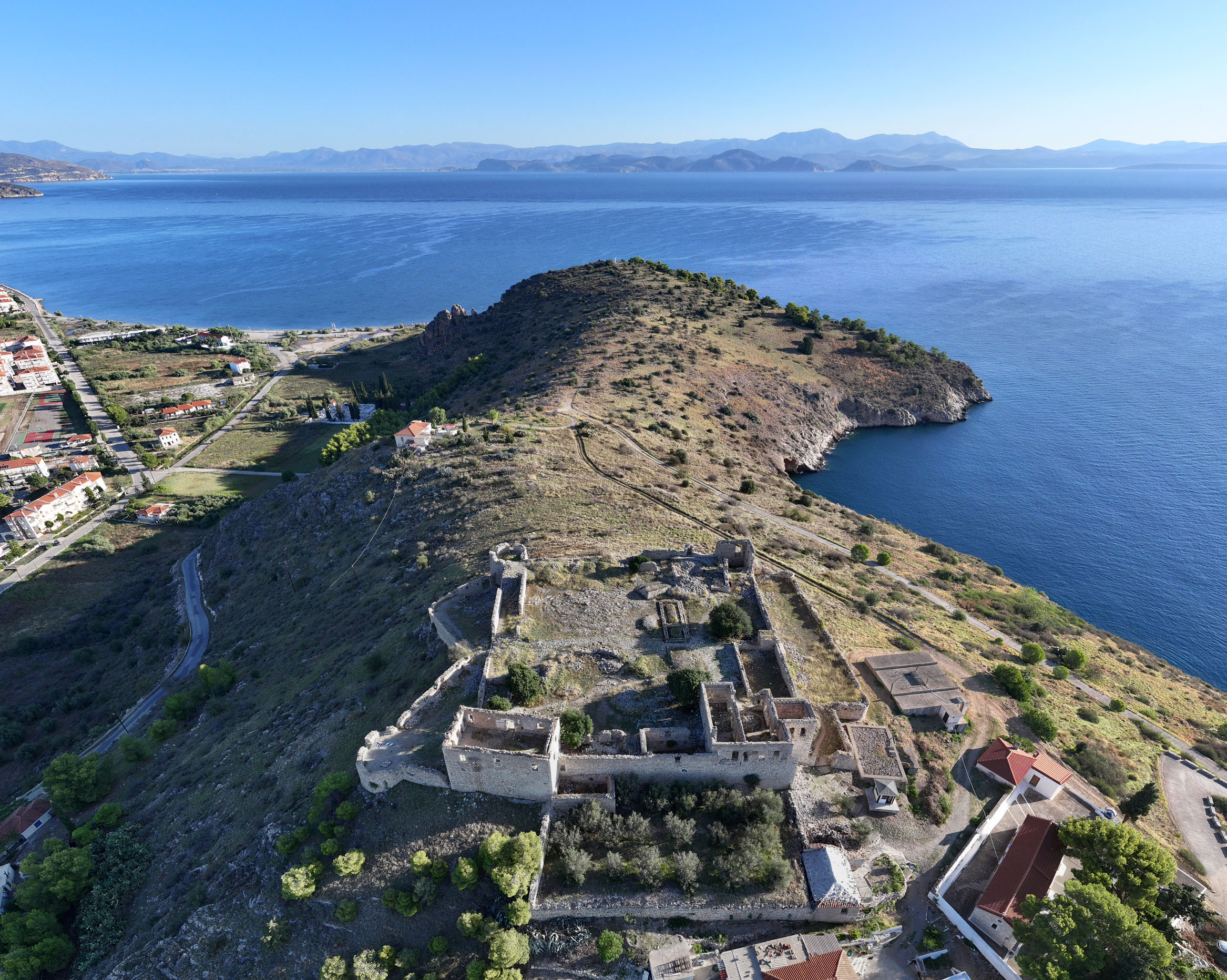
Paralio Astros Castle stands on a hill above the settlement of the same name in the southern part of the Nisi Peninsula. From this strategic position, it controlled the roads to Doliana, Astros and Leonidio, while overseeing the Argolic Gulf and Spetses.
According to scholars of the monument, the initial fortification of the site dates from the late 17th to the late 18th century. Although it is not mentioned in historical written sources, its construction can be attributed – albeit with some reservation – to the second period of Venetian rule in the Peloponnese (1685–1715) or, most likely, to the period following the Ottoman reconquest of the area (1715), to prevent any revolutionary activity by the local population. Archaeological evidence has not identified any earlier construction work. In the past, the site was mistakenly identified as the location of Estrella Castle, established locally by William of Villehardouin.
ΑΠΟ ΤΟ ΠΑΡΕΛΘΟΝ ΣΤΟ ΠΑΡΟΝ
In its current form, the castle dates to 1824/25, when it was remodelled to serve both as a residence of the Zafeiropoulos brothers and as a defensive stronghold for the protection of the local population. The three Zafeiropoulos brothers, Konstantinos, Ioannis and Panos, were wealthy merchants living abroad who returned to Greece to contribute to the liberation struggle. General Panagiotis (Panos) Zafeiropoulos, in particular, was one of the most important figures of the Greek Revolution.
On 5–6 August 1826, Greek forces led by Panagiotis Zafeiropoulos and Nikitaras successfully repelled an attack on the castle by Ibrahim Pasha’s Egyptian troops. It is reported that about 5,000 civilians, women and children from the surrounding villages, and prominent families from Nafplio, sought refuge within the fortress.
The castle remained inhabited until the 1950s, when it was finally abandoned.
THE CASTLE
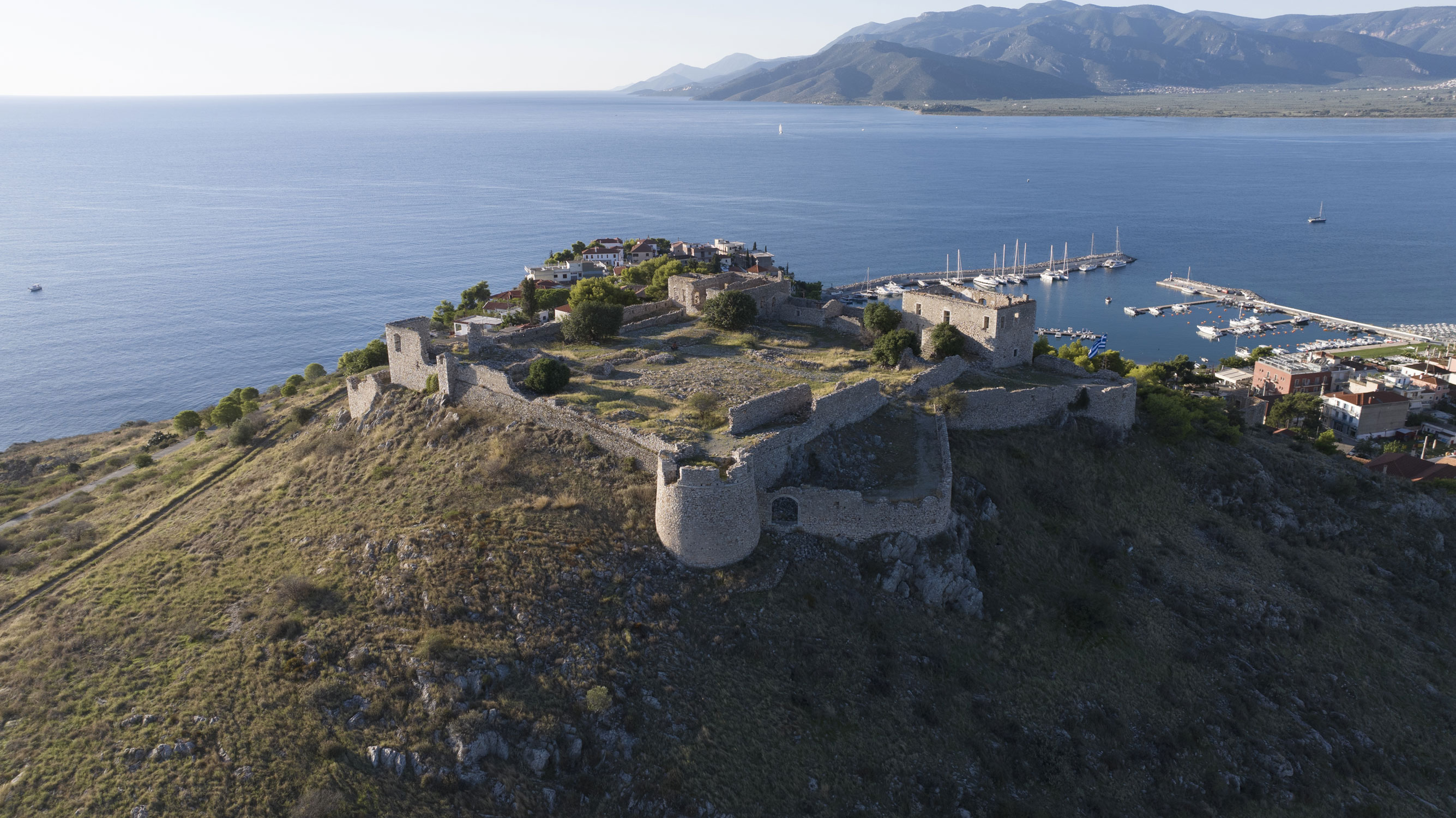
The castle consists of three fortified enclosures: a four-sided inner enclosure and two outer ones. The eastern outer enclosure, a rectangular courtyard, is the first area that visitors encounter. A stone staircase leads up to the entrance gate, behind which a narrow, vaulted corridor/passage provides access to the inner enclosure, where the residences of the three Zafeiropoulos brothers are located. Both the gate and the residences belong to the second construction phase of the castle.
The three residences are spacious two-storey buildings, equipped with underground cisterns, reception areas, bedrooms, auxiliary rooms, latrines (projecting outward on corbels) and fireplaces. These houses were not fortified themselves, since their position within the castle walls protected them. The house of Panos Zafeiropoulos, located in the southwestern corner, was built atop an older building. It features a simple floor plan and an external staircase supported by an arch, characteristic elements of local Tsakonian architecture. In contrast, the houses of Konstantinos and Ioannis Zafeiropoulos share a more complex layout, with additional auxiliary extentions, while their arched windows reflect architectural influences from the nearby island of Hydra.
The western enclosure belongs to the initial phase of the castle. It comprises two triangular protrusions-platforms resembling bastions. At the end of the southern protrusion, a semicircular tower/bastion with cannon embrasures was constructed. A second, stronger, semicircular tower with cannon embrasures reinforces the northwestern corner and guards an arched entrance gate on this side of the castle. The castle walls also had gun loops, some of which were closed up, while new ones were created, probably during the Greek Revolution.