
Palamidi
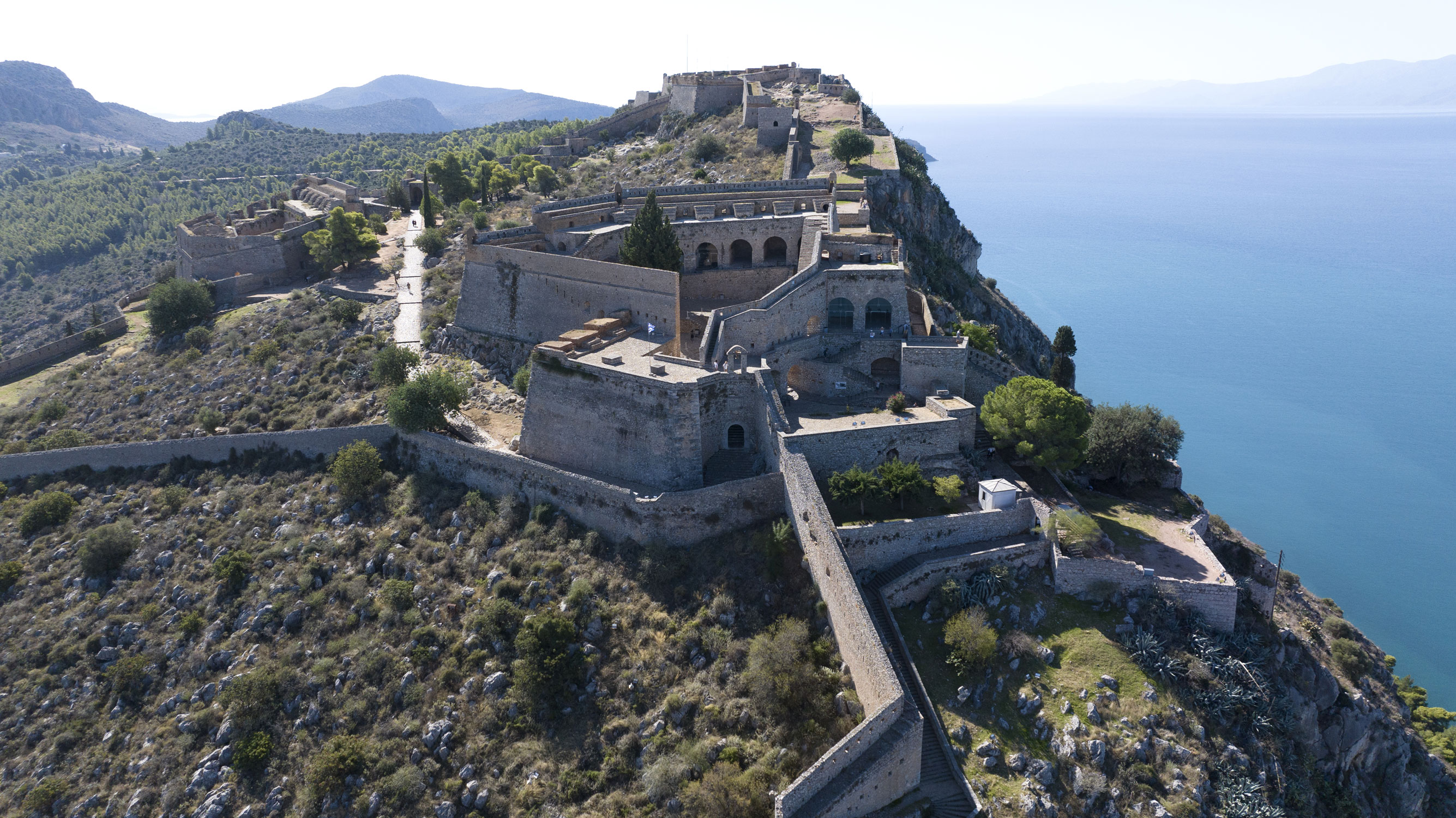
The imposing Palamidi Fortress crowns the steep hill overlooking the Acronauplia Peninsula and the city of Nafplio. The hill was named after the Homeric hero Palamedes, son of Nauplius. The Venetians erected the fortress in the early 18th century to protect the city, then the capital of the Venetian Kingdom of the Morea, and to render it impregnable. Today, it constitutes one of the most important examples of fortification architecture in the Eastern Mediterranean.
ΑΠΟ ΤΟ ΠΑΡΕΛΘΟΝ ΣΤΟ ΠΑΡΟΝ
The strategic location of Palamidi was exploited in 1686, when Admiral Francesco Morosini placed artillery there during the siege of Nafplio, the old Venetian possession that had fallen to the Ottomans in 1540. After Morosini and the Venetians captured the city, it was designated the capital of the new Kingdom of the Morea, and its fortifications were repaired, reinforced and remodelled. However, Palamidi Hill remained the main vulnerability in the city’s defence, offering a critical vantage point for bombardment in the event of a future siege. To neutralise this threat, it became necessary to construct a strong fortress on the hill – a project fraught with practical challenges and considerable financial cost.
The construction of the fortress started in 1711 under Proveditore Agosto Sagredo and the engineers Antonio Giancix, the principal designer, and Pierre de la Salle. The project advanced rapidly and was almost completed within the next few years, but despite its strength, the fortress was unable to prevent the Ottomans from recapturing Nafplio in 1715.
During the second period of Ottoman rule in the Peloponnese (1715–1822), Palamidi’s fortifications were completed to become the primary defence of Nafplio, overshadowing the importance of Acronauplia. On 30 November 1822, Greeks forces, led by Staikos Staikopoulos, captured the fortress and liberated Nafplio. Further works were undertaken by the newly established Greek state, including the reconstruction of the open staircase during the reign of King Otto – the same staircase, with its famous number of steps, that visitors still use to climb to the castle from the city.
Part of the fortress functioned as a prison from the early years following Greece’s liberation. The Miltiadis bastion housed long-term convicts, while the Agios Andreas bastion accommodated those serving shorter sentences. In May 1834, Theodoros Kolokotronis, a leading figure of the Greek Revolution, was imprisoned here on charges of high treason, only to be pardoned and released 11 months later. In August 1923, the Palamidi prison was closed, and its inmates transferred to Athens and Aegina.
THE FORTRESS
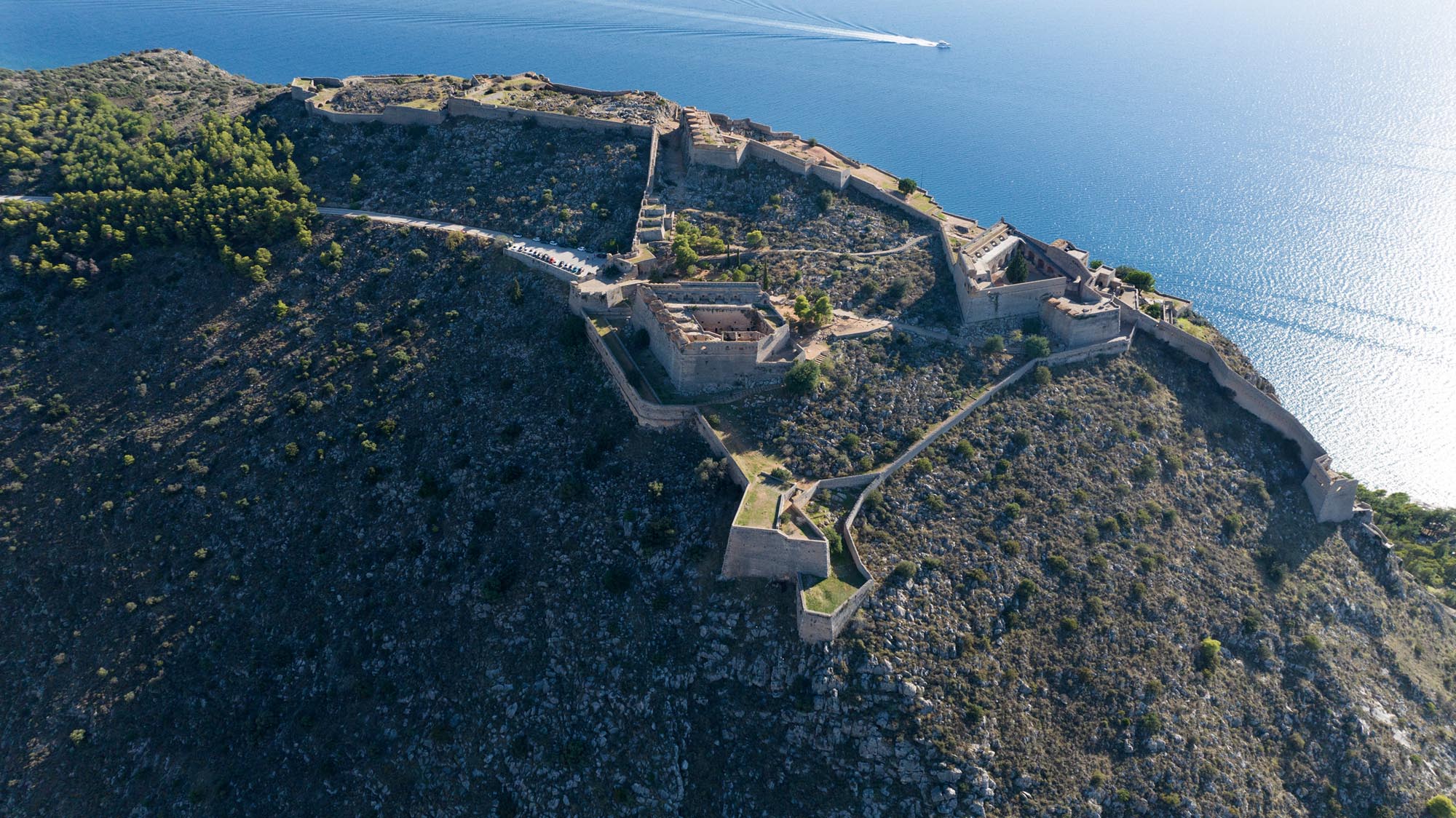
The fortress’ innovative design included individual fortifications or bastions positioned at strategic points on the hill, with the firearms on each strategically covering the adjacent bastions. A fortification wall connected them, allowing defenders to move safely from one to another. Although the bastions operated collectively as a single defensive system, each remained an autonomous fort, equipped with barracks, cisterns, gunpowder storerooms and food depots to support its garrison independently. This way, even if one bastion fell to the enemy, the fortress’ defence could continue from the others.
ACCESS
Today, visitors enter Palamidi Fortress through the central gate of the Epaminondas bastion, located next to the car park. A second entrance lies at the top of the reconstructed 19th-century staircase, which begins opposite Staikopoulos Park and the Grimani bastion. It goes through the gate at the Robert bastion and leads into the Agios Andreas bastion.
A carved staircase, vaulted along its lower half, was one of the first construction works carried out on the western side of the hill during the second period of Venetian rule in 1690. Although now inaccessible, the staircase once connected Palamidi with the Grimani bastion and the city of Nafplio.
THE BASTIONS
The Greek names of the eight bastions were assigned after the liberation of Nafplio in 1822, replacing the Ottoman-era titles. Originally, according to written records and drawings of the time, they bore Venetian names, except for the Epaminondas bastion, which was likely completed by the Ottomans.
Agios Andreas bastion
The Agios Andreas bastion was the first to be constructed, followed by the rest in a radial arrangement. It initially bore the name of Saint Gerard, patron saint of the Sagredo family. Above its central gate, a relief depicting the winged Lion of Saint Mark, the symbol of Venice, survives, with an inscription dated 1712 extolling the founder of the fortification, Proveditore Agostino Sagredo. After the Ottoman reconquest in 1715, the bastion was renamed Disdar Tabya and became the commander’s headquarters. In its central courtyard lies the small Venetian church of Saint Gerard, which was rededicated after 1822 to Saint Andrew because the fortress was liberated on his feast day. According to tradition, “Kolokotronis’ prison”, a dark, quadrilateral room where the revolutionary hero was held, lay near the church.
Robert bastion
West of the Agios Andreas bastion stands the Robert bastion, named in honour of the French philhellene Major François Robert, who fell heroically during the siege of the Acropolis of Athens in 1827. A small bastion, it aimed to guard the ascent on the hill and monitor Nafplio harbour and Acronauplia Castle.
Leonidas, Miltiadis and Epaminondas bastions
On the northeastern side of the hill stand three bastions: the Leonidas bastion, the Miltiadis bastion and the Epaminondas bastion. The Leonidas bastion, built at the easternmost end of the castle above the city of Nafplio, protected it from attacks across the plain.
The Miltiadis bastion, was the most autonomous and formidable among Palamidi’s strongholds, boasted walls reaching 22m in height and a moat flanking its southern and eastern sides. It housed a cistern and various buildings ranging from the Venetian period to modern times, when it served as a prison for long-term convicts.
The smaller Epaminondas bastion was built to protect the castle’s central gate. It features a cannon battery on its eastern side and a cistern within. The Ottomans called it Seytan Tabya (the “devil’s bastion”), perhaps reflecting the site’s reputation as the fortress’ most vulnerable point.
Phocion, Themistocles and Achilles bastions
The Phocion bastion, situated south of the Agios Andreas bastion, contains a cistern and a barracks complex and is believed to have been constructed by the Ottomans. A gate and steep staircase connected it with the larger Themistocles bastion, which commands the second-highest peak of the hill. A moat separated the Themistocles from the Achilles bastion.
The Achilles bastion – known to the Ottomans as Yuruis Tabya, or “raid” bastion – occupies the most accessible point of the hill, making it the fortress’ most vulnerable spot, its Achilles heel. It was from this point that the Ottomans stormed the fortress in 1715, as did the Greeks when they liberated it in 1822. The bastion contained a cistern and quarters for the garrison.