
New Fortress
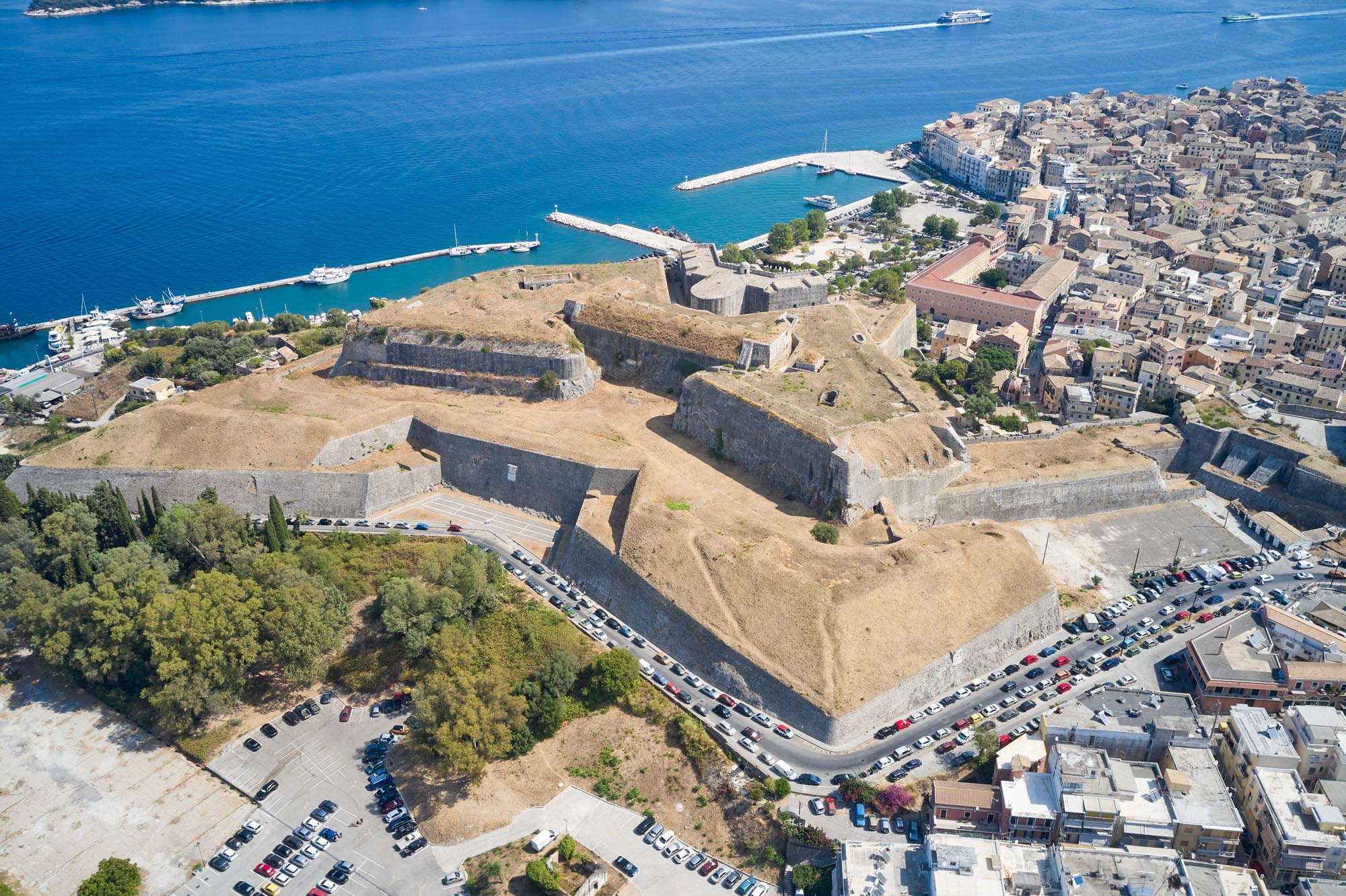
Built on the northwestern side of the city, on Agios Markos Hill, Corfu’s New Fortress protected and controlled the extensive suburbs and the adjacent harbour of Spilia. Constructed between 1576 and 1588, it forms part of the city’s perimeter fortifications, which included the surrounding hills and suburbs (borgo). In the Venetian archives, it appears under the name Nuova Fortezza (New Fortress), a designation used to distinguish it from the Old Fortress.
ΑΠΟ ΤΟ ΠΑΡΕΛΘΟΝ ΣΤΟ ΠΑΡΟΝ
The suburbs outside the Old Fortress remained unfortified until after the second Ottoman attack in 1571. The first recorded request by inhabitants to fortify the suburbs dates to 1542, following the Ottoman raid of 1537, which almost destroyed them. Despite sending at least five more delegations to Venice, it was only after the Ottomans’ second destruction of the suburbs in 1571 that the inhabitants secured approval for the fortification of their city. This extensive project was entrusted to the Venetian military engineer Ferrante Vitelli, who modified the initial plans to erect a separate fortification on Agios Markos Hill. All existing buildings on the hill were demolished to make room for the New Fortress, and their materials repurposed for the construction of the new fortification.
The island’s new defensive works proved to be very effective. A striking example of the New Fortress’ defensive capacity was the siege of 1716, when 3,000 defenders under Field Marshal Johann Matthias von Schulenburg repelled a force of about 33,000 Ottomans.
The New Fortress retained its basic form almost unchanged until the period of British rule (1815–1864), when extensive repairs were carried out (construction of two barracks, additions to the parapets of the walls and reshaping of the cannon embrasures). During World War II, the New Fortress served as an anti-aircraft shelter for residents.
THE FORTRESS
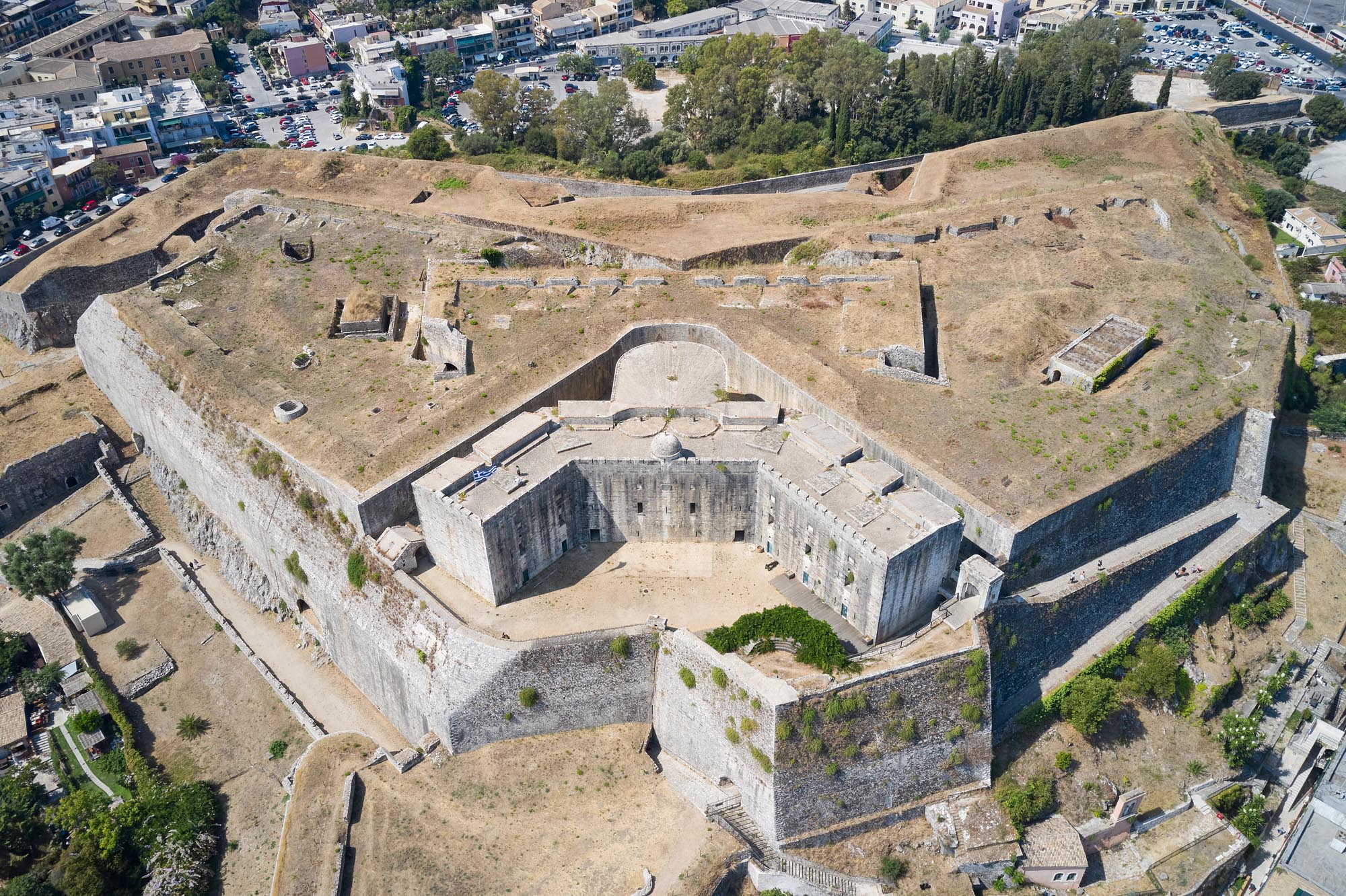
From the outset, the New Fortress functioned exclusively as a military centre. As a result, it did not contain residential quarters, except for those of the garrison commander and other officials. The fortification is structured on two levels: a lower one on the northeastern side, facing the sea, to protect the commercial harbour of Spilia, and a higher one on the western side, facing inland. The western upper section is protected by twin bastions – the Bastions of the Six and Seven Winds – connected by an intermediate wall. In 1587, the horn-shaped Skarponas rampart was added at a lower point to strengthen the western defensives. The walls were reinforced by a dry moat, along which several exits from the fortress fortification were located, though these are now blocked.
At the lower fortification level, a bastion front extends along the northeastern side of the fortress. To the north, a large pentagonal bastion, reaching the sea and protected by a rampart, was constructed, while to the south, a second, quadrilateral bastion and a third facing the harbour of Spilia – where the two gates of the fortress are located – were built. The northern part of the lower fortification level was reinforced by the small fortress of Punta Perpetua, which was demolished by the British in March 1864.
Access to the upper level was through a quadrilateral bastion located to the south. Three of its sides are equipped with gun emplacements and were filled in during the British rule in accordance with the British practice of reinforcing parapets.
THE GATES
The fortress was accessed through two gates that opened onto the southernmost quadrangular bastion of the lower fortification level. The northern gate, known as Porta Otturata, was the official gate and was used exclusively for the passage of the commander. It is framed by semi-columns on either side of the central opening, and its crowning features a decorative stone relief of the winged lion, the symbol of the Venetian Republic. The main entrance, which facilitated movement within the New Fortress, was the southern gate, formed by pillars with engaged semi-columns on either side of the opening. Today, access to the New Fortress is through a gate located north of the Sarantaris bastion.
THE INTERIOR
On the plateau of the Seven Winds bastion, the imposing three-storey barracks from the period of British rule still stand, along with two gunpowder storerooms. The eastern part of the fortress is closed to the public, as it houses Corfu Naval Base.