
Nafpaktos
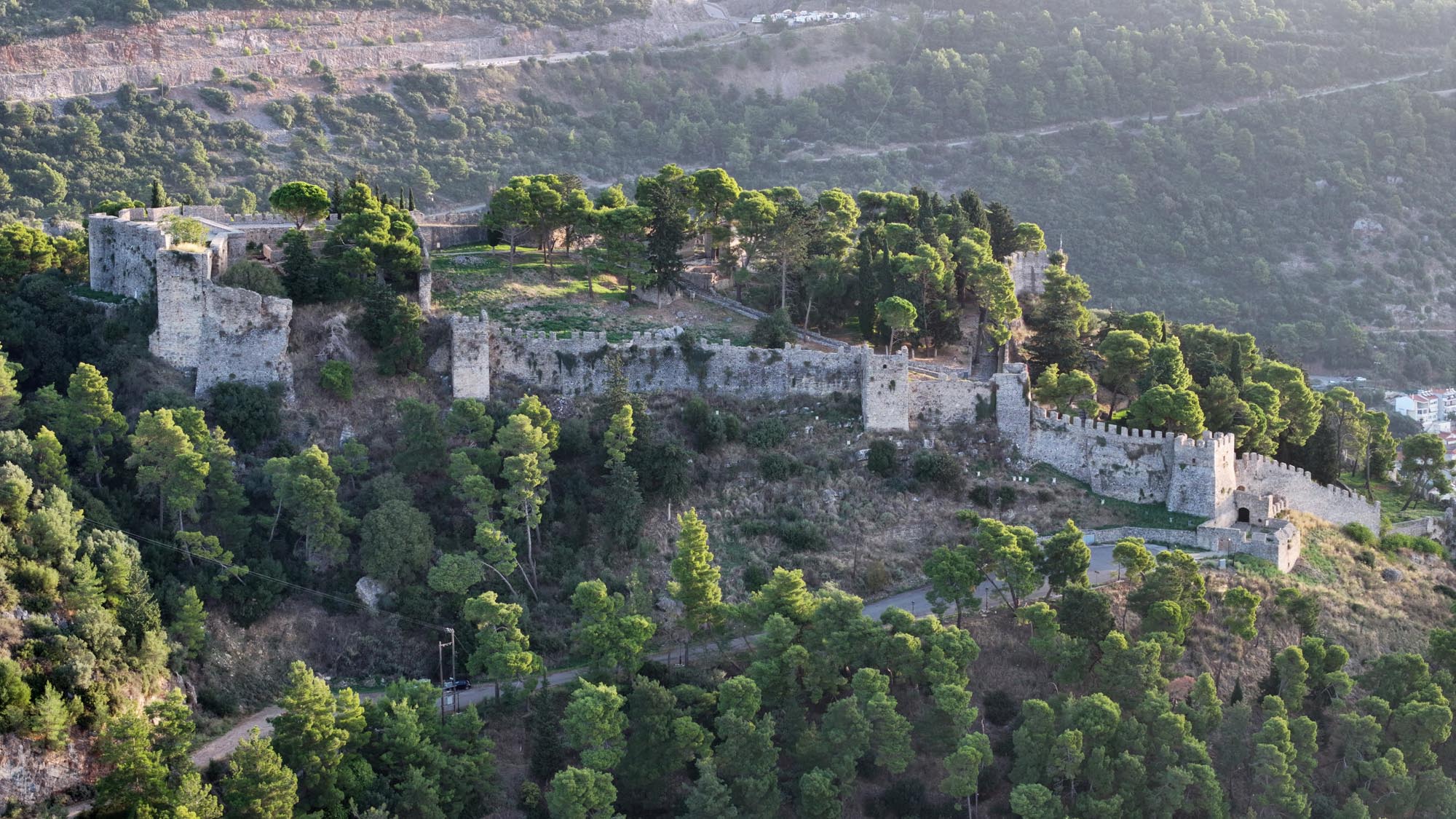
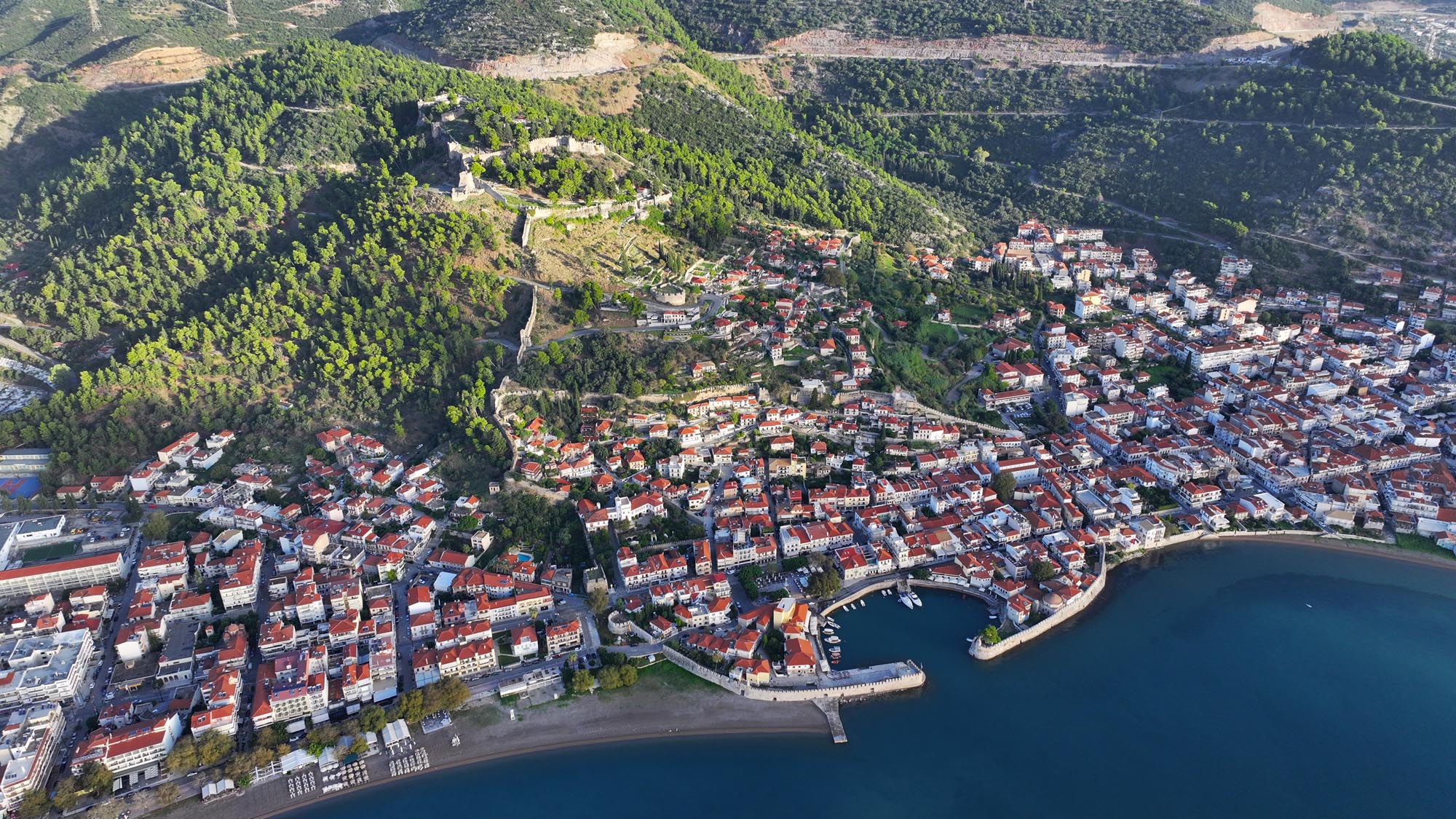
The imposing Nafpaktos Castle stands on the southern slope of a steep hill that rises abruptly at the foot of Mount Rigani, overlooking the entrance to the Corinthian Gulf. It encompasses the historical core of the city of Nafpaktos, which has been inhabited continuously since antiquity. Its naturally fortified location provided control over the sea passage to the gulf and was its only entrance until the opening of the Corinth Canal in the 19th century. The privileged location and the harbour of Nafpaktos contributed to its rise as a key transit hub between East and West. Its strategic significance determined its historical course, ensuring it remained a focal point of contention among the dominant political powers of each era.
According to ancient writers, the city was named Nafpaktos (which derives from ναῦς -or naus- [ship] and πήγνυμι -or pignymi- [build]) because it was here that the Dorians, in the late 12th century BCE, built their ships to cross over to the Peloponnesian coast opposite. In medieval and later historical sources, its Western overlords referred to it as Le Pacto, Nepanto and Lepanto, while it was Epaktos or Epachtos and finally, Inebahti for the Ottomans.
ΑΠΟ ΤΟ ΠΑΡΕΛΘΟΝ ΣΤΟ ΠΑΡΟΝ
The oldest traces of habitation in the area date to the 2nd millennium BCE. The ancient city, located where the modern one stands today, flourished after the 5th century BCE, when it was fortified. The ancient fortifications enclosed a larger area to the east than the medieval one. Remains of the ancient walls survive in fragments, embedded in the lower parts of the later fortifications. According to Thucydides, the walls of Nafpaktos, which extended to the harbour, were exceptionally strong, and the city served as a base for the Athenians for their sea and land operations during the Peloponnesian War.
In the 4th century BCE, Nafpaktos joined the Aetolian League. Following the Roman conquest in the 2nd century BCE, it became part of the colony of Patras. During the early centuries of the Byzantine Empire (4th–7th c.), Nafpaktos belonged to the Province of Achaia and was the seat of a diocese. In the 6th and 7th centuries, Avar-Slavic raids and natural disasters, such as the powerful earthquake of 551/552, had an impact on the extent and prosperity of the city, leading to the gradual abandonment of its eastern coastal part.
The city recovered after the 10th century, becoming the capital of the Theme of Nicopolis as well as the seat of a metropolis. Due to its particular strategic importance, the castle was built on the site of the ancient acropolis, while the Lower Town and suburbs remained unwalled. Parts of this Byzantine fortification are still visible today in the upper tiers of the castle. In the 12th century, Nafpaktos was a thriving city with significant commercial activity, and its fortifications were reinforced. Within the citadel, the military and administrative centre of the region, stood the metropolitan church and the bishopric.
After the dismemberment of the Byzantine Empire by the Crusaders in 1204, Nafpaktos became part of the state (later Despotate) of Epirus. In 1294, it passed to the Angevin Kingdom of Naples as the dowry of Tamar, daughter of Nikephoros I of Epirus, upon her marriage to Philip of Taranto. Philip undertook fortification works and established a mint in the castle. The 14th century was a period of significant turmoil for the region. Nafpaktos was contested by the Catalans, the Knights Hospitaller and local Albanian rulers. In 1380, the castle was owned by the Albanian ruler of Arta, Gjin Bua Shpata. In 1407, Nafpaktos passed to Venetian rule.
Under Venetian rule (1407–1499), Nafpaktos was a significant trade hub. The Venetians undertook extensive fortification works, significantly contributing to the castle’s present form. Not only were the walls extended to enclose the previously unwalled city and the harbour, but they were raised and reinforced. Although it managed to repel three Ottoman attacks (1462, 1477 and 1485), on 26 August 1499 Nafpaktos, “the most fortified stronghold of the Christian world”, was conquered by the Ottomans and became the seat of a sanjak.
During the following two centuries of Ottoman rule, Nafpaktos remained a densely populated city and trade flourished. It was among the richest in the Balkans and served as a station for North African corsairs. The castle was mainly inhabited by Muslims and several public buildings, such as the Fethiye and Vezir mosques, were erected.
After the construction of the Rio and Antirrio fortresses (1499), the Ottoman fleet used Nafpaktos as a base for operations in the western part of the empire. In 1571, near the Echinades islands at the entrance to the Gulf of Patras, the Holy League of the Catholic powers defeated the Ottomans. The naval battle, which became widely known as the Battle of Lepanto, marked a significant victory of Christian forces over the Ottomans, pivotal in terms of its symbolism, and brought the name of the city to the forefront of world history.
The Venetians temporarily recaptured Nafpaktos in 1687, but in 1699, under the Treaty of Karlowitz, it was returned to Ottoman rule. In the 18th century, the city went into decline; it ceased to be a major commercial centre, while neighbouring Patras rose in regional economic importance. Nafpaktos was liberated in the spring of 1829 following the Ottoman surrender of the castle after a siege. Greek fighters, mainly from Souli, settled in the city and in the mansions abandoned by its Muslim inhabitants.
The fortifications of Nafpaktos have undergone extensive enhancement and restoration works in recent years, particularly in the last decade, under the supervision of the Ministry of Culture (22nd Ephorate of Byzantine Antiquities, Ephorate of Antiquities of Aetolia-Acarnania and Lefkada, Directorate for the Restoration of Byzantine and Post-Byzantine Monuments).
THE CASTLE
Nafpaktos Castle, one of the best-preserved fortifications in Greece, spans an area of approximately 17.5 hectares. Its walls form a monumental palimpsest, bearing traces of every period in its long history. On the upper part of the hill is the fortified citadel, whose walls follow the natural contours of the terrain. From this point, two arms of the walls descend to the sea, enclosing the city and its U-shaped harbour.
Four transverse walls divide the interior of the castle into five tiers, each functioning as an independent fortification zone with its own gate. The three upper defensive zones constituted the fortified core of the castle, housing administrative and military building. Significant sections of the ancient and Byzantine fortifications have survived. Today, these areas comprise an organised archaeological site. The larger two lower defensive zones, the Upper and Lower (or Inner) Town, are still inhabited and form the historical core of the modern city of Nafpaktos.
The two lower defensive zones were fortified in the 15th century, under Venetian rule, with extensive reuse of ancient building materials. The fortification work was carried out gradually, and continually reinforced and improved throughout the 15th century, a period marked by the spread of artillery. The final phase of this effort, which occured before the Ottoman conquest, included the construction of robust frustum-shaped tower-bastions, with artillery positions behind low and thick parapets on their upper level. A typical example is the bastion that protected the Faltsoporti Gate, where a relief of the Lion of Saint Mark and the date 1491, in Latin numerals, remain visible to this day.
During both periods of Ottoman rule, the evolution of firearms prompted further modifications to the fortifications. On the sea wall, arched embrasures were created to accommodate cannons. Several existing bastions, such as the Clock bastion and the one on the western stretch of the sea walls, were repaired and reinforced, while new ones were constructed to bolster the defences, including the West Gate, Faltsoporti Gate, Çavuş Dapia and Botsaris Dapia bastions. Also characteristic are the outposts that were placed above the gates of the wall and in towers.
THE GATES
Nafpaktos Castle had five main gates, four landward gates and one sea gate, that connected it to the city beyond the walls and the key road routes. The main sea entrance was the Venetian Gate. The Lower Town had two land gates, one to the west, reinforced with a moat, and the Salona Gate to the east, which was located along the wall adjacent to the present metropolitan church.
Internal communication gates were created within the walls dividing the five tiers. The Sidiroporta (“Iron Gate”) connected the two lower tiers and was secured by a wooden door with iron cladding.
The main access to the Upper Town was through the Faltsoporti, a robust gate to the northeast. This gate was protected by a circular bastion dating from the first Venetian period, while later the Ottomans added a rectangular bastion. A smaller, secondary gate to the Upper Town existed on the western wall. The main entrance to the castle’s upper enclosure and citadel, located on the third tier, consisted of three successive gates reinforced by strong bulwarks. It now serves as the entrance to the archaeological site.
THE ARCHAEOLOGICAL SITE
On the lower third tier, where visitors begin their tour of the archaeological site, stands the modern guardhouse and refreshment bar as well as the remains of buildings that once served as storage rooms and water cisterns.
In the defensive zone immediately below stood key buildings of the Byzantine-era ecclesiastical and political administration. The later church of Prophitis Ilias was constructed on the site of a large, three-aisled basilica, probably the metropolitan church of Nafpaktos, dedicated to the Theotokos of Nafpaktos. Shortly after the Ottoman conquest in 1499, it was converted into a mosque. North of the church, a restored vaulted building and the remains of a Byzantine structure with arched openings and brick decoration are considered part of the 12th–13th-century Episcopal Palace complex. In the southeast, a restored building that formerly served as an armoury now functions as an information centre for visitors, featuring a digital application on the fortifications of Aetolia-Acarnania alongside extensive informational material.
The Nafpaktos Castle Museum operates within the citadel of the castle, known as Iç Kale, in the four restored barrel-vaulted halls that likely constituted the core of the fortified Byzantine keep, the last line of defence. The museum’s exhibits trace the history of the city of Nafpaktos, highlight aspects of the daily life of its inhabitants, from the Early Byzantine era to the 19th century.
THE CITY
The traditional settlement within the city walls retains visible traces of its long history among its modern buildings, particularly from the period of Ottoman rule. Nineteen fountains from this period are preserved within the urban fabric. The Ephorate of Antiquities of Aetolia-Acarnania and Lefkada has undertaken enhancement works on 12 of them, as well as on the fragmentary remains of the Ottoman-era Vezir Mosque in the Upper Town dating from 1701–1702. The mosque was part of a complex that included two fountains, a bath and a school. In the centre of the Upper Town tier stands the Çavuş Dapia bastion. Among the surviving residences, the Botsaris mansion-tower, located next to the Western Gate and once likely the residence of the Ottoman governor, and the later Tzavellas residence are of particular note.
On the eastern pier of the harbour lies the Fethiye (“Conquest”) Mosque, the first mosque erected in Nafpaktos by Sultan Bayezid II immediately after the conquest of the city in 1499. It has been restored by the Ministry of Culture (Directorate for the Restoration of Byzantine and Post-Byzantine Monuments) and functions as a space for temporary exhibitions, events and educational programmes.
THE VENETIAN HARBOUR
The U-shaped fortified Venetian harbour is a landmark and focal point for the city of Nafpaktos. During the first period of Venetian rule, two strong semicircular bastions were constructed at each end of the harbour. According to testimonies, a chain between them blocked the entrance to the harbour. The Ottomans also undertook modifications to the harbour’s fortifications. The guardhouse with the pyramid-shaped roof that was added to the eastern bastion (a similar one stood on the western bastion, but it has not survived) served as a lighthouse. In the 19th century, the western bastion hosted a customs house.