
Mistras
The castle-city of Mistras, the capital of the Byzantine territories in the Peloponnese, was founded and flourished economically, artistically and spiritually during the last two centuries of the Byzantine Empire. Unlike other major centres of the Byzantine state, it has preserved all the essential elements of its urban structure – palaces, monasteries, districts, roads, water supply systems, etc. – largely intact and unaffected by disruptive modern interventions.
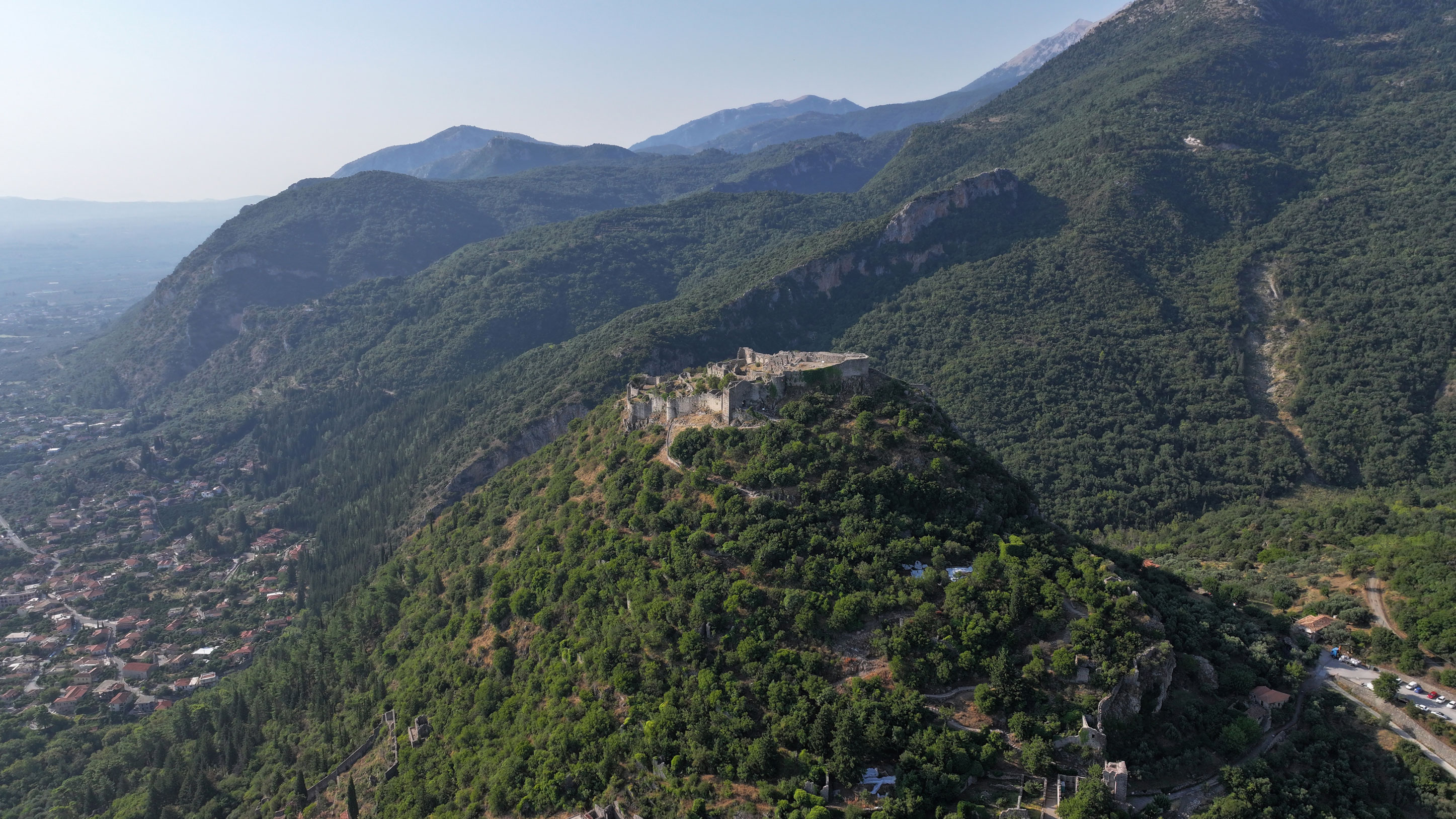
It occupies a naturally fortified location on a steep hill rising in front of the eastern slopes of the Taygetos mountains. This hill offered commanding views of the entire plain of Sparta and lay near key road networks that connected central Lacedaemon to Arcadia in the north, Mani in the south, Tsakonia to the east and Messenia to the west.
ΑΠΟ ΤΟ ΠΑΡΕΛΘΟΝ ΣΤΟ ΠΑΡΟΝ
The site does not appear to have been inhabited until the mid-13th century. In 1249, William of Villehardouin, the Frankish ruler of the Peloponnese, built the castle at the top of the hill. Following the defeat of the Franks at the Battle of Pelagonia in 1259, Mistras Castle was ceded, along with Monemvasia, Geraki and Megali Maini, to the Byzantine emperor in 1262 in exchange for the release of the captive William.
From 1262 to the mid-14th century, Mistras served as a stronghold in the Byzantine campaign to reconquer the Peloponnese from the Franks. During this period, a governor (kephale) was appointed to Mistras, initially for a one-year term. The constant conflicts led the residents of the neighbouring city of Sparta to relocate to Mistras for their protection. These population movements gradually gave rise to a new settlement on the smoother eastern slopes of the hill, transforming the original core of the castle into a citadel.
By 1308, Mistras had gained such importance within the empire that Emperor Andronikos II Palaiologos appointed a permanent governor (epitropos) to the castle. In 1348, Emperor John VI Kantakouzenos placed his son Manuel as governor and made it the capital of a despotate, that is, a self-governing province, but not an independent one, as it was part of the Byzantine Empire. Under the Kantakouzenos family’s rule of the Despotate of the Morea, Mistras evolved into an important political and administrative centre, directly connected to Constantinople. The historical and political conditions of the period transformed Mistras into a flourishing and large-scale city. It developed a palace, large residences for aristocrats, commercial streets for shops and craft workshops, as well as churches and monasteries – monuments of unique artistic value, with rich mural and sculptural decoration.
In 1384, control of Mistras passed from the Kantakouzenos family to the Palaiologos family. Despite the constantly shrinking territory of the Byzantine state and the general atmosphere of decline and insecurity, Mistras continued to flourish and remained a dynamic centre of the empire. By 1432, the Palaiologos family managed to recapture the entire Peloponnese. At the same time, the arts and letters continued to flourish, with the philosopher Georgios Gemistos Plethon (1355/60-1452) as its primary representative.
In 1443–1448, the despot of Mistras was Constantine XI Palaiologos, who would later become the last Byzantine emperor (1448–1453). He was succeeded by his brother, Demetrius II Palaiologos, who surrendered Mistras to the Ottomans in 1460.
During the First Venetian-Οttoman War (1463–1479), and specifically in 1464, Sigismondo Malatesta, lord of Rimini, temporarily captured the castle and removed Plethon’s remains to transport them to Rimini. During the first Ottoman period (1460–1687), Mistras served as the seat of the Sanjak of the Peloponnese until 1540, when it was transferred to Nafplio. Nevertheless, Mistras remained an important city due to its agricultural and craft activities, becoming one of the most important centres of silk production and processing in the eastern Mediterranean. During the short period of Venetian rule (1687–1715), it became the seat of an administrative district (territorio), although this period saw a decline in both its population and production. During the second period of Ottoman rule (1715–1821), Mistras became a kaza seat and appears to have experienced a population and economic recovery.
In 1770, following the Orlov Revolt, Albanian troops invaded the city and caused great destruction, plundering the wider area of Laconia for almost a decade. While the Ottoman army crushed them in 1779, Mistras never recovered from the disaster and was left greatly diminished in size.
On 17 March 1821, just before the outbreak of the Greek Revolution, the Ottomans abandoned Mistras and fled to Tripolitsa, allowing Greeks to capture it without a fight. In 1825, Ibrahim Pasha’s army passed through the Sparta region, looting and destroying it. The extensive destruction inflicted by the Ottoman troops reduced Mistras to a small, sparsely inhabited settlement.
After independence in 1831, the Greek state re-established the city of Sparta in its ancient location, prompting most of Mistras’ inhabitants to relocate there. Europeans’ interest in Sparta and Mistras was renewed during this period. Johann Wolfgang von Goethe referenced Mistras in his work Faust (1808), while an act in the tragedy Helen (1827) partly takes place in the castle-city. In the late 19th century, European Byzantine scholars, such as Gabriel Millet, began visiting Mistras, initiating the first research and conservation efforts on the monuments.
In the early 20th century, the Archaeological Society at Athens, under Adamantios Adamantiou, conducted the first systematic Greek excavations at the site, while in 1930 Anastasios Orlandos began the first restorations. In 1953, the last properties of Mistras were expropriated and the remaining inhabitants were relocated, allowing the area to become an archaeological site in its entirety. In 1989, Mistras was added to the UNESCO World Heritage List and the study and conservation work of the monuments continues to this day.
THE CASTLE CITY
Mistras, like the other major urban centres of the Late Byzantine period, was divided into three distinct fortified zones. The first line of defence was the wall of the Lower Town, which enclosed the lower part of the northern and eastern slopes of the hill. The second line of defence was the wall that protected access to the castle-citadel and Upper Town on the northeastern slope. At the summit of the hill stood the Frankish castle, the strongest and last line of defence – the citadel of the settlement.
LOWER TOWN DEFENSIVE WALL
The wall that protected the Lower Town extended on the smooth eastern slope of the hill, the most vulnerable part of the castle-city. It followed the natural contours of the terrain, and, due to its location, only parts of it have survived. It started from the monastery of Peribleptos in the southeast, proceeded east to enclose the church of the Metropolis, and ended at the monastery of Brontochion in the northwest. The wall was reinforced along its length with large, multi-storey towers, such as the one at the northeastern corner of the Brontochion monastery and that of the Peribleptos monastery, which housed the monastic refectory (Trapeza) on its first floor.
THE GATES OF THE LOWER TOWN
The current entrance gate to the archaeological site is dated later than the fortification, having been created during the post-Byzantine period on the ground floor of a two-storey tower in the walls.
The original main entrance gate of the Lower Town is no longer extant; it is believed that it was located a short distance from the present gate of the archaeological site, near the later gap in the walls known today as the Marmara Gate.
LOWER TOWN
Inside the fortification, adjacent to the current entrance gate, stands a large, two-storey building complex – possibly used for military purposes – whose ground floor now hosts the museum shop of the archaeological site. From this point, the main road of the archaeological site begins, running parallel to the eastern wall up and leading to the Metropolis building complex, the seat of the ecclesiastical administration and the central focal point of the Lower Town.
This complex comprises the metropolitan church of Agios Dimitrios, which was flanked by auxiliary buildings, including the Episcopal Palace that now houses the archaeological site museum. The metropolitan church of Agios Dimitrios is the oldest in the city, as it was built around 1270 as a three-aisled basilica with a narthex and a belfry. During the second half of the 15th century, it was reconstructed based on the Mistras type: the ground floor remained a basilica, while the upper floor was shaped as a cross-in-square church. According to tradition, Constantine XI Palaiologos, the last Byzantine emperor, was crowned here in 1448.
The main road of the Lower Town continued westward, following a winding, uphill course, and ended at the Monemvasia Gate and the Upper Town.
To the west of the Metropolis complex stands the two-columned cross-in-square church of the Evangelistria, dating to the early 15th century and the ecclesiastical complex of the Brontochion monastery. The monastery, built in the late 13th century at the northeastern end of the wall, is the oldest monastic complex in Mistras. Its first katholikon was the cross-domed octagon of Agioi Theodoroi, built between 1290 and 1295, which was later converted into a cemetery chapel after the construction of the monastery’s new katholikon, the church of Panagia Hodegetria or Aphentiko, between 1310 and 1320. The Aphentiko is the oldest known church to which the Mistras type was applied. In the northwestern chapel of its narthex lie the tombs of the founder of the church, the monk Pachomios, and Despot Theodore I Palaiologos, who died in 1407. In the 15th century, the church was converted into a mosque and later fell into ruin. Only fragments of its high-quality murals have been preserved.
Panagia Pantanassa is the only monastery in Mistras still permanently inhabited by nuns. It belongs to the Mistras type, and its Byzantine and Frankish architectural and sculptural elements, combined with its high-quality, 15th-century iconographic decoration, make it one of the most impressive monuments on the site.
Southeast of the church of Pantanassa lies the Peribleptos monastery. It was built in the mid-14th century by the first despot of Mistras, Manuel Kantakouzenos (1348–1380), and his wife, Isabella of Lusignan, and it marked the southeastern end of the wall of the Lower Town. The katholikon of Peribleptos belongs to the simple two-columned cross-in-square church type. Later, smaller chapels were attached to its outer walls. Its iconographic decoration is one of the most significant painting ensembles of Byzantine art. In addition to the katholikon, the enclosure, with its inner and outer gates, the Trapeza tower and two auxiliary buildings are preserved.
The Lower Town, the commercial hub of Mistras, was the most densely populated area of the settlement. Several residences, notable as rare surviving examples of post-Byzantine secular architecture in Greece, are preserved in good condition. The most prominent among them are the mansions of the Frangopoulos and Laskaris families. After the 15th century, the settlement expanded north of the Lower Town, outside the walls, in the area called Exo Poli or Exo Chora.
UPPER TOWN - DEFENSIVE WALL
The wall of the Upper Town served to separate the part of the settlement located high on the northeastern slope from the vulnerable Lower Town for defensive reasons. The fortifications of the Upper Town began west of the citadel and enclose the flat area where the Palace of the Despots of Mistras was located. They terminated to the south, after the Pantanassa monastery near the steep slope of the hill.
The walls to the north protected the only direct access point to the Upper Town from external attacks, where the current Upper Gate of the archaeological site is located. In this section, they were reinforced with large towers at regular intervals. Notable features include the finely crafted stone masonry with interspersed brick courses. Along the walls, both internally and externally, horizontal impressions and holes are visible; these would once have borne wooden beams or joists supporting floors of adjacent buildings.
THE GATES OF THE UPPER TOWN
There are three entrance gates to the Upper Town. The central one, located north of the walls, is known as the Nafplio Gate because it marked the end of the road that connected Mistras with Nafplio. It was protected by two towers and a bulwark. A second, the Upper Gate, located in the western part of the northern wall, connected the Upper Town with the exterior of the walls. Today, it serves as the second entrance to the archaeological site.
The Upper and Lower Town were connected through the gate in the eastern part of the wall, which separated the settlement. This gate, located near the palace complex, is known as the Monemvasia Gate, as it marked the end of the road linking Monemvasia with Mistras.
UPPER TOWN
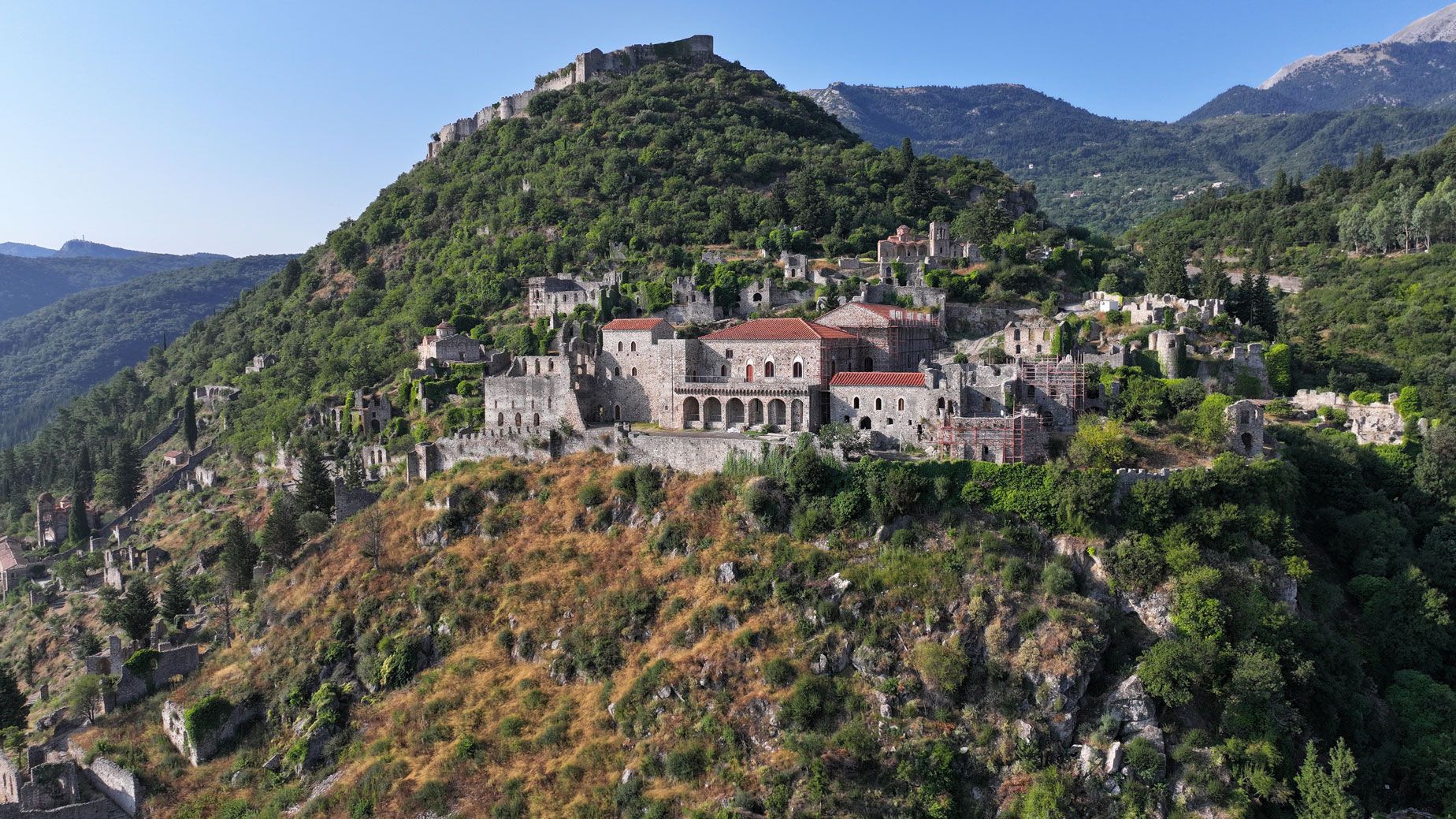
The central monument and focal point of the Upper Town is the Palace of the Despots of Mistras, which served as the seat of political power. The palace complex was constructed, configured and gradually expanded from the late 13th to the 15th century, ultimately taking its current form with an L-shaped ground plan. Its most notable features are the two-storey wing built by the Kantakouzenos family (14th c.) and the three-storey wing of the Palaiologos family (15th c.). On the top floor of the latter, the elongated throne room, the Chrysotriklinio, stands out.
The Palace of the Despots is the only Byzantine palace complex preserved in Greece. It has been restored and is open to visitors. In front of the palace lies a large natural forecourt, known as the Phoros, where the inhabitants of the city would assemble before the ruler. The main road of the Upper Town, which connected the Monemvasia and Nafplio gates, passed through this forecourt.
Near the palace lies the two-columned cross-in-square church of Agia Sophia, built in the mid-14th century by the first despot of Mistras, Manuel Kantakouzenos. Originally a katholikon of the monastery of the Life-Giver Christ, later it was converted into a chapel for the palace and served as a burial site for members of the despots’ family. Over time, a narthex, chapels, porticoes and a belfry were added to the church, which, after 1460, was converted into a mosque by the Ottomans.
In the Upper Town also lies the church of Agios Nikolaos, which was built during Venetian rule. Several residences belonging to members of the Mistras aristocracy are also well preserved.
THE CITADEL
Built atop the hill, the fortified citadel of Mistras was not near the settlement. It was accessed via an uphill stone-paved road from the southwestern side of the Upper Town. Originally built by the Franks in 1249, it was Mistras’ first fortification. However, few traces of its initial construction phase survive due to the interventions carried out over the centuries. Significant modifications were made during the first period of Ottoman rule (1460–1685) to strengthen its defences against firearms.
The castle walls form an oblong irregular plan, following the natural terrain, and feature a wide rampart-walk. All sides except the west are inaccessible, as they are situated above steep slopes and were reinforced throughout by towers. Internally, the citadel is divided by outer and inner enclosures.
THE GATE OF THE CITADEL
The citadel had a single entrance gate on the northwestern side of the walls, providing access to the outer enclosure. The gate was barrel-vaulted and protected by a tower.
THE INTERIOR
The outer enclosure occupied the largest area of the citadel. During the Ottoman period, the garrison was based here. Today, the remains of houses, storage rooms and two rainwater cisterns are still visible. In the southeastern corner stood a tall tower that functioned as a watchtower overlooking the Evrotas Valley.
The inner enclosure, located in the uppermost part of the hill, was accessed through an arched gate to the northwest. It occupied a smaller area than the outer one and enclosed a large building with a cistern on its ground floor, which has been identified as the residence of the citadel’s military commander. In the centre of the enclosure stands a small twin chapel, probably dedicated to the Prophet Elijah. On the northwestern side, at the highest point of the hill, another watchtower overlooked the western slopes of Taygetos. A forecourt with a semicircular bastion was created north of the watchtower to provide additional protection.