
Koroni
Koroni Castle fortified the peninsula that marks the western boundary of the Messenian Gulf. Its walls enclose the highest point of the peninsula and overlook the modern, picturesque town of Koroni. This strategic location, with its sheltered harbour, was of particular geopolitical significance and served as an important hub on medieval maritime routes. It flourished as a Venetian possession from the 13th to the 15th century and, along with neighbouring Methoni, was characterised as one of the “main eyes” of Venice (“oculi capitales Communis Veneciarum”) in the East.
ΑΠΟ ΤΟ ΠΑΡΕΛΘΟΝ ΣΤΟ ΠΑΡΟΝ
Material remains suggest that Koroni, considered to be the continuation of the ancient settlement of Asini, was inhabited since antiquity. The establishment of the castle probably dates to the Early Byzantine era. The Arab geographer Muhammed al-Idrisi, in the 12th century, speaks of “a small city with a fortress above the sea”. Owing to its central geographical location, Koroni was frequently targeted by pirates and aspiring conquerors.
In 1205, the castle, described as “powerless” in the Chronicle of the Morea, was captured without much difficulty by the Franks. A year later, Koroni passed to Venetian hands. In 1209, Venice’s sovereign rights in the region were officially ratified by the Treaty of Sapienza. The Venetians transformed the “powerless” fortress into a formidable seaside stronghold, which safeguarded a vital harbour for the Serenissima’s commercial activities in the Mediterranean.
During the first period of Venetian rule (1209–1500), Koroni flourished as a port, which was a mandatory stop for both merchants and ships carrying pilgrims to and from the Holy Land. Their accounts describe Koroni as a thriving city with a mixed Latin and Greek population. A suburb, or borgo, also developed outside the castle walls, towards the harbour. Compared to Methoni, its neighbouring “twin” Venetian colony, Koroni seems to have had a larger population and greater wealth. A Venetian document of 1348, written during the difficult years following the Black Death, notes that “Koroni always has an economic surplus, unlike Methoni, which remains in deficit”. Exports were key to the prosperity of the two cities, with products such as olive oil being a major export for Koroni and its region.
After the capture of Methoni by Sultan Bayezid II and the massacre of its inhabitants in August 1500, the people of Koroni, fearing a similar fate, surrendered to the Ottomans. Many chose to flee, seeking refuge in the Venetian-ruled Ionian islands, mainly Zakynthos and, somewhat later, Kefalonia. Between 1532 and 1534, in retaliation for the Ottoman attacks on Vienna, Andrea Doria, a Genoese admiral in the service of Habsburg Emperor Charles V and allied with the papacy and the Knights of Malta, captured Koroni. Upon his withdrawal, he was accompanied by more than 2,000 residents who settled in southern Italy.
In 1685, Francesco Morosini, head of the Venetian expeditionary fleet for the recovery of the Peloponnese, besieged and occupied Koroni, restoring it to the Venetians for a brief, 30-year period. In 1715, the Ottomans recaptured it, along with the rest of the Peloponnese. During the Orlov Revolt in 1770, the castle sustained damage by bombardment. Six years later, the French traveller Choiseul-Gouffier described a “terrified city” that had not yet recovered from the Orlov shelling.
In 1828, the Ottomans surrendered the castle to the French expeditionary force under General Maison and shortly thereafter was handed over to the newly established Greek state. During World War II, it served as a base for the Italian and German occupation forces. On their departure, the German troops detonated their ammunition stored in the northeastern bastion, destroying it. Today, Koroni is the only castle in Messenia that remains inhabited.
THE CASTLE
Koroni Castle has an irregular triangular shape, adapted to the natural contours of the hill on the peninsula that it was built to fortify. It is flanked by the sea to the north and south and is connected to the mainland on its western side. Southeast of the fortified settlement, a significant portion of the peninsula remained unwalled. This unwalled section, now known as Livadia or Livada, served as the arable land for the castle’s inhabitants, and parts of it continue to be cultivated today.
The fortification comprises two enclosures: one smaller to the west, occupying the highest point of the castle and likely corresponding to the location of the original Byzantine fortification, and a larger one to the east. The eastern enclosure, which encloses an area four times greater than the western one, is attributed to the Venetians and dates to the 13th century. It was reinforced with towers, while residential and commercial facilities occupied its interior. The two enclosures are separated by an intermediate wall, probably a remnant of the Byzantine fortification.
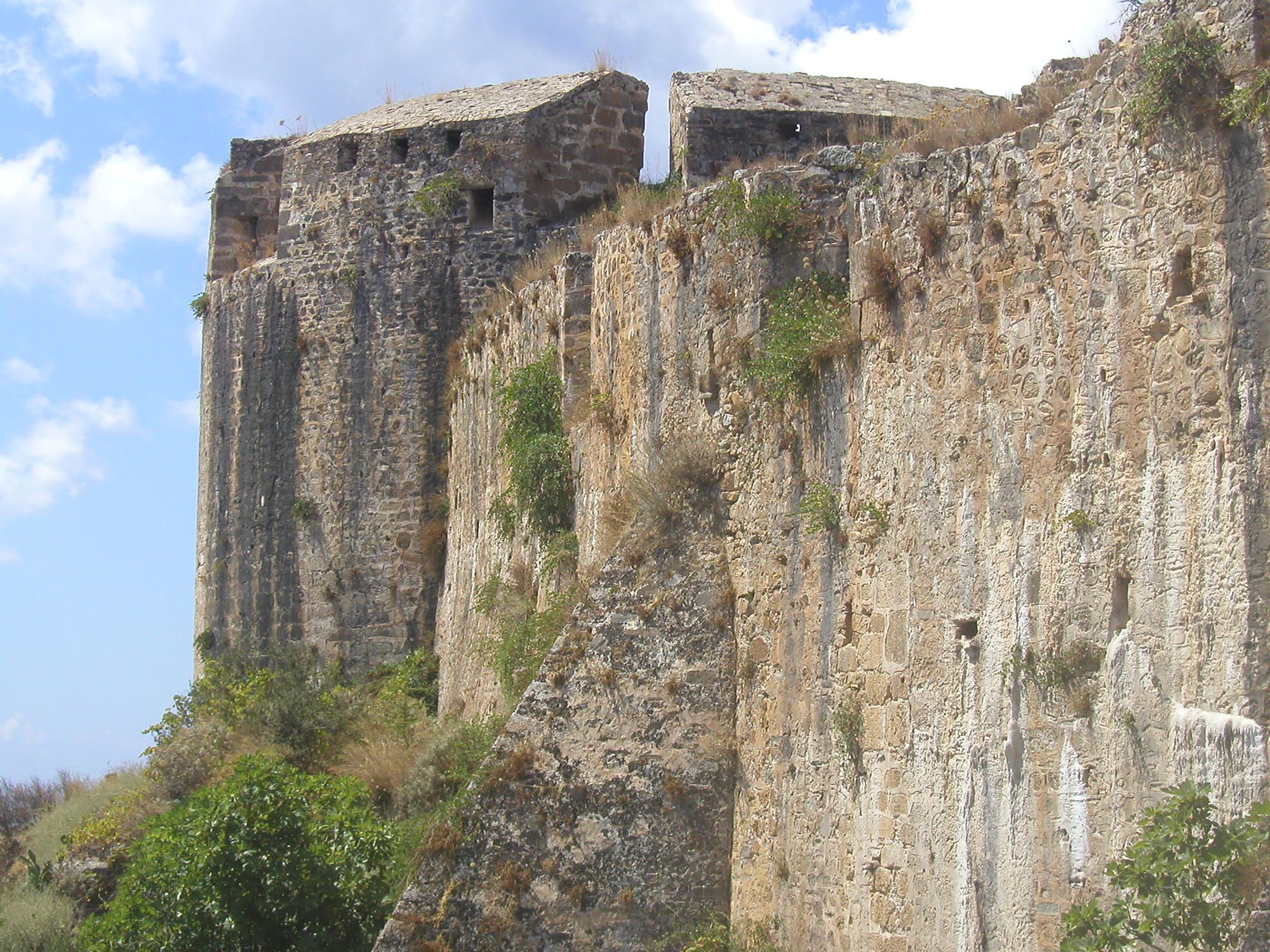
After the mid-15th century, in response to the evolving demands of warfare following the introduction of gunpowder, the Venetians carried out continuous repairs and reinforcements of the walls. The Ottomans continued with interventions and additions during their first period of rule (1500–1685). As successive rulers of the castle constantly reinforced the walls, their construction phases are not always distinguishable. The masonry features well-dressed stones and incorporates reused ancient materials. In its present form, the castle retains nine rectangular towers and five bastions, constructed and reconstructed over various periods.
The rectangular towers are situated in the western enclosure and along the intermediate wall, in the oldest part of the castle. With the exception of the one that incorporates the castle’s main gate, most of these towers are largely ruinous. Today, they house cells and auxiliary spaces of the Timios Prodromos monastery. Bastions protected the eastern part of the walls, facing the arable area of Livadia, and formed the so-called eastern bastion front, which was further reinforced by a moat and a bulwark. A moat ending at the main entrance of the castle also separated the western enclosure, the citadel of the castle, from both the landward side and the suburb. The particularly vulnerable area was reinforced by the western bastion, now four-sided, which was built in successive construction phases. The final phase, which remained unfinished, dates to the period of the second period of Venetian rule (1685–1715).
EASTERN BASTION FRONT
Of particular interest is the eastern bastion front, which was the main line of defence of the city from the sea. It was reinforced by two circular bastions on its southeastern side, dating to the first period of Ottoman rule and which find parallels in other Ottoman forts, such as Rio Fortress. The northeastern bastion was destroyed during World War II in an explosion. The surviving southeastern bastion is a particularly distinctive example of fortification architecture from the first period of Ottoman rule. It represents a rare, if not unique, case of a circular bastion featuring a central interior pillar. The octagonal pillar supports the dome of the ground floor, forming four vaulted openings at its upper points that served as both light sources and smoke vents. Embrasures were set into the walls, while a corridor led to an open square in the upper part of the bastion.
In the northeastern corner of the walls stands a double semicircular bastion. The original structure, likely Ottoman, was largely destroyed during Morosini’s bombing in the siege of 1685. Bastion’s current form, the result of the Venetian repairs after 1685, is considered as one of the most beautiful examples of Venetian fortification in Greece.
THE GATES
The main gate of the castle is located on the northern side, at the base of a tower-portal. A particularly elaborate construction of dressed limestone, it probably dates to the first period of Venetian rule. Externally protected by a small enclosure or bulwark, it is perhaps an Ottoman work. This gate remains the castle’s primary entrance. The second gate, situated on the eastern side of the walls, provided access to the unwalled part of the peninsula, Livadia. The third gate, dating to the 19th century and situated on the southern side of the walls, leads to the later church of Panagia Eleistria, which lies south of the castle. Finally, a small gate in the intermediate wall linked the two fortified enclosures. Today, visitors enter the castle either through the main northern gate or the gate near Panagia Eleistria church.
THE INTERIOR
Koroni Castle is still inhabited and numerous interventions within its interior have altered its original medieval character. In the eastern enclosure stands the basilica of Agios Charalambos, erected in 1689 as a Latin church dedicated to Saint Roch, the Catholic patron saint against the plague. A marble votive inscription, immured in the women’s gallery, records the date of the church’s construction and includes an invocation to Saint Roch to protect the city from a plague epidemic. After the Ottomans captured the castle, the Catholic church was converted into a mosque. Following Greece’s liberation in 1828, it became the current Orthodox church of the castle cemetery, dedicated to Saint Charalambos, who, like Saint Roch, is also a protector against infectious diseases, especially the plague.
Near Agios Charalambos, in the northeastern corner of the remains of a large three-aisled basilica, lies the small church of Agia Sophia. Scholars have proposed various dates for the construction of the ruined basilica, ranging from the late 6th to the 9th century. During the first period of Venetian rule, it served as a Latin cathedral dedicated to the Virgin Mary, while under Ottoman rule, it was converted into a mosque. Near Livadia Gate lie the ruins of an Ottoman bath. In addition, the remains of several cisterns have been identified at various points within the walls. After the 16th century, the cisterns in the castle and borgo, which supplied the population’s water needs, were fed by an aqueduct built by the Ottomans, a structure that remained partially in use until the 20th century.
The western enclosure, which once formed the citadel of the castle, is now occupied by the buildings of the Timios Prodromos convent, founded by Old Calendarists in the early 20th century. Within the convent grounds stand the ruins of an octagonal tower, built in the 16th century shortly after the Ottoman conquest. Only the lower part of the tower, which would initially have had five or even seven floors, remains. The tower projected the power of the new conquerors, probably housing the headquarters of the commander and the garrison.