
Kalamata
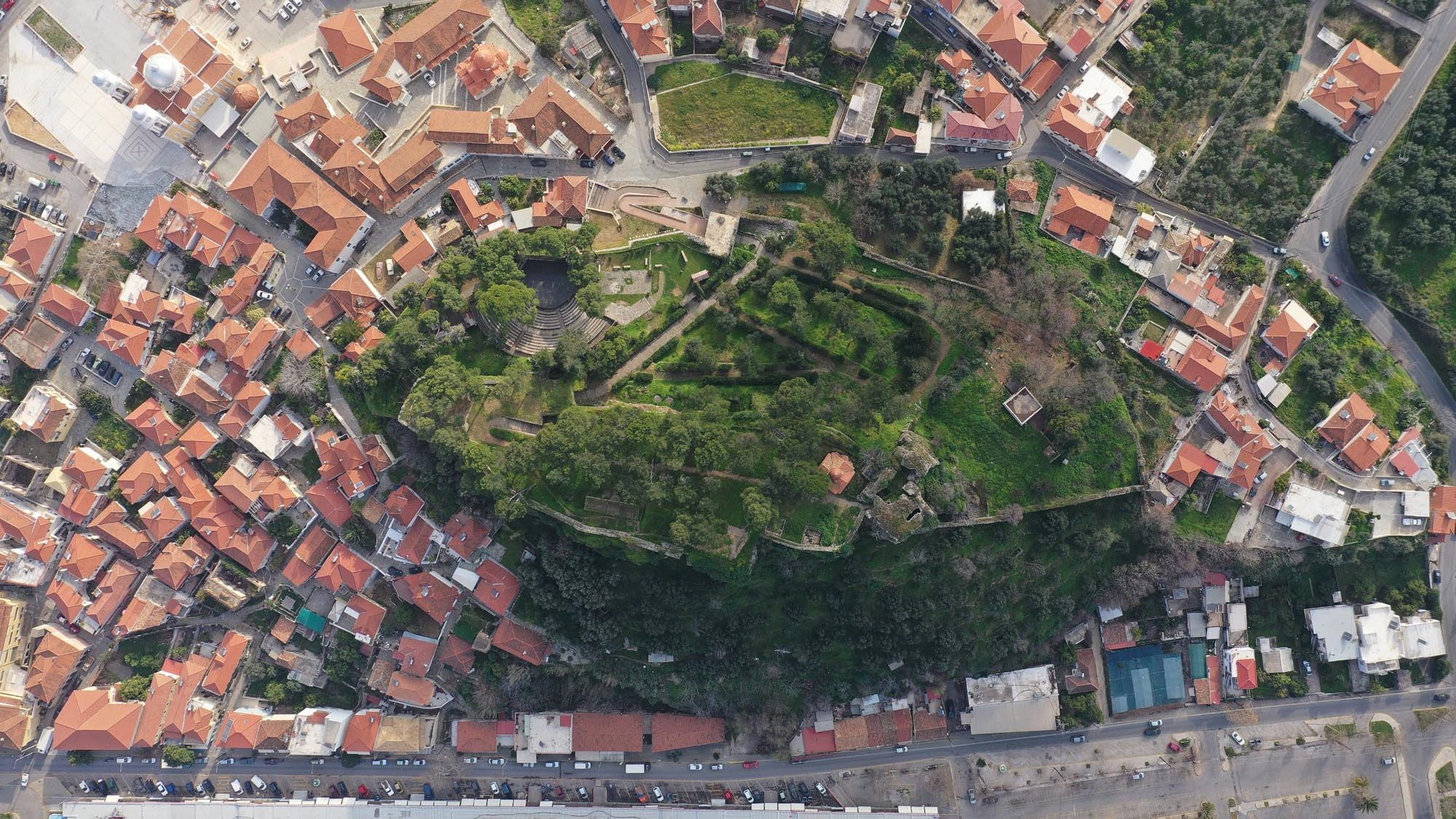
Kalamata Castle was built at the northwestern edge of the historic centre of the modern city, on a low hill overlooking the Nedonas River. Its strategic location offers a commanding view of the Kalamata Plain and the coastline of the Messenian Gulf, while also controlling the mountain passes of Taygetus towards the Laconian Plain.
ΑΠΟ ΤΟ ΠΑΡΕΛΘΟΝ ΣΤΟ ΠΑΡΟΝ
The ancient city of Phares or Phirai, first mentioned in the Homeric epics, is located in the wider area of the castle hill. Archaeological evidence indicates that the area was inhabited continuously until the Hellenistic and Roman periods. The new name of Kalamata first appears in the Life of Nikon the Metanoeite. In the early 13th century, the castle hill had a fortification, not a particularly strong one, which was converted into a monastery, as confirmed by the Chronicle of the Morea, a 14th-century verse narrative of the conquest of the Peloponnese by the Frankish knights of the Fourth Crusade.
In 1205, it was given as a hereditary fief and seat of the barony of Kalamata to Geoffrey of Villehardouin, later ruler of the Principality of Achaia (r. 1209–1229). It remained in the Villehardouin family until 1322, when the last descendant, Maud of Hainaut, lost all hereditary and sovereign rights to the principality. The most eminent Villehardouin, Prince William II was born in 1218 in Kalamata and was thus called De Kalomatas or Kalamatas.
The Chronicle of the Morea mentions the castle again, noting that after William’s death in 1278, in around 1292 or 1293, Greeks and Slavs from neighbouring Giannitsa, using ladders, managed to capture it by surprise. Florent of Hainaut, husband of Isabella of Villehardouin, William’s daughter, reclaimed the ancestral fortress and ordered the walls to be heightened to prevent any future surprises for the garrison.
After 1322, the castle’s fate followed that of the Principality of Achaia, changing hands multiple times. Around 1430, it came under the control of the Palaiologos family and became part of the Despotate of the Morea. In 1460, the Ottomans conquered most of the Peloponnese, except for the Venetian territories and Monemvasia. The First Venetian-Οttoman War (1463–1479) followed and, by its end, the castle was described as being in ruins. Two centuries later, during the Sixth Venetian-Οttoman War (1684–1689), the Ottomans detonated the castle’s gunpowder storerooms, causing extensive damage as they retreated from Kalamata following their defeat on the outskirts of the city by a united force of Venetians, Saxons and Maniots.
Venetian rule lasted until 1715, when the castle returned to the Ottomans. It gradually lost its strategic significance, becoming abandoned by the early 19th century. In 1825, like the city, it suffered great destruction by the army of Ibrahim Pasha. In the early 20th century, its interior was transformed into a wooded park, and since 1938 part of it has been occupied by a municipal reservoir, which remains in operation.
THE CASTLE
Kalamata Castle is a typical example of a Frankish-period fortress in the Peloponnese. Its current layout is primarily due to the conversion of the fortress into a feudal seat and possibly a fortified settlement by the Villehardouins. The castle features two fortified enclosures: an inner one surrounding the elongated plateau at the top of the hill and an outer one enclosing a larger area on its more vulnerable eastern side. In the inner enclosure, at the steepest point of the hill, stands a fortified tower (keep or donjon), which served as the final point of defence, the residence and a symbol of the feudal lord’s power. The castle’s fortification walls are vertical and follow the terrain. A later protective parapet of the wall is preserved in the upper enclosure, which features gun loops. Both the Ottomans and the Venetians (during the second period of their rule, 1685–1715) seem to have made repairs and interventions to the castle, ranging from minor to more significant works.
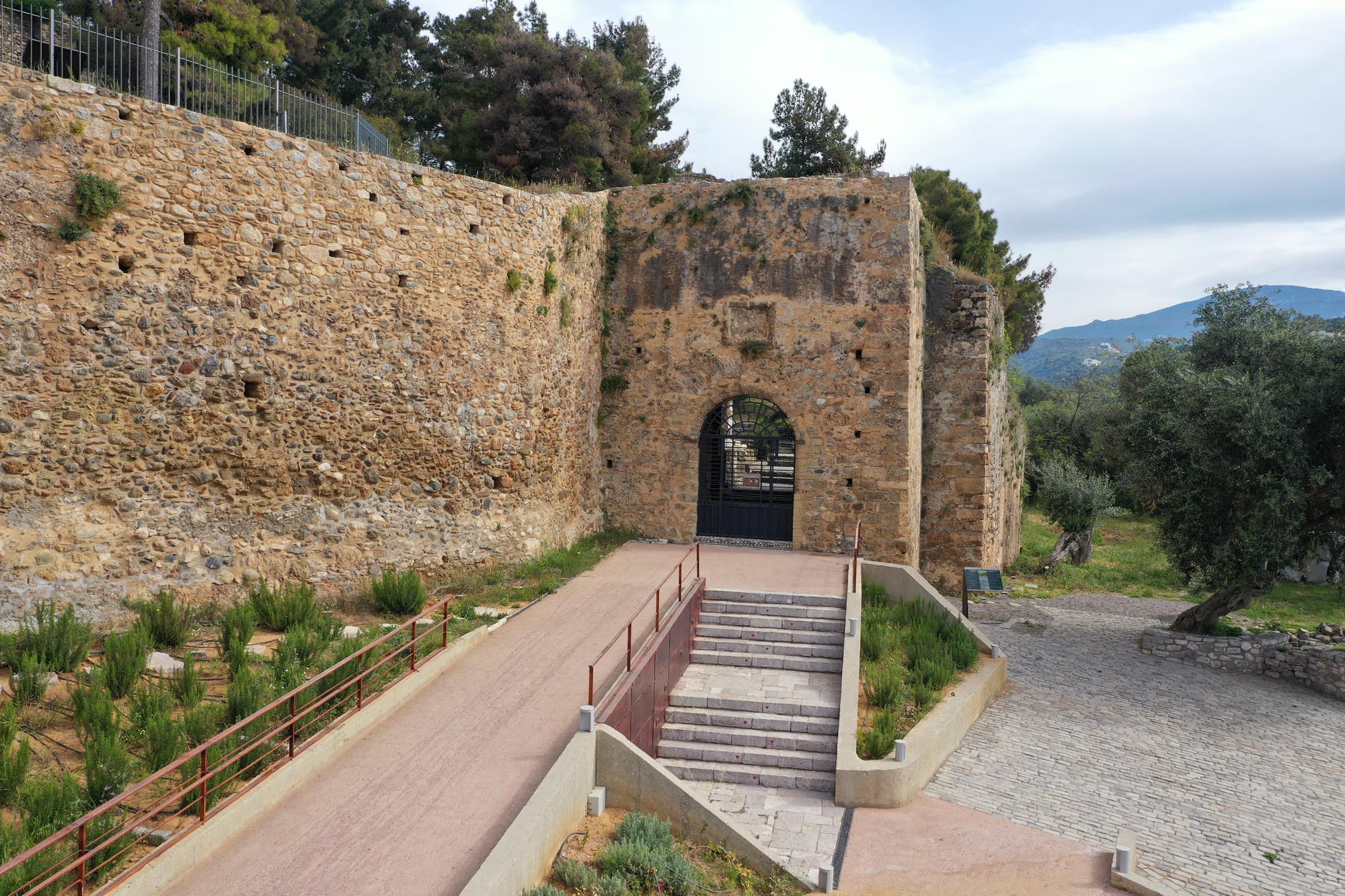
A square portal constitutes the only entrance to the castle and is located on the eastern side of the walls. It dates to the second period of Venetian rule (1685–1715) from the immured relief depicting the Lion of Saint Mark, the symbol of Venice. Beyond the gate, a set of steps, added in the 20th century, leads to the inner enclosure gate. Along the way, visitors pass the entrance to the small open-air theatre, constructed in the 1960s, which hosts cultural events during the summer.
The inner enclosure, like the rest of the castle, has become a pine grove. In the 17th century, the Ottoman traveller Evliya Çelebi noted that this area housed the garrison’s living quarters, which have not survived. The dating of the building preserved along the western wall is unknown. Opposite the entrance, at the most inaccessible point of the castle, stands the ruined ground floor of the keep, with a water cistern adjoining its northern wall. The remains of the monastery church mentioned in the Chronicle of the Morea are believed to have been incorporated into this tower. In front of the remains of the keep stands the modern church of the Evangelistria.