

Ioannina
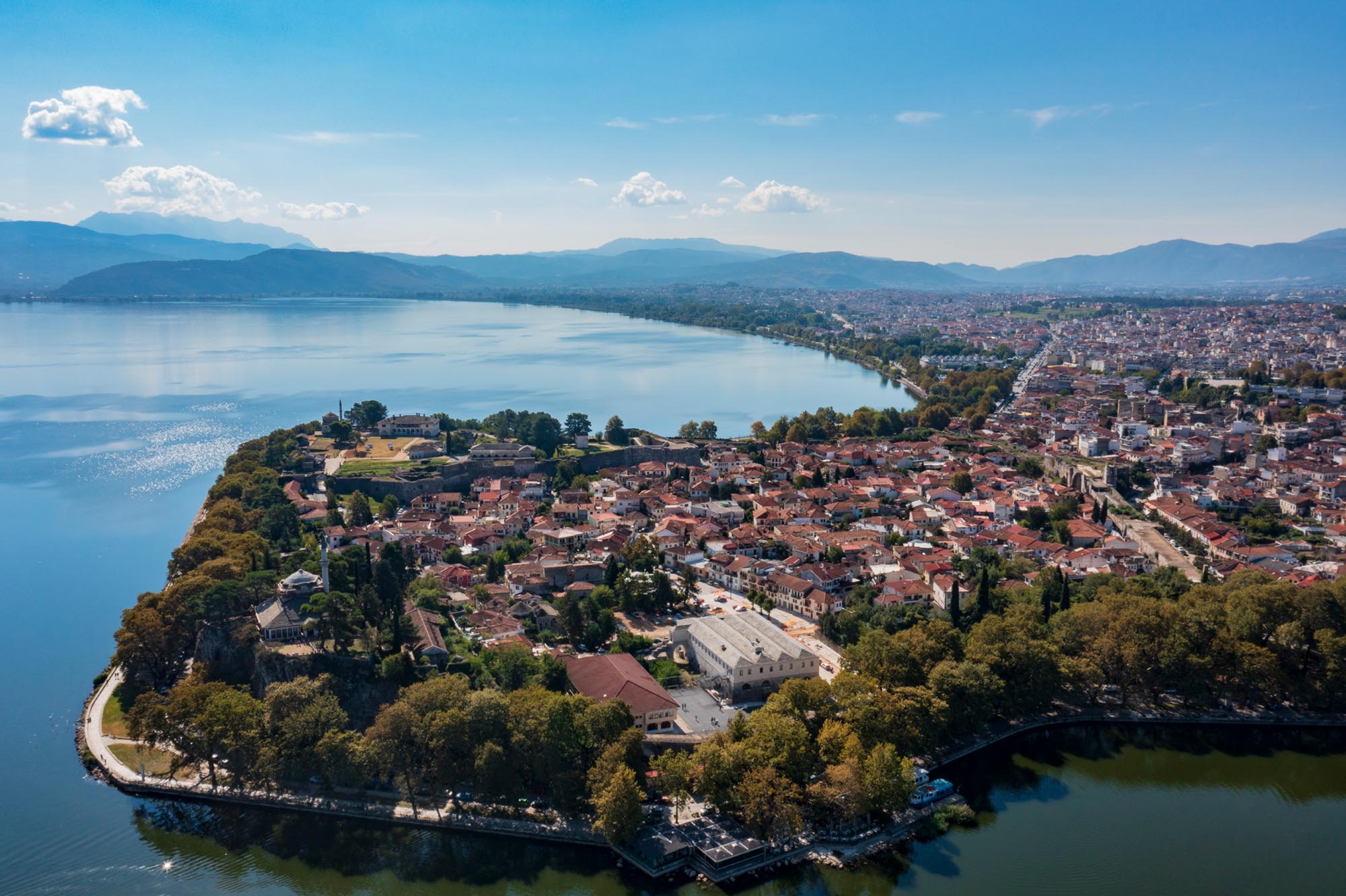
Ioannina Castle stands in the southeastern part of the modern city, on a rocky peninsula on Lake Pamvotis. The castle was established in Byzantine times at this location, which was fortified in antiquity. Its current form, however, is due to Ali Pasha (early 19th c.), who carried out extensive work incorporating the earlier fortifications.
ΑΠΟ ΤΟ ΠΑΡΕΛΘΟΝ ΣΤΟ ΠΑΡΟΝ
The name Ioannina first appears in written sources in the late 9th century, though archaeological evidence confirms human presence in the area long before the Middle Byzantine era. On the naturally fortified rocky peninsula where the castle stands, the earliest traces of habitation uncovered by archaeological research date to the Classical and Hellenistic periods. These concern parts of strong fortification walls, house foundations and other findings that attest to the existence of an important ancient city.
As there is no archaeological evidence for the continuity of habitation during the later Roman and Early Byzantine eras, it is likely that the Hellenistic settlement was destroyed during the Roman conquest (167 BC) and was then abandoned or shrank.
In the 6th century, the historian Procopius, in his work On Buildings, writes that Emperor Justinian founded a fortified city called Nea Euroia in a location resembling that of Ioannina Castle, to which the emperor relocated the inhabitants of the old city of Euroia, seeking to protect them from barbarian invasions. This led some scholars in the past to identify Nea Euroia with Ioannina, but the connection has not been confirmed by historical or archaeological evidence.
The reference to Ioannina as an episcopal seat in the last decades of the 9th century suggests that the city had a significant population at that time. In the late 11th century (1082), according to Anna Komnene in her work Alexiad, the city was occupied for a few months by the Normans under Bohemond, who repaired the walls, surrounded the city with a large moat and, deeming the existing citadel inadequate, built a second one, remains of which lie in the southeastern citadel of the castle (Iç Kale).
After the conquest of Constantinople by the Crusaders (1204) and the partition of the Byzantine Empire, Ioannina joined the independent state of Epirus, widely known today as the Despotate of Epirus. Its first ruler, Michael I Komnenos Doukas, made significant repairs to the castle. Refugees from Constantinople settled in the city, including some prominent families like the Philanthropinos and Stratigopoulos, who played a key role in its development. During this period, the city expanded, flourished and gained commercial power, maintaining ties with Venice and Byzantine centres, while important monasteries were founded on the island of Lake Pamvotis.
In the mid-14th century (1348), when the Serbs captured Epirus, Ioannina’s inhabitants surrendered the city but retained all the privileges granted to them under imperial golden bulls. In 1411, the city was ceded to Carlo I Tocco. It remained under the rule of the Tocco family until 1430, when it surrendered to the Ottomans, again retaining its privileges.
During the Ottoman period, until the early 17th century, the image of the castle and its correlation with the city remained largely unchanged. Christians continued to live within the castle, enjoying their privileges. However, with the settlement of Ottomans around the castle, its role gradually became more decorative, eventually turning into a simple district of the enlarged urban fabric.
In 1611, the failed revolutionary movement of Dionysios the Philosopher, bishop of Trikki and Stagoi, became a turning point in the history of the city. The Ottomans’ reprisals were severe, as they settled in the castle, expelling the Christians and replacing their churches with mosques and hammams.
From 1788 to 1822, Ioannina was ruled by the renowned Ali Pasha, whose name became closely associated with the city. Extensive construction work was carried out in the castle, the population grew, consulates and important cultural centres were established. The city attracted European interest and became the economic and commercial hub of Epirus.
However, Ali Pasha’s political ambitions led to him being declared an apostate by the sultan. Between 1820 and 1822, the siege of the city by the sultan’s troops aiming at expelling Ali Pasha had disastrous consequences. Many residents fled, and the city’s economic and commercial activity suffered a severe blow. Anticipating defeat, Ali Pasha torched much of the city and the market. In 1822, having fled to the island of Lake Pamvotis, he was beheaded, and his head sent to Constantinople.
During the 19th century, the castle remained the heart of Ioannina, even though the city had begun to expand beyond its walls several centuries before. Despite interventions and repairs, the castle gradually lost its significance. In 1913, following the city’s liberation from the Ottomans, the castle was handed over to the Greek army. At that time, its moats were filled in and turned into streets. The castle was damaged during World War II, and in 1978, the southeastern citadel (Iç Kale) and various other parts were entrusted to the Ministry of Culture, which to date has been carrying out enhancement and restoration work.
THE CASTLE
Ioannina Castle has an irregular trapezoidal layout, as its walls follow the contours of the terrain. It acquired its present form in 1815, under Ali Pasha, when it enclosed the initial residential core of the city, which remains inhabited. Generally, its walls follow the course of the Byzantine fortifications, in the form they likely took during the major interventions of the 13th century, along with additions or improvements made in the 14th century.
Within the castle are two citadels: one in the northeast and one in the southeast (Iç Kale), which also took shape during post-Byzantine times.
The Ottomans reinforced the western, more vulnerable side of the castle with a second outer wall, built parallel to the pre-existing Byzantine one. Between these two walls lies a series of vaulted chambers. Those located north of the central gate have been restored and today host a photographic exhibition entitled “From the Byzantine Castle-City to the Ottoman Megalopolis”. Through the exhibits, the visitor can trace the historical development of the city and its castle, from their establishment to Ioannina’s liberation in 1913. The western side, which faces the mainland, was also protected by a moat (which ran where modern Karamanlis and Ethnikis Antistaseos streets are now) and three large bastions.
A second wall was also constructed on the southern side of the fortification, with 40 single-spaced rooms built along its interior. In addition, the Ottomans formed a wide rampart-walk on the upper part of the walls.
THE GATES
The castle’s main gate is located in the middle of its western side, near the site of the earlier Byzantine one. It is known as the gate of Agios Georgios. Saint George of Ioannina, the city’s patron, was executed at this spot on 17 January 1838. The gate was protected by a bastion. The north end of this bastion terminates in a rectangular clock tower built in 1896. Access to the gate was originally provided by a movable bridge over the moat. Externally, the gate features a large double arch, flanked by two immured stone reliefs depicting animal figures. At the centre of the arch, an inscription bears the date 1843 and the name of its restorer, Osman Nuran Pasha.
Since the castle fortifications once surrounded the entire city, numerous gates – both large and small – were opened along all sides of its walls to facilitate communication with the surrounding areas. The most important among them are the northwestern gate on Filanthropinon Street, the now-closed southwestern gate on Ethnikis Antistaseos Street, the southern gate leading to the citadel of Iç Kale and the northern lakeside gate next to Soufari Serai.
THE INTERIOR
The settlement within the castle walls is preserved almost intact, featuring traditional houses mainly from the 19th and 20th centuries. The Kahal Kadosh Yashan Synagogue, also known as the Old or Inner Synagogue, is preserved today near the main gate. It underwent various construction phases, the most important being that of 1829. A short distance to the right of the gate of Agios Georgios is the best-preserved tower of the Late Byzantine fortification, which is commonly known as the “Tower of Thomas”, based on the dedicatory inscription. The inscription probably refers to Thomas Preljubovi, the Serbian ruler of Ioannina from 1367 to 1384, who carried out extensive repairs to the walls. However, another interpretation links it to ruler Thomas Komnenos Doukas, who sought refuge in Ioannina from 1303 to 1305.
Near the entrance of the northeastern citadel stands the Soufari Serai, the cavalry school built by Ali Pasha, which today hosts the General State Archives of Ioannina, and the house of Kalos (“Good”) Pasha, one of the few surviving 18th-century houses inside the castle. In the same area, the remains of a Byzantine bath hypocaust, constructed with spolia of an ancient building, are preserved. Also surviving are an 17th-century Ottoman hammam and the library of the Muslim madrassa (Islamic seminary) of the neighbouring citadel.
NORTHEASTERN CITADEL
The northeastern citadel, already formed during the Middle Byzantine times, is identified with the “Epano Goulas” of the written sources of the 14th century, which included the residence of the local ruler. The Ottomans reshaped the citadel after the failed revolt of 1611 and the subsequent expulsion of Christians from the castle. The current citadel enclosure, which preserves parts of the Byzantine fortification, dates to that period. Its defences were reinforced by a tower in its southwestern corner, the construction of which began during the works undertaken by Michael I Komnenos Doukas, which also serves as the highest observation point of the castle, along with two more towers flanking the southern gate.
After 1611, the citadel became a religious centre, with the construction by Aslan I Pasha, the city’s Ottoman governor, of a large mosque (1618), a madrassa and auxiliary buildings for housing and feeding students and worshippers. Today, these buildings host Ioannina Municipal Museum and its rich collections. The mausoleum (Türbe) of Aslan Pasha is preserved in the courtyard of the mosque, while underground caves – once used as warehouses and prisons – are accessible from within the citadel.
In the 18th century, a new central gate was added on the western side, which remains in use today.
SOUTHEASTERN CITADEL ((Iç Kale)
The southeastern citadel was also formed for the first time during the Middle Byzantine period. Here stood the churches of the Taxiarches and Pantokratoras mentioned in 14th-century sources. The so-called Tower of Bohemond, which comprises part of the fortification of this period, stands almost in the centre of this area. This tower, which was later incorporated into Ali Pasha’s Saray (palace), is part of the citadel formed in the castle by Bohemond when the Normans conquered the city in 1082. Ancient building material from the Hellenistic fortifications was probably used in its construction. It is a two-storey circular structure, preserved to a height of 13 m.
In the early 19th century, the citadel was fortified again and expanded into an impregnable fortress, where Ali Pasha established his saray, which was the administrative seat of the Pashalik of Ioannina. It has an irregular trapezoidal plan, reinforced by four bastions of various designs. Its main gate is located on its northern side, with two smaller gates nearby and another one on the southern side of the walls.
Several military and administrative buildings stood inside the citadel during the 19th century, along with Ali Pasha’s Saray, which was destroyed by fire in 1870. A hospital was later built on the site, followed in 1958 by a Royal Pavilion, which now houses the Byzantine Museum of Ioannina, with important exhibits of the Byzantine period from various regions of Epirus. Today, the remains of the saray are visible in the area and a preserved part of it, known as the “Treasury”, forms part of the museum.
The Fethiye Mosque, which now houses an exhibition of visual material dedicated to Ali Pasha and the Late Ottoman period of Ioannina, the tomb of Ali Pasha and the area of the Ottoman kitchens, which is adjacent to the western bastion of the citadel and has been turned into a refreshment bar, are also preserved. Finally, the western bastion of the citadel now houses the Silversmithing Museum of the Piraeus Bank Group Cultural Foundation (PIOP). Silversmithing flourished in Ioannina and Epirus from the 16th century onwards.