
Dragamesto
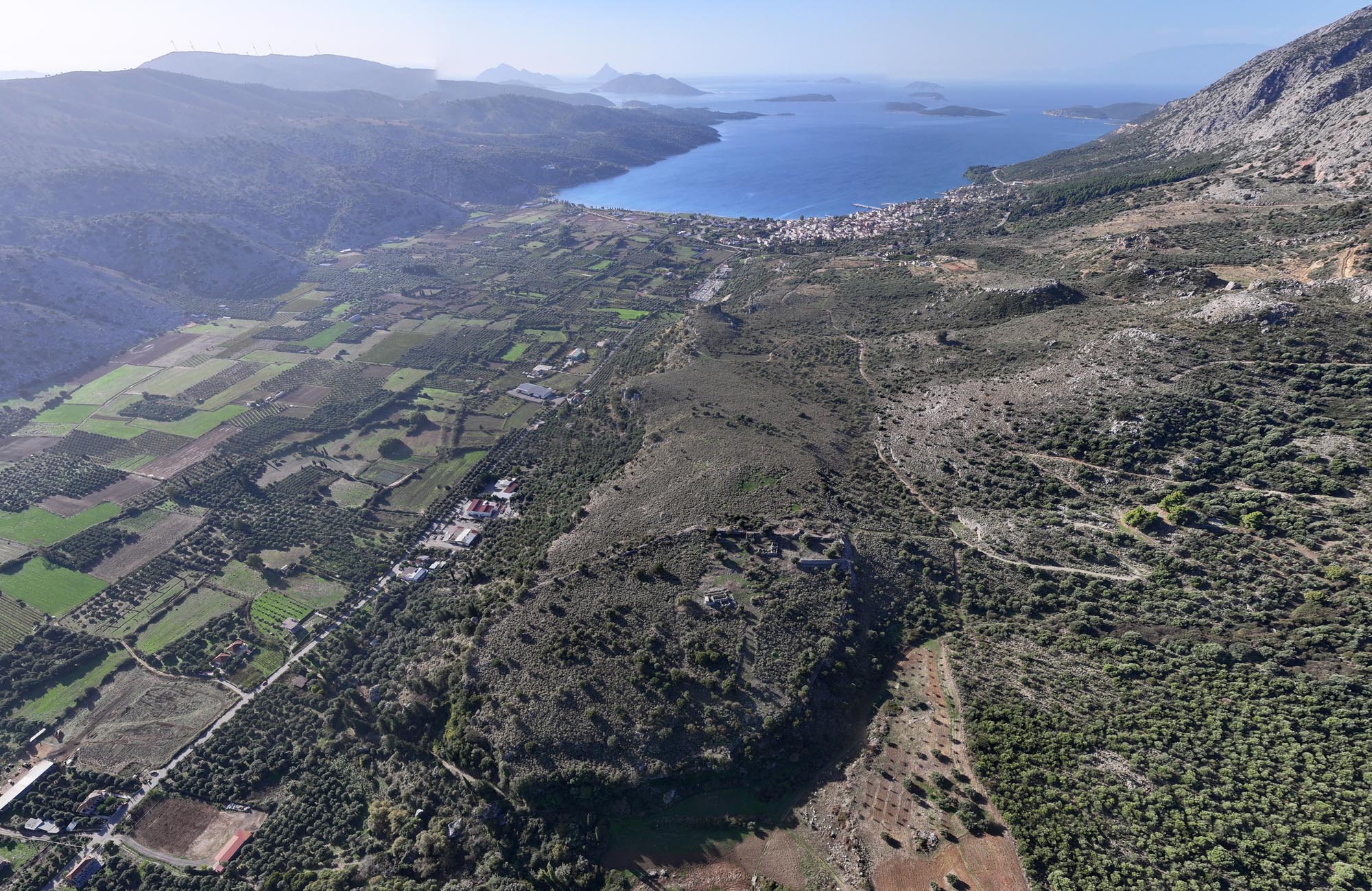
Near the modern town of Astakos, on a plateau atop a hill on Mount Veloutsa, are preserved the fortifications of the ancient city of the same name and, in its northern part, the Byzantine Dragamesto Castle. The naturally fortified site provided control over the anchorage in the neighbouring bay and the route towards the mainland, while Astakos harbour served as a commercial station for its products. Thucydides refers to the ancient city in connection with the events of the Peloponnesian War (431 BCE). In Hellenistic times, Astakos formed part of the Acarnanian League and issued its own coins.
ΑΠΟ ΤΟ ΠΑΡΕΛΘΟΝ ΣΤΟ ΠΑΡΟΝ
Between the 6th and 8th centuries, according to most scholars, part of the fortification of the ancient city was completed and repaired, forming the medieval castle of Dragamesto. These centuries are characterised by the decline and transformation of ancient urban centres throughout the Byzantine Empire, as the result of hostile raids, natural disasters and epidemics, among others factors.
The earliest recorded mention of the name Dragamestos appears in the Life of Saint Barbaros, a text from 1225 that draws from earlier sources to reference an unsuccessful siege by the Arabs between 824 and 829. After the dissolution of the Byzantine Empire by the Crusaders, Dragamestos joined the newly established state of Epirus, widely known today as the despotate of Epirus, following its historical trajectory. Early 13th-century sources mention a bishopric of the same name.
By the late 13th century, the wider region had become a battleground for power struggles between the rulers of the state of Epirus, the Angevin kings of Naples, the Byzantine emperor, Serbian rulers and Albanian toparchs. Probably after 1359, Dragamesto was under the rule of Leonardo I Tocco, the count palatine of Kephalonia, Zakynthos and Ithaca. In 1371, the castle was acquired by the Albanian ruler of Angelokastro, Gjin Bua Shpata, and managed by his son-in-law, Lalthi. In 1404 or 1405, Carlο I Tocco captured the fortress by surprise. It remained under the control of the Tocco family until the Ottoman conquest of the area around 1460.
In 1684, a Venetian armada, led by Francesco Morosini, ended Ottoman rule over most of the Acarnanian coast. In 1685, the armada regrouped and sailed from the bay of Dragamesto (Astakos) to conquer the Peloponnese. The area fell to the Ottomans again in 1699. From the late 17th century, Dragamesto, a poor and small village, gradually became deserted, and its inhabitants relocated to the steep slopes of Mount Veloutsa. In 1827, Sir Richard Church, the philhellene commander-in-chief of the Greek forces, converted the ruined castle into a camp and base for his subsequent operations in Aetolia-Acarnania.
THE CASTLE
The ancient fortification spans the plateau on the hill and is divided into two sections by a transverse wall. The Byzantine fortifications are confined to the smaller northern part, largely following the older course of the ancient wall, with large portions built on top of it. The remarkably steep eastern slope of the hill remained unfortified. A new wall was erected north of the ancient wall, which was the outer southern wall of the Byzantine city. At least five rectangular towers reinforced its defences, as this side was the most vulnerable to enemy attacks.
The main gate of the castle was located in the western part of the southern wall and was protected by two rectangular towers. According to the Chronicle of the Tocco, the castle also had a fortified tower-residence of the commander, probably near its steep side.
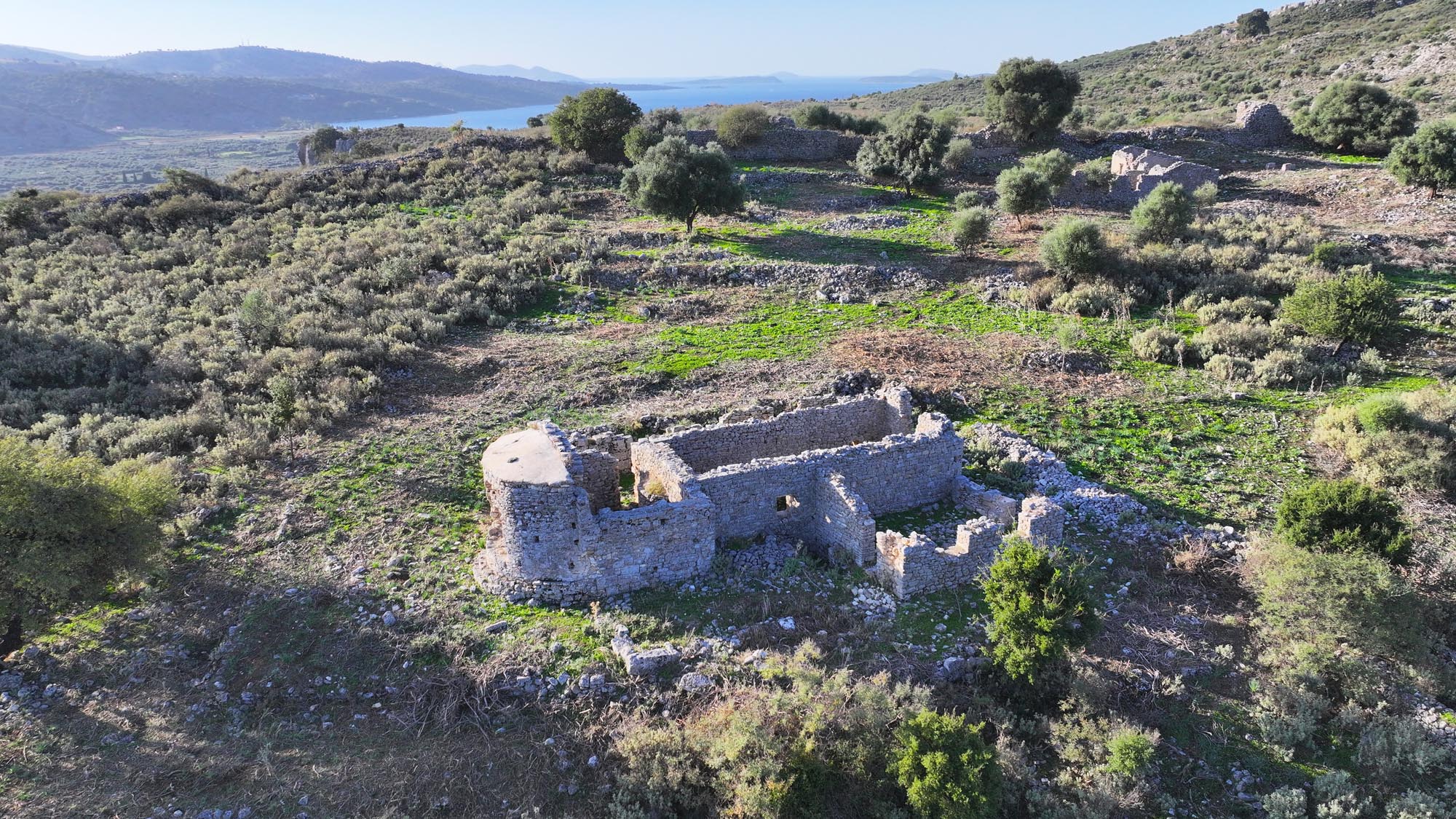
Within the castle, the ruins of settlement buildings remain, some dating to modern times, as well as wells and cisterns that provided drinking water to the inhabitants. Close of the centre of the Byzantine settlement stands a prominent three-aisled basilica from the 10th or 11th century. In its central aisle, a small aisleless church was later erected, probably during the final phase of Ottoman rule. Some 40 m east of the basilica, the foundations of a church with a cross-shaped ground plan are visible, while, to the north, another small aisleless church remains.