
Chlemoutsi
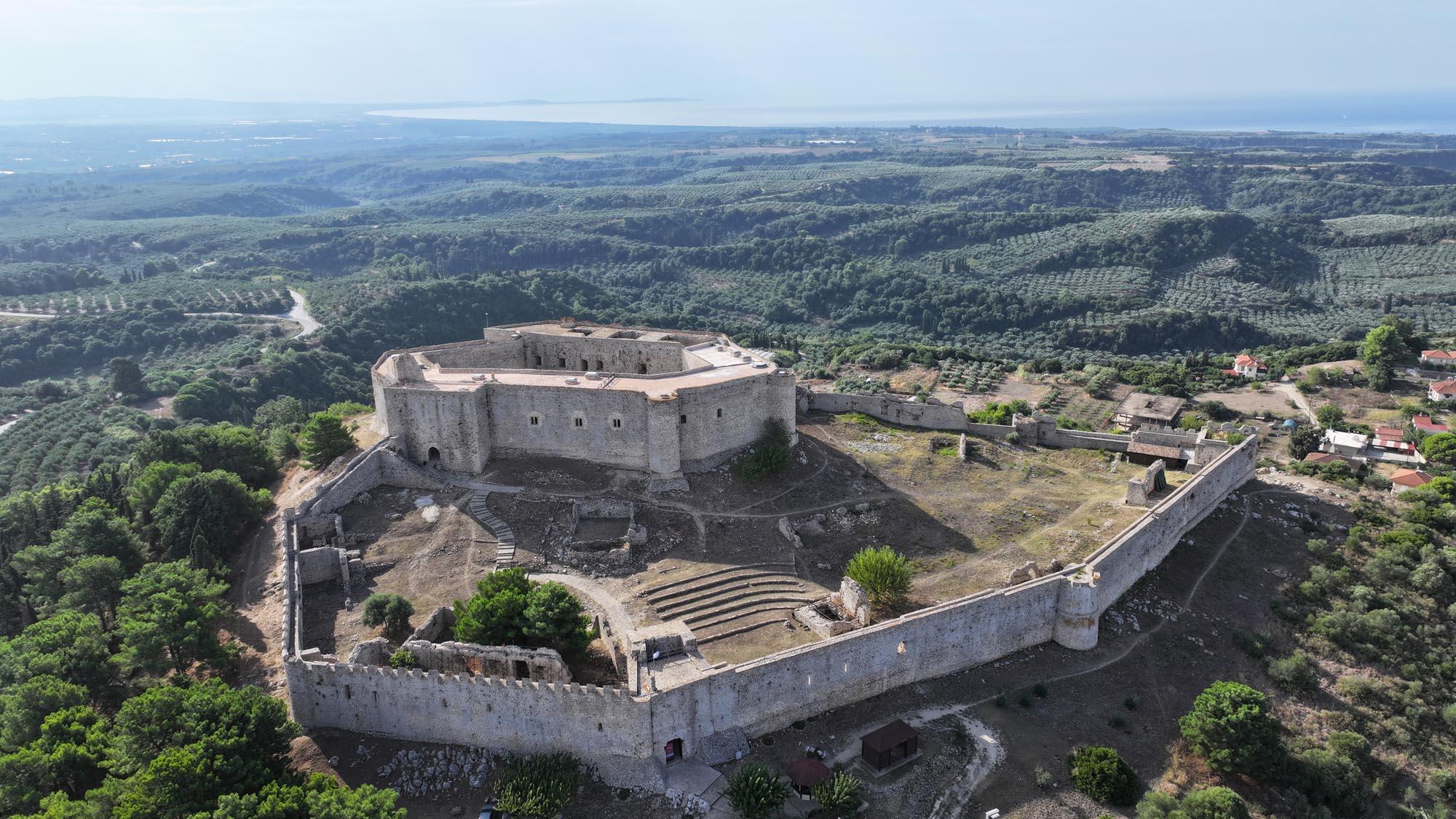
Standing on a strategic and prominent location atop Chelonata Hill, on the westernmost cape of the Peloponnese, Chlemoutsi Castle dominates the Ilia Plain while overseeing the Ionian Sea up to the coast of Aetolia-Acarnania. This position provided vital protection to the area, which constituted the centre of the Frankish Principality of Achaia and, specifically, its capital Andravida and the nearby harbour of Glarentza. The Frankish founders called it Clermont or Clairmont, while the Greeks referred to it as Chloumoutzi and, later, Chlemoutsi, probably a corruption of the French name. The Venetians, mistakenly believing that the Frankish mint for the deniers tournois of Glarentza was located here, called it Castel Tornese.
ΑΠΟ ΤΟ ΠΑΡΕΛΘΟΝ ΣΤΟ ΠΑΡΟΝ
According to the Chronicle of the Morea, the castle was built between 1220 and 1223 by Geoffrey I of Villehardouin, the first ruler of the Principality of Achaia. He withheld ecclesiastical revenues to complete its construction, which led to a clash with the Catholic clergy of Achaia and his excommunication by the pope. His excommunication was subsequently revoked when, after the completion of the castle, he informed the pope that his aim was to protect the harbour and the coast from the schismatic Greeks, thus serving the interests of the Roman church.
The castle constituted the administrative and military centre of the principality. It flourished especially during the reign of William II of Villehardouin (r. 1246–1278). However, after his death, disputes over the succession to the principality led to a period of uncertainty, with the castle being the point of contention among various nobles. Initially, Chlemoutsi was inherited by his wife, Anna-Agnes, daughter of Michael II Komnenos Doukas, despot of Epirus. In 1313, a major controversy erupted between the husbands of William II’s two granddaughters, both of whom claimed control of the principality. In 1315, the castle was captured by the Catalan Ferdinand of Majorca, husband of one of the granddaughters. In 1316, Louis of Burgundy, the husband of William’s other granddaughter, defeated the Catalans, and thus the castle returned to the Franks.
In the early 15th century, the castle came into the possession of Carlo I Tocco, count of Kefalonia and despot of Epirus, while in 1427, it passed, along with Glarentza, to Konstantinos Palaiologos, after his marriage to Tocco’s daughter, who a few years later handed it over to his brother Thomas. In 1460, it was conquered by the Albanian Zagan Pasha on behalf of the Ottomans. In 1687, it passed into the possession of the Venetians for a short period, until 1715, when it was recaptured by the Ottomans, under whose control it remained until 1821. However, already under Venetian rule, Chlemoutsi had lost its strategic role in the defence of the area, as confirmed by the proposal of Francesco Grimani, the Venetian general proveditore of the Morea, to demolish and replace it with a new fortress at the then-abandoned site of Glarentza. In 1825, during Ibrahim Pasha’s campaign of plunder in Ilia, local inhabitants sought refuge in Chlemoutsi, which suffered significant destruction. After the Greek Revolution, the castle seems to have been abandoned.
THE CASTLE
Chlemoutsi, an outstanding example of Crusader fortress architecture, constitutes the most ambitious building project undertaken by the Franks in the Peloponnese. Rather than repairing or expanding an older one, the conquerors chose to build a new castle from scratch. Essentially a medieval palace with fortress features, it was built according to French standards of the 12th and 13th centuries. Its design was determined not so much by its defensive role as by the intention of the Frankish rulers to use it as a symbol of their sovereignty.
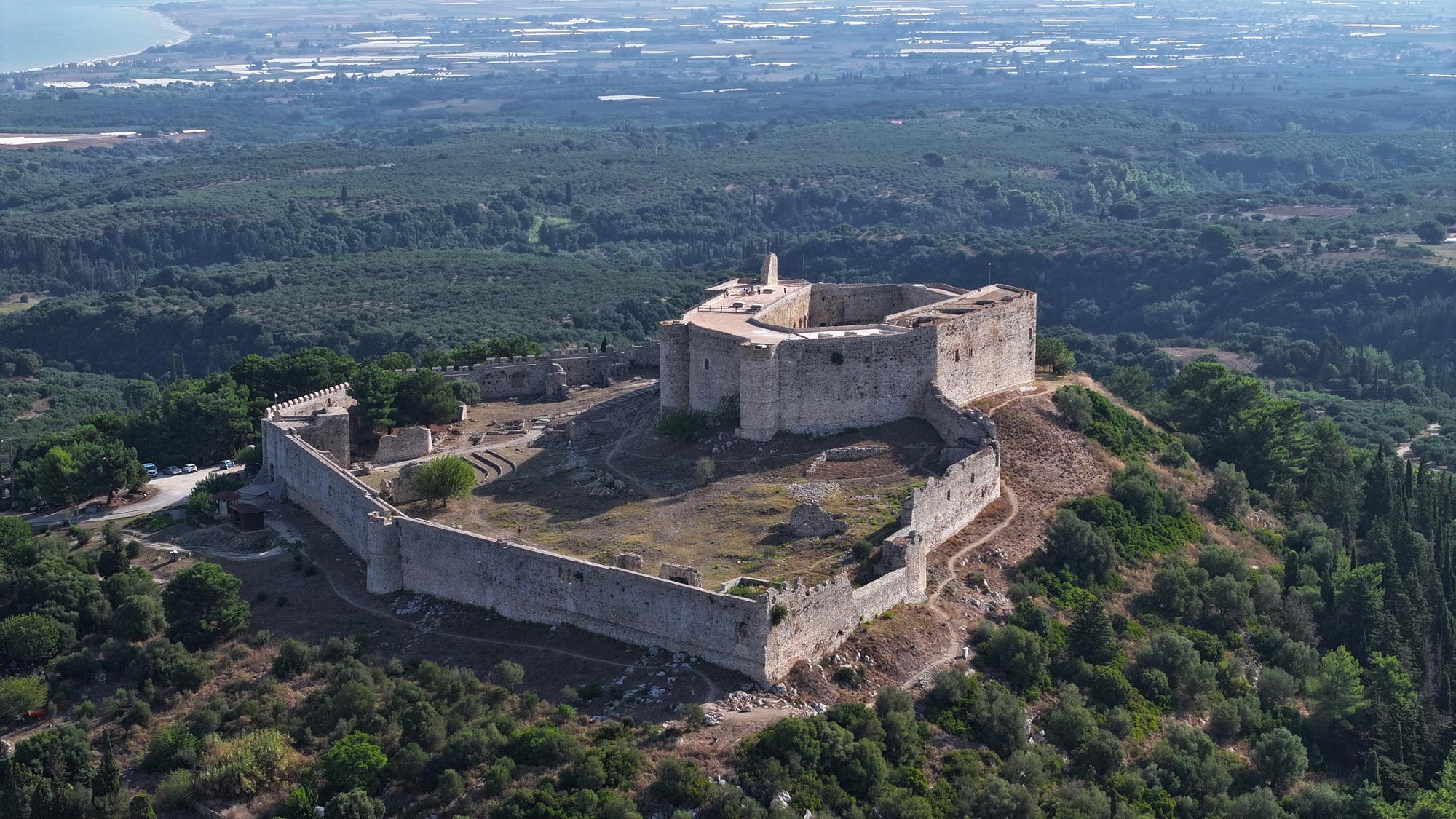
The construction of the castle was completed in three successive phases during the 13th century, as the archaeological evidence indicates. The hexagonal inner enclosure, located at the top of the hill and identified with the palace of the Villehardouins, took shape in two stages. In the last phase, the polygonal outer enclosure was added, extending along the smoother northern and western sides of the hill. Its high walls, which enclose an area occupied by barracks, stables, warehouses and cisterns, culminate in a rampart-walk and battlements and have windows with arrow slits. During the first period of Ottoman rule (1460–1687), the walls of the outer enclosure underwent reconstruction and reinforcement, with the addition of three bastions in its corners and a semi-cylindrical tower on the western side.
THE GATES
The original main entrance of the castle, located on the northwestern side, comprised a simple corridor leading to a gate. In its current form, which dates to the Ottoman period, the entrance is incorporated into a quadrilateral tower featuring three successive gates, a vaulted room with a roof terrace above it and a machicolation. Two secondary small gates are located where the outer walls meet the inner enclosure.
The entrance to the inner enclosure is through an imposing vaulted passage with an arched gate. Its current form dates to the Ottoman era and is a reconstruction of the Frankish entrance, which was located between two rectangular towers.
THE INTERIOR
Remains of buildings from both the Frankish and Ottoman periods are still preserved in the outer enclosure today. Among them are three large, originally two-storey, elongated structures built along the inner side of the walls. These buildings, which retain traces of fireplaces and wooden floor supports, were likely intended to house the staff of the ruler’s court. Elsewhere in the outer enclosure lie other remains, mostly of poor construction from the Ottoman period. The remains of a mosque, probably commissioned by Sultan Bayezid II (r. 1481–1512), mentioned by the 17th-century Ottoman traveller Evliya Çelebi, stand out. As the castle had no natural springs, numerous cisterns were built to collect rainwater from rooftops. Most of these are underground and located in the outer enclosure, while a large, vaulted cistern is situated in the basement of the princely quarters of the inner enclosure.
The hexagonal inner enclosure originally comprised the entire castle during its initial construction phase. Later, in the 13th century, during its final phase, which it retains to this day, it was transformed into a magnificent palace complex with vaulted halls, most of them two storeys high, arranged around a central courtyard. Opposite the entrance, on the eastern and southern sides of the hexagon, three two-storey wings housed the residence of the ruler and his family. The ground-floor rooms, which lacked heating and had small windows, served as auxiliary spaces. The residence halls were located on the upper floor, accessed via external staircases and linked with each by other passages. Lit by double-arched windows, the halls had fireplaces, wooden floors, built-in cupboards and latrines.
Above the vaulted passageway entrance, next to the princely quarters, stands the castle’s chapel, which was dedicated to Saint Sophia, according to tradition. Inside, fragments of wall paintings survive. Next to the chapel, along the northwestern side of the hexagon, lies the castle’s grand hall, which functioned as the throne room, used for administrative purposes and the reception of officials. It was heated by an impressively large fireplace and lit by windows with stone seating. Access to both the hall and chapel was from the courtyard, via a large balcony reached by a monumental staircase supported by three pointed domes. The reception hall was also connected to the castle’s kitchens, believed to have been located to its southeast, where the remains of an oven and chimneys can be seen.
Today, the inner courtyard houses the Castle Museum. Its permanent exhibition, entitled “The Knights’ Era: The Crusaders in the Morea”, includes more than 500 objects dating from the 13th to the 15th century.
In recent years Chlemoutsi Castle has undergone consolidation, enhancement, redevelopment and restoration. It is easily accessible by road from the Patras–Pyrgos National Road and from the village of Kastro. Visitor amenities include information boards and brochures, with options in Braille also.