
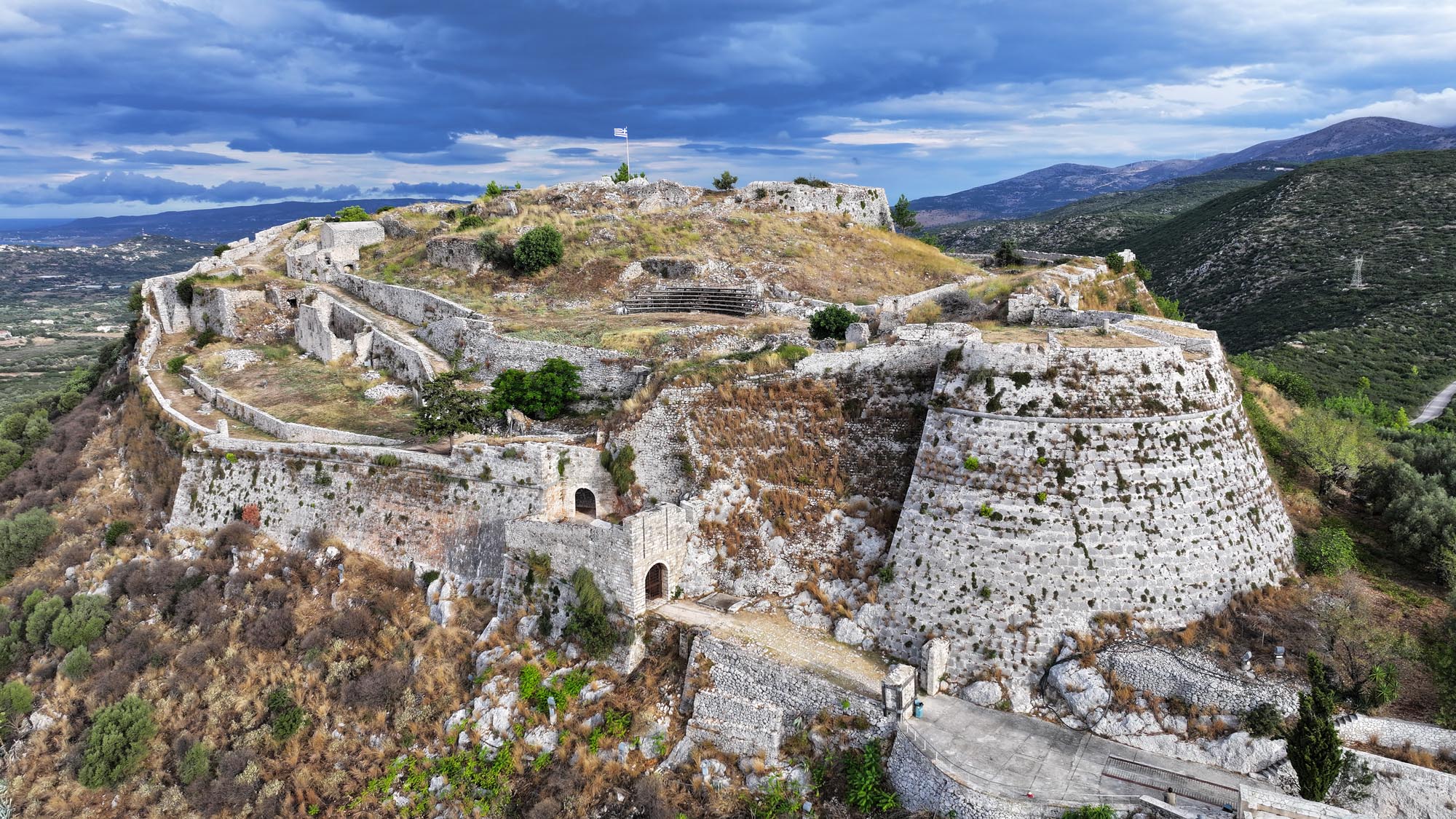
Castle of St George
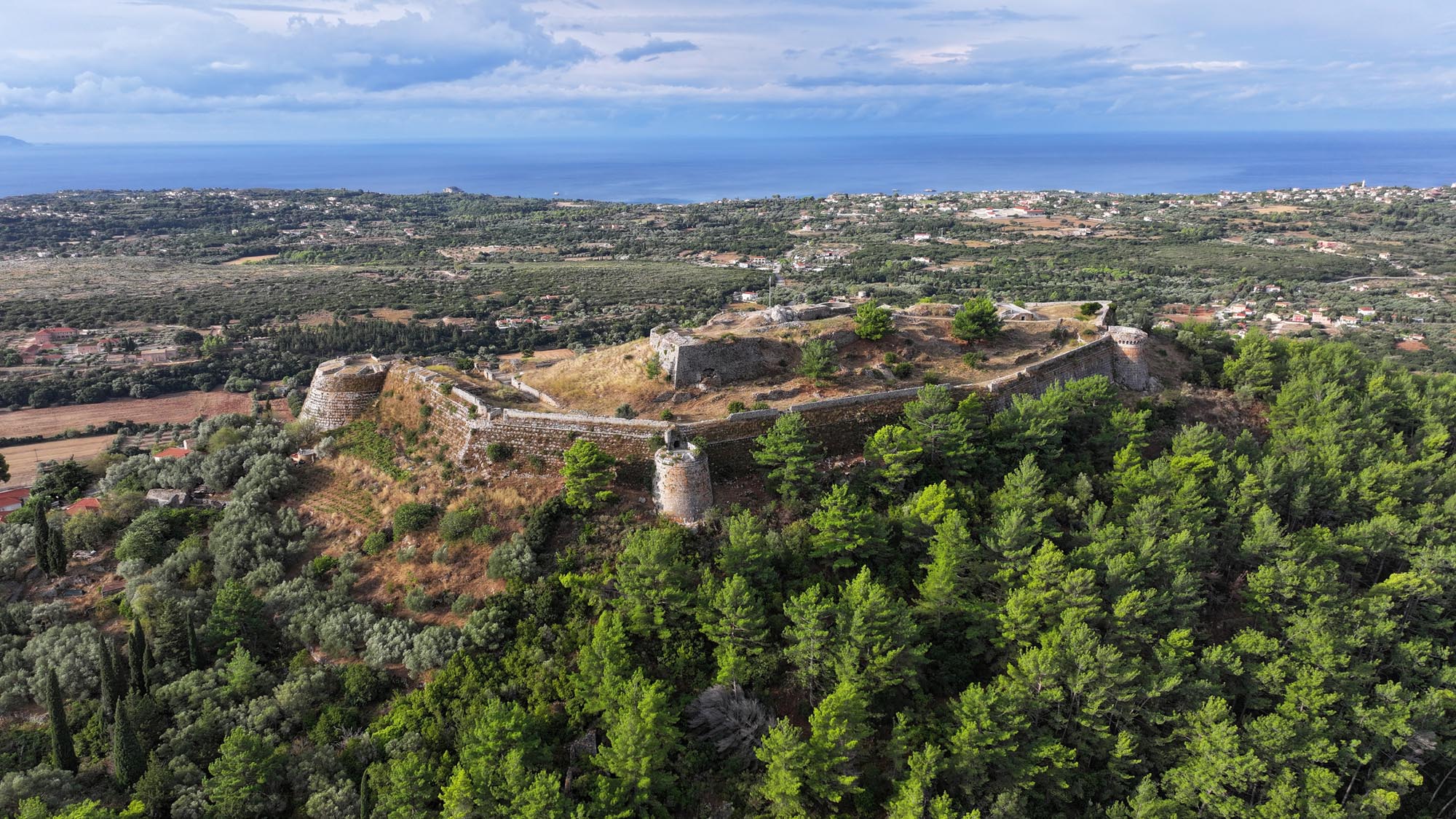
Agios Georgios Castle (Castle of St George) sits atop a hill in Leivatho, in the southwestern part of the island. Although it is located inland, it once controlled the island’s most important anchorage, the Bay of Livadi, as well as the sea passage between Zakynthos and Kefalonia. The first fortification on the hill has been assigned to the Middle Byzantine period and has been linked to the establishment of the naval theme – an administrative and military division of the Byzantine Empire – of Kefalonia in the 8th century. The Byzantine castle, the seat of the theme commander, probably occupied the highest point of the hill. However, this hypothesis has not been substantiated archaeologically, as numerous later reconstructions of the fortress resulted in the loss of its earlier phases.
ΑΠΟ ΤΟ ΠΑΡΕΛΘΟΝ ΣΤΟ ΠΑΡΟΝ
The castle or city of Kefalonia – the island’s most important settlement and seat of administration – repelled invasions of the Pisans and Normans in the 11th century. In 1125, it was briefly occupied by the Venetians, who, according to tradition, transferred the relic of Saint Donatus from Kefalonia to the Venetian island of Murano. The site first appears in written sources as Agios Georgios castle (Castle of St George) in the 13th century, a name that has been attributed to a church dedicated to Saint George within the fortification.
In 1184, Kefalonia was conquered by Margaritus of Brindisi, a pirate and admiral of the Norman Kingdom of Sicily. The County Palatine of Kefalonia, Ithaca and Zakynthos was subsequently established in the castle. Over the next three centuries, the lords of the county and the castle were the Italian Orsini family (1195–1325), the Angevin rulers of Naples (1325–1357) and the Tocco family, also of Italian origin (1357–1479). The castle functioned as the administrative and military headquarters, hosting the residence of the count palatine. In the early 15th century, Western visitors were impressed by the sophisticated court of Charles I Tocco and his wife, Francesca Acciaiuoli.
In the late 15th century, the Ottomans briefly captured the island and the castle (1479–1481, 1485–1500). Despite the short duration of both periods of Ottoman rule, repairs and reinforcements were carried out on the fortifications, which had been destroyed by a powerful earthquake in 1469.
At Christmas 1500, having suffered significant damage after a harsh three-month siege, the castle was captured by the Venetians with the assistance of Spanish troops, and Kefalonia was incorporated into the Venetian dominions. Reconstruction of the fortifications began in 1501, a process that continued until 1544, though it was interrupted by strong earthquakes in 1503 and 1542. Initially, the engineer Jacomo di Gavardo oversaw the works, followed by Nicolò della Cimara. The island’s inhabitants also contributed to the reconstruction through taxes and forced labour. The castle was rebuilt as the seat of the Venetian administration, complete with the necessary public buildings, and assumed its current form.
In 1569, an attempt was made to fortify the settlement outside the castle walls (borgo), but the project remained unfinished. Around the same time, the castle’s military significance began to decline, as its fortifications were considered outdated and inadequate, and its size insufficient to shelter the population. In 1636, following a powerful earthquake and as part of a broader effort to reshape the castle, the fortification of the suburb was attempted once more, but ultimately remained incomplete. In 1757, the castle ceased to be the island’s capital, a role transferred to Argostoli, which had already developed into an important commercial harbour. The castle declined thereafter and was gradually abandoned by its inhabitants.
In 1797, the Republic of Venice was dissolved and dismembered, and Kefalonia followed the historical course of the other Ionian islands. It passed from Republican French to Russian control in 1798, joined the Septinsular Republic in 1800 and returned to French rule in 1807. In 1809, the British captured Kefalonia, stationed a garrison in the castle and altered some of its buildings. The island remained under British protection until 1864, when the Ionian Islands were incorporated into the Greek state. The castle suffered significant damage again during World War II and the devastating earthquake of 1953.
THE CASTLE
The fortification, which measures about 600 m in length, follows the natural contours of the hill and forms an elongated, irregular polygon in plan. Its walls were reinforced by three bastions, the strongest of which was the southeastern one, which protected the entrance and the most vulnerable side of the fortifications facing the settlement (borgo). The sole entrance was located in a rectangular recess to the left of the southeastern bastion, a position that offered strong protection and made it difficult for enemy forces to access. The current form of the gate is the result of later modifications.
Within the fortification, the remains of the Venetian-era settlement are preserved. Just beyond the entrance lies a small square named after the Venetian cannon that was used for ceremonial salutes until 1940, when it was destroyed and replaced with the current, smaller 18th-century cannon. The castle’s interior was densely built, with narrow cobbled streets, private residences and churches, such as the Catholic church of Saint Mark and the chapel of Our Lady of the Guard. It also housed the public buildings required for the operation of the castle and the services of the Venetian administration, including a powder magazine, arsenals, a water cistern, residences for Venetian officials, a garrison headquarters and barracks.
As visitors ascend to the top of the castle hill along the path parallel to the southern wall, they encounter the church of Agios Nikolaos and public buildings, such as the so-called command post, the powder magazine and the residence of the proveditore, or Venetian governor. North of the entrance lie a small, recently constructed open-air theatre for hosting events, the ruins of the church of Saint Mark and the former barracks.
At the top of the hill, the Venetians constructed an elevated defence zone (cavalier), likely on the ruins of the older fortress. This section of the castle was significantly altered during World War II, when Italian forces levelled the area to install heavy artillery and a machine gun nest, which is still preserved.
Outside the walls, on the eastern and northern slopes, lies the settlement or borgo (Exobourgo), which was almost destroyed in the 1953 earthquake. The church of Evangelistria, built in 1580, was the metropolis of the capital of Kefalonia and is preserved in excellent condition.