
Bourtzi
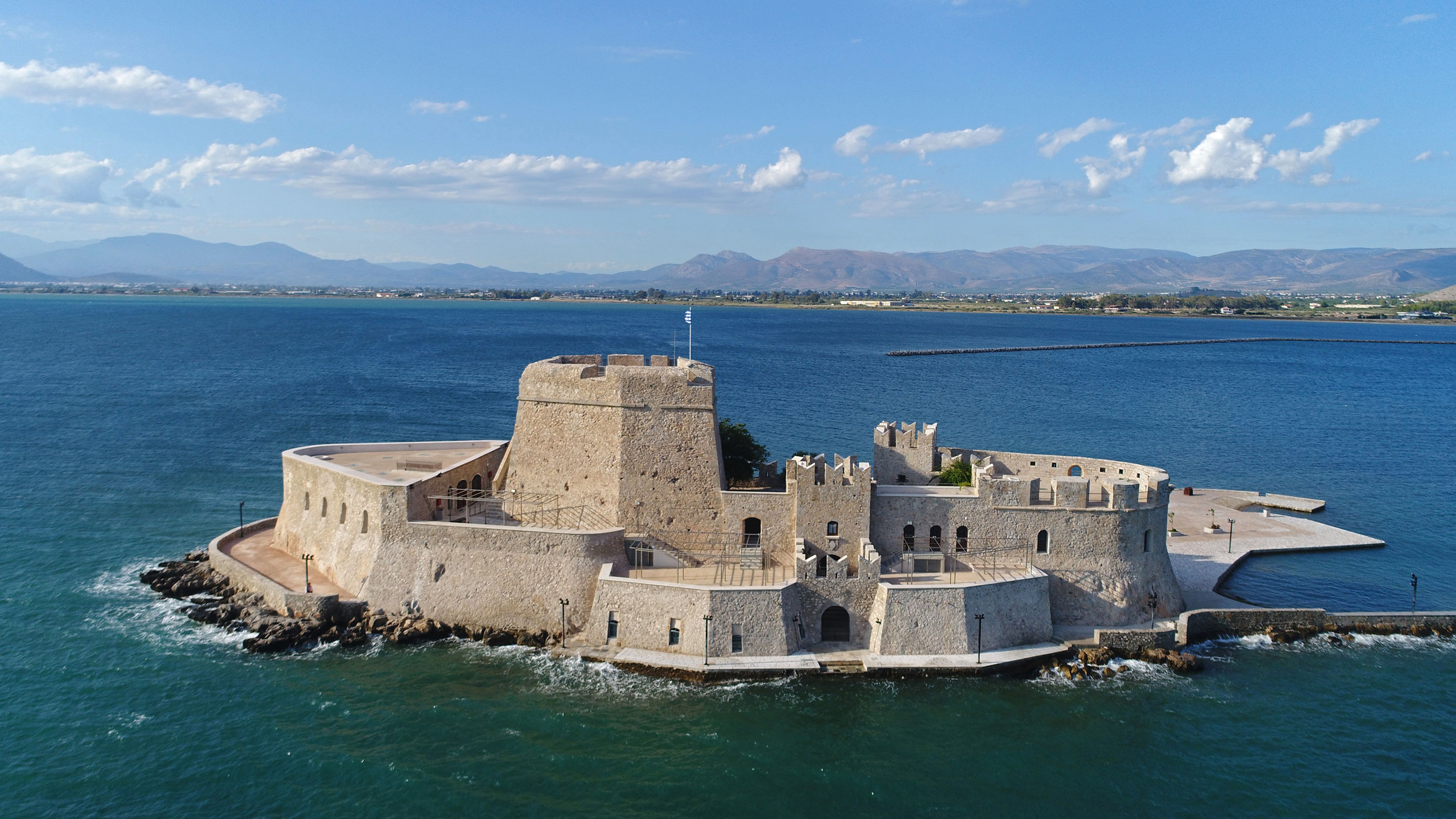
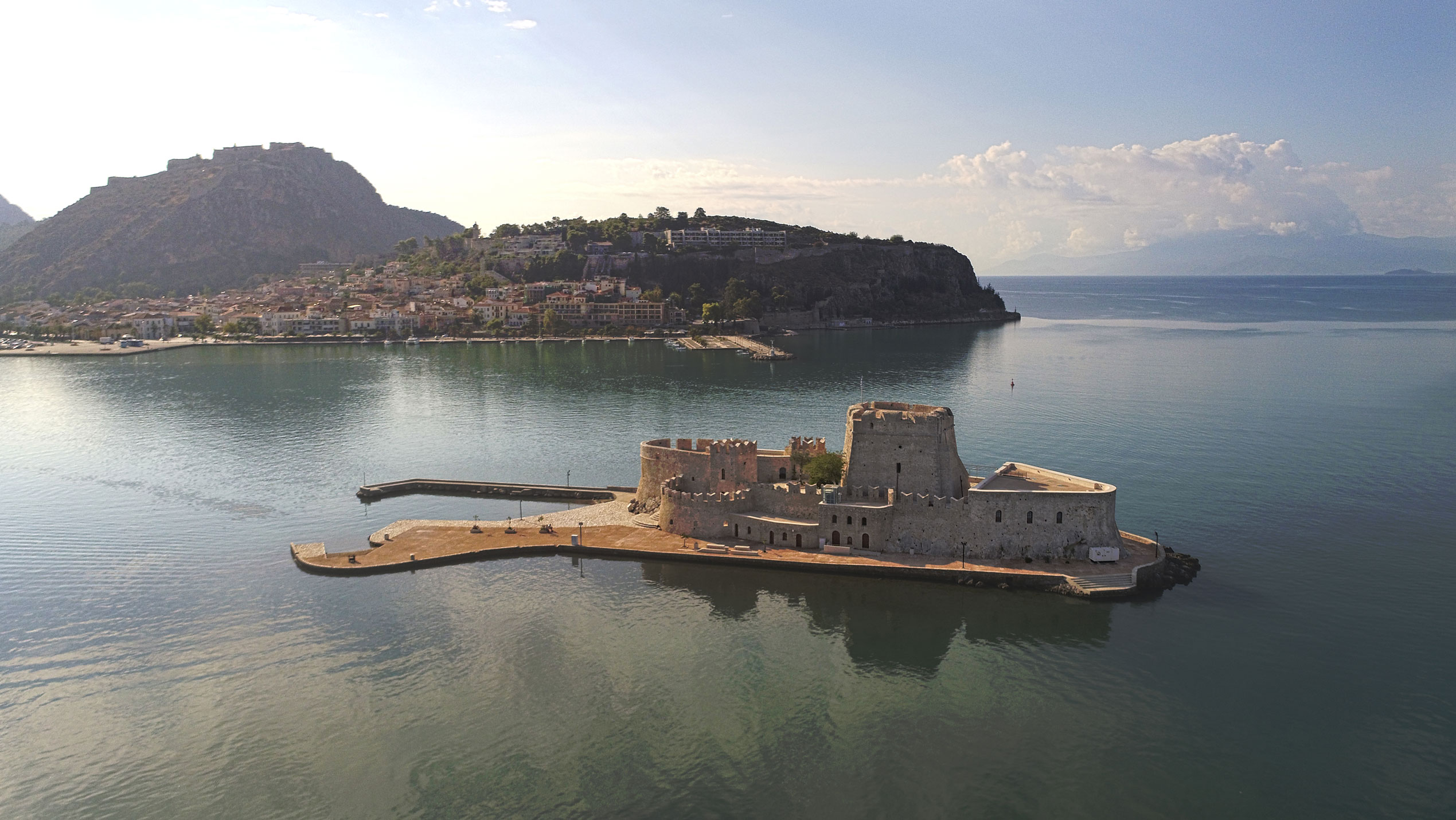
At the entrance to the Bay of Nafplio, on the rocky islet of Agioi Theodoroi, stands the small Venetian sea fortress of Bourtzi. Together with the fortifications of Acronauplia, the Lower Town and later Palamidi, it formed part of a strong and unified defence system against the Ottoman threat.
The fortress occupied a strategically vital position, as it, along with the Five Brothers bastion on the northwestern side of Acronauplia, controlled navigation in the city’s harbour. Built by the Venetians in the 15th century, the fortress was initially called Castel Pasqualigo, after Vittore Pasqualigo, the proveditore of Nafplio. Later, it became known as Castello da Mare (“Castle of the sea”) and Castello dello Scoglio (“Castle of the rock”). The name Bourtzi derives from the early Ottoman pronunciation of the Turkish word burç, meaning “fort”. During the Greek Revolution of 1821, it was referred to by the Greeks as the Thalassopyrgos (“Sea tower”) or Kasteli.
ΑΠΟ ΤΟ ΠΑΡΕΛΘΟΝ ΣΤΟ ΠΑΡΟΝ
According to tradition, during the Byzantine period, a church dedicated to Saint Theodoros stood on the islet where Bourtzi stands today. When Nafplio fell to the Venetians (the first period of their rule lasted from 1389 to 1540), the new rulers fortified the island. Work began in June 1471, but it is unknown when it was completed. The initial architect was Antonio Gambello, who returned to Venice a year later; the construction was then overseen by another engineer, Brancaleone. To bolster the fortress’ defences, an underwater fortification project known as a porporèlla was constructed around the islet. It consisted of large boulders arranged in a circular formation to prevent the approach of vessels with deep draughts. The method of construction was particularly ingenious: between 1480 and 1515, a decree required every vessel entering Nafplio’s harbour to carry a load of stones and to unload it at a designated point on the breakwater, as directed by the harbourmaster.
In the three centuries leading up to the Greek Revolution, the fortress underwent extensive modifications and structural interventions. During the struggle for independence, Bourtzi played a crucial role, serving as a base for Greeks. Its southern side, facing the city of Nafplio, suffered extensive damage from incoming fire. During the First Civil War (1823–1825), Bourtzi served as a stronghold for government forces.
In 1865, the fortress became the residence of the executioners of the Palamidi prisons. According to the 1834 penal code, death row inmates were to be publicly beheaded, using a guillotine brought to Nafplio from Marseille. Executioners were typically convicts who had been sentenced to death but had their punishment commuted to life imprisonment by the courts. They were incarcerated in Bourtzi and were only escorted out by gendarmes when a convict was about to be executed.
In the early 1930s, Bourtzi came under the ownership of the Public Properties Administration of the Ministry of Finance and was leased to a Nafplio entrepreneur for restoration and conversion into a holiday retreat. In 1935, it was transferred to the Greek National Tourism Organisation and transformed into a tourist centre featuring a 14-room hotel and a restaurant – a project undertaken by the German architect Wulf Schaefer. During its 37-year operation as a hotel, the fortress welcomed several important international personalities. The hotel closed in the late 1960s. Between the mid-1980s until about 1995, a restaurant and refreshment bar operated on the site. Following extensive restoration work by thw local Ephorate of Antiquities, the fortress recently reopened to the public.
THE FORTRESS
The fortress has an irregular and elongated layout, with its enclosure covering the entire islet. The walls are built directly onto the bedrock, appropriately shaped by carving and filling in its natural cavities. At the centre of the fortress stands a massive central tower, with two bastions at each end. The northern and southern towers are protected by barbicans. Two gun emplacements were built under the southern barbican.
From the southern side of the fortress extended a long chain that was connected to an artificial pier near the Five Brothers bastion in the Lower Town of Nafplio. During times of siege, the chain was raised just a few centimetres above the surface of the water, preventing ships from approaching the harbour. When lowered, it rested on the seabed, allowing vessels to pass freely. Nafplio was named Porto Cadena (“Harbour of the chain”) after this device.
THE GATES
Access to the fortress is provided through two gates, located on its northern and southern sides. The northern gate – which was approached via an artificial cove built for that purpose – was built into a rectangular tower that forms part of the outer fortification. Entry is gained through a passageway with a vaulted staircase. Above the passageway lies the garrison commander’s quarters. The gate is protected by a semicircular barbican, constructed slightly later than the rest of the fortress.
On the southern side – facing the city of Nafplio – another arched gate serves as the main entrance to the fortress. It is set within a tower that is rectangular on the exterior and octagonal on the interior. The gate is adorned with an escutcheon bearing the coat-of-arms of Venetian Admiral Mocenigo, which was placed there by Schaefer during the works in 1936–1937. At the same time, a window was created above the escutcheon to light the room above the gate.
THE INTERIOR
Today, the fortress has been fully restored as a monument open to visitors, retaining the form it took when it was converted into a hotel in the 1930s.
The central tower dominates the highest point of the islet. It has an irregular hexagonal shape and contains four successive vaulted rooms. Communication between these rooms, as well as access to the roof terrace, was facilitated by a trapdoor. In the basement, a cistern collects water from the roof terrace through a clay pipe. During the conversion of the fortress into a hotel, the external masonry of the eastern side of the tower was removed to make way for an internal reception hall. Today, this space is used for storage and auxiliary purposes.
The western bastion (the artillery battery facing the sea) consists of seven vaulted rooms arranged in a semicircle, with a round cistern at its western end. Arched gates leading from a corridor, which was initially uncovered, provide access to these rooms. To ensure lighting and ventilation of the space, each room features a square or circular opening at the top of the vault, framed in stone and protected by a metal grid. Today, the western bastion hosts temporary exhibitions organised by the Ministry of Culture.
The eastern bastion, smaller than the western one, contains five domed rooms. The vestibule, which was originally open, was later enclosed with a vaulted structure, while a roof terrace was added at the highest level. Access to the interior is through arched doors and, as in the western bastion, each room features openings at the top of the vault to provide ventilation and lighting. The eastern bastion is now a shop.
The interior of the southern tower retains its layout as a hotel room, its fittings and furnishings having been restored.
On the southern side, the two gun emplacements beneath the barbican at the gate were initially unroofed. Today, the western one has been turned into a restaurant and the eastern one into a kitchen.
Finally, the northern buildings, which were added during the fortress’ use as a hotel (1936–1960), are now auxiliary rooms.