
Assos
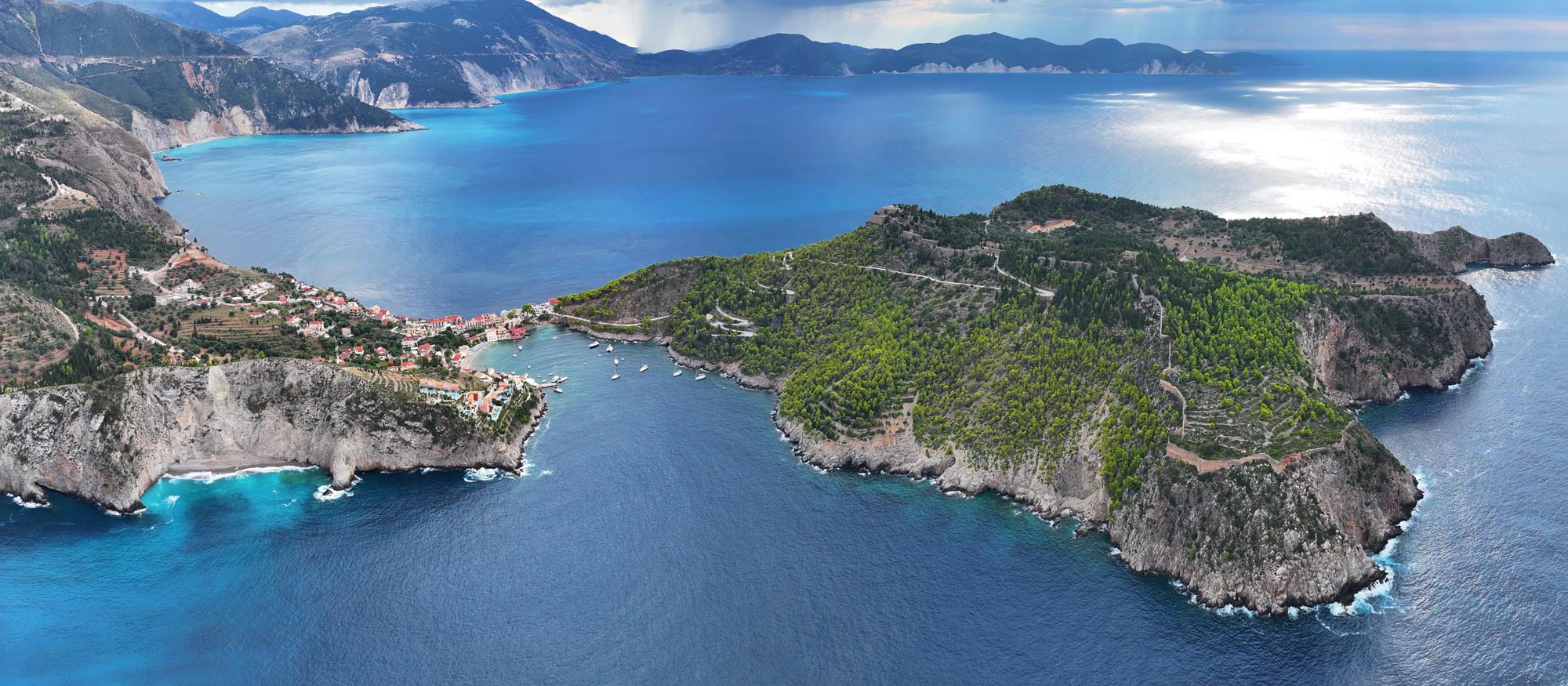
Assos Castle constitutes Venice’s most ambitious fortification project on Kefalonia. It is located on the eponymous peninsula on the island’s northwestern coast, in a naturally fortified position with steep slopes and a single point of access via the isthmus connecting it to the mainland. The construction of the fortress was part of a broader initiative to reinforce Venetian possessions in the East in the late 16th century, after the loss of Cyprus in 1571 and in response to the ever-growing Ottoman threat.
ΑΠΟ ΤΟ ΠΑΡΕΛΘΟΝ ΣΤΟ ΠΑΡΟΝ
In 1577, the proveditore of Kefalonia, Francesco Tiepolo, reported the need for a new castle on the island. In 1584, a delegation from the Community of Kefalonia visited Venice to present the same request. Agios Georgios Castle, the island’s capital, was inadequate to protect the population from the frequent raids of the Ottoman fleet and the pirates from neighbouring Lefkada. Constructing a new fortress in the island’s north would serve both as a deterrent and a reinforcement of Venice’s line of defence in the Ionian Sea.
The construction of the castle finally began on the Assos Peninsula in 1593, following a second delegation from the Community of Kefalonia to Venice. The fortification was designed by the engineer Marino di Gentilini, with technical supervision provided by Raffaele Rasponi and Piero Gambuti. The main structure was completed quickly and in secrecy in just two years, while construction work inside the castle continued throughout the first half of the 17th century.
The Venetians not only fortified the peninsula but also developed a comprehensive urban plan for the entire area, featuring large roads and building blocks. Their aim was to provide refuge for the population during raids and to create a new city that would serve as the island’s administrative centre. To that end, they called on the residents of the surrounding areas to purchase plots of land; however, this initiative failed to attract significant interest. Assos never developed into a true urban centre, mainly due to its limited water supply and remote, inaccessible location.
In the early 17th century, a port was constructed north of the isthmus, though its small size and shallow waters limited its capacity to accommodate ships. During the same century, a settlement began to develop outside the castle, the suburb (borgo) that became modern Assos. In 1684, the Venetians’ capture of Lefkada from the Ottomans significantly reduced Assos’ strategic importance for the defence of the island. In 1797, the Venetian state was dissolved by the French. During the brief period of Republican French rule in Kefalonia, from 1797 to 1798, the castle was designated as the seat of a temporary municipal headquarters, while some of the buildings inside it were converted to meet the needs of the administration and the garrison. Improvements were also made to the rainwater collection and drainage systems during this time.
By the 19th century, the castle had lost all strategic significance, gradually declined and was eventually abandoned, while the population of modern Assos – the former suburb – increased. From 1927 until the devastating 1953 earthquake, the castle housed the county prison.
THE CASTLE
With a total perimeter of approximately 3 km, the castle walls follow the contours of the peninsula and are reinforced in key points by five bastions. Part of the northern side, being particularly steep, were unwalled. Due to the rocky terrain and steep slopes, engineers were unable to fully apply the principles of the bastion system. As a result, all five bastions, which reinforce the weakest points of the walls, are incomplete and have a peculiar form, resembling more protrusions of the walls. The most powerful and complex one is the southeastern bastion, Agios Ioannis Komis (Canal), which consists of two hexagonal structures connected by a wide corridor.
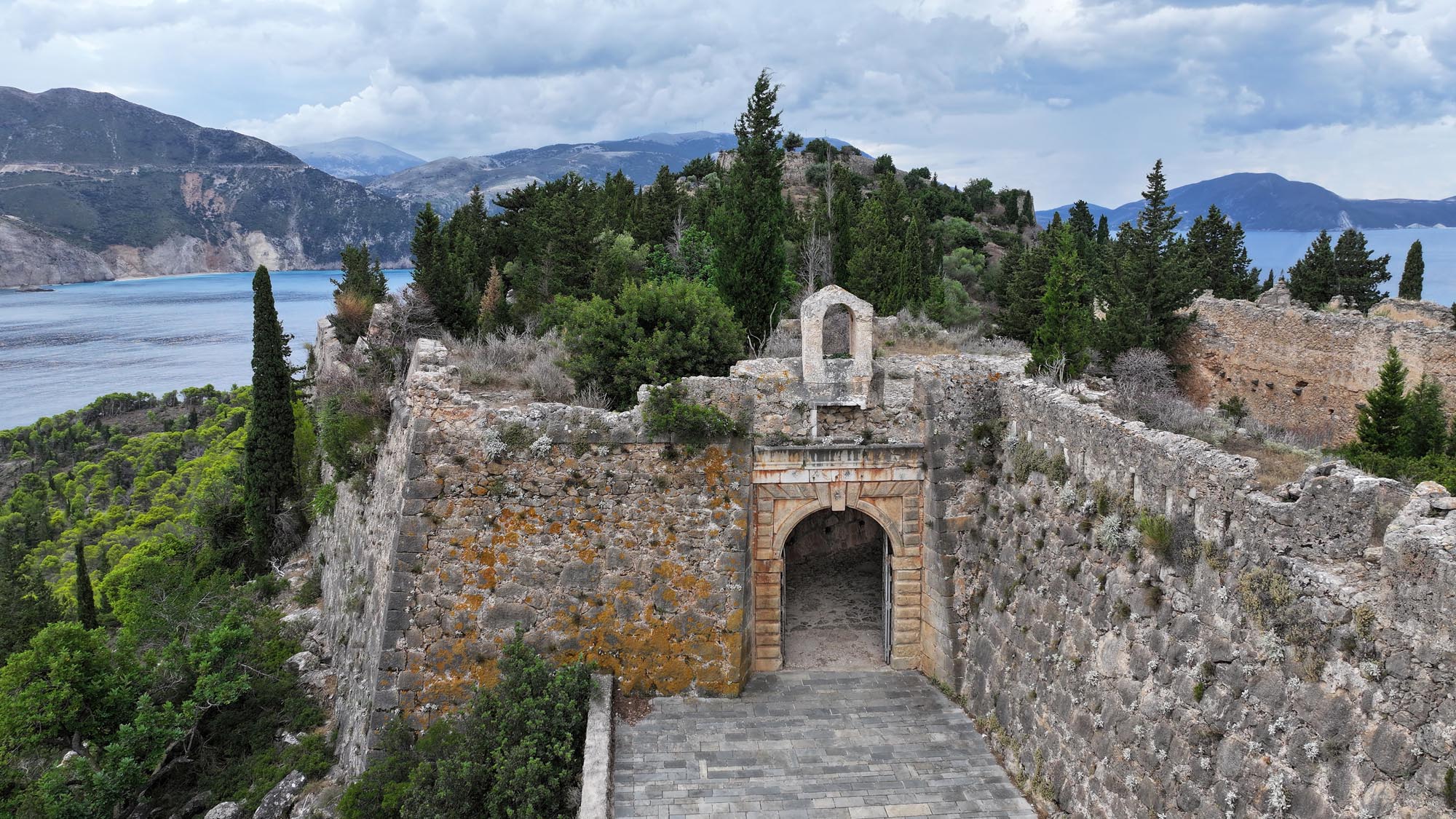
The main gate of the castle, set within a bastion (Mocenigo bastion) on the eastern side of the walls, features a monumental doorframe and leads into the fortification through a vaulted portico. On the inner facade of the gate, the year of its construction, 1611, is inscribed on the arched lintel. Two smaller auxiliary gates are located on the southern side of the walls and in the northwestern corner. The latter connects the castle to an outpost at the northern end of the peninsula.
In 1685, the Venetian cartographer Vincenzo Coronelli noted the existence of 60 public buildings and 200 residences inside the walls. By the time of the French occupation of the island in 1797, several buildings within the castle were already in ruins. Today, the remains of various structures are preserved, including the proveditore’s residence and the Catholic church of Saint Mark, near the central gate. In the southern part of the castle, the complex of prison farm – in use until the 1953 earthquake – is also preserved.