
Antirrio
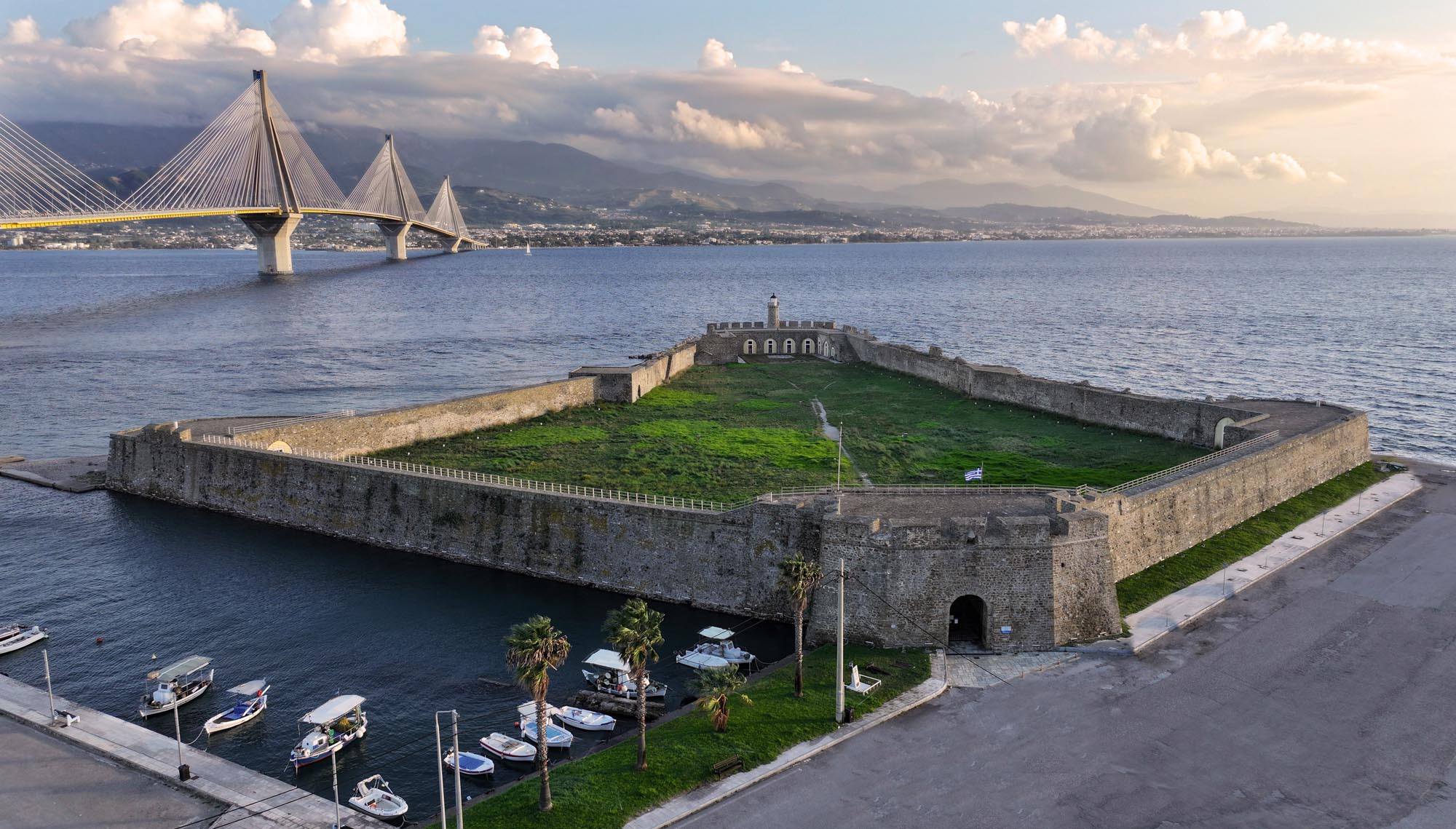
Antirrio Fortress was built by Sultan Bayezid II on the promontory of the same name to control and observe, along with Rio Fortress, the strait between the Peloponnese and Central Greece. The two fortresses were known to the Venetians as Castello di Rumelia (Antirrio) and Castello della Morea (Rio).
ΑΠΟ ΤΟ ΠΑΡΕΛΘΟΝ ΣΤΟ ΠΑΡΟΝ
The construction of the two fortresses was completed within a short period shortly after the Ottoman conquest of Nafpaktos in 1499. The introduction and spread of firearm technology in the 15th century provided the possibility to control narrow sea passes from land. The firepower of the two fortresses at the entrance of the Corinthian Gulf protected access to Nafpaktos harbour. Known as the Dardanelli di Lepanto (Dardanelles of Nafpaktos) or Little Dardanelles, they were modelled on the two forts in the Dardanelles that Mehmed II constructed to control access to Constantinople after the fall of the city to the Ottomans, as well as on the forts built in the Bosporus before the capture of the city.
A few years after the castle’s completion, in 1504, the Ottomans ensured the fortification was fully equipped with artillery pieces. In 1532, it was destroyed during the siege and brief occupation by the Genoese admiral Andrea Doria, who was serving Habsburg Emperor Charles V, but the Ottomans rebuilt it after regaining it in 1534. In 1543, Admiral Hayreddin Barbarossa installed powerful artillery units from Nafpaktos in the fortress and gave it a new form. In 1603, it was destroyed after an attack by the Knights of Malta, who removed and transferred the fortress cannons to their island. The Ottomans repaired the fortress, retaining it until 1687, when, under pressure from Francesco Morosini’s army, they blew it up before abandoning it to the Venetians. The fortress’ new masters, wanting to consolidate control of the strait, reconstructed and equipped it.
In 1701, after the Treaty of Karlowitz (1699), the castle passed again into the hands of the Ottomans, and this time the Venetians destroyed it before handing it over. During the second period of Ottoman rule (1701–1829), the fortress retained its importance and was repaired. Architectural similarities to fortifications built by Ali Pasha of Ioannina, whose territory included the fortress, point to extensive repairs by the Ottomans in the late 18th or early 19th century. The fortress remained in Ottoman hands until 1829, when it was handed over to the Greeks under a treaty signed by Augustinos Kapodistrias, brother of the governor of the newly founded Greek state.
The castle
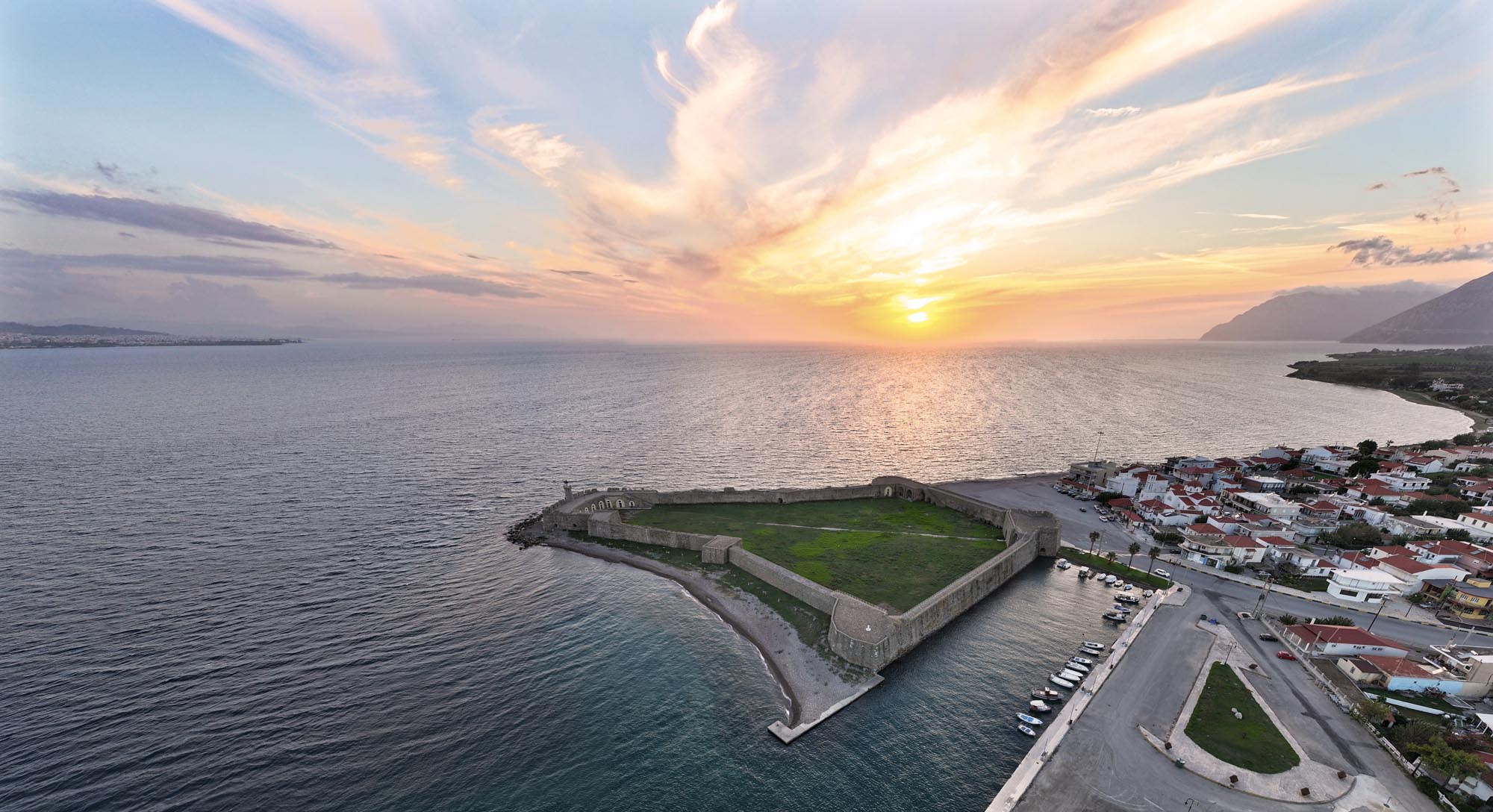
Due to its location, the fortress underwent successive destructions, reconstructions and repairs from the 16th to 19th century, when it assumed its present form. The fortification mostly follows the terrain’s natural contours and is surrounded by the sea on three sides. Its current form features an irregular rhomboid-shaped ground plan, with polygonal bastions at the corners, each backfilled internally. The main entrance to the fortress, located on the northern side, leads to the interior through a vaulted corridor, with vaulted outposts on the right and left.
Today, the perimeter walls and bastions of the fortress are still intact, though no buildings remain within its interior. Ramps and staircases facilitated the access and movement of soldiers and supplies from the inner ward to the rampart-walk and the top of the walls. On the southern side is the central bastion-emplacement, with six cannon loops facing the strait. Two smaller bastions, positioned at the centre of the eastern and western walls, covered the other two sides of the fortress and the sea passage with their cannons. A moat, which once separated the fortress from the wider area, was located on the side facing the mainland today, though it is now covered by the embankments of the modern harbour.
According to the description of the Ottoman traveller Evliya Çelebi, which, however, is not supported by archaeological evidence, the fortress in the 17th century (just before 1670) contained a settlement with more than 80 houses, a mosque built by Sultan Bayezid II, a small mosque built by Sultan Suleiman and an Ottoman bath. In the late 19th century (1880), the castle lighthouse was erected on the southern side of the southern wall.