
Agia Mavra
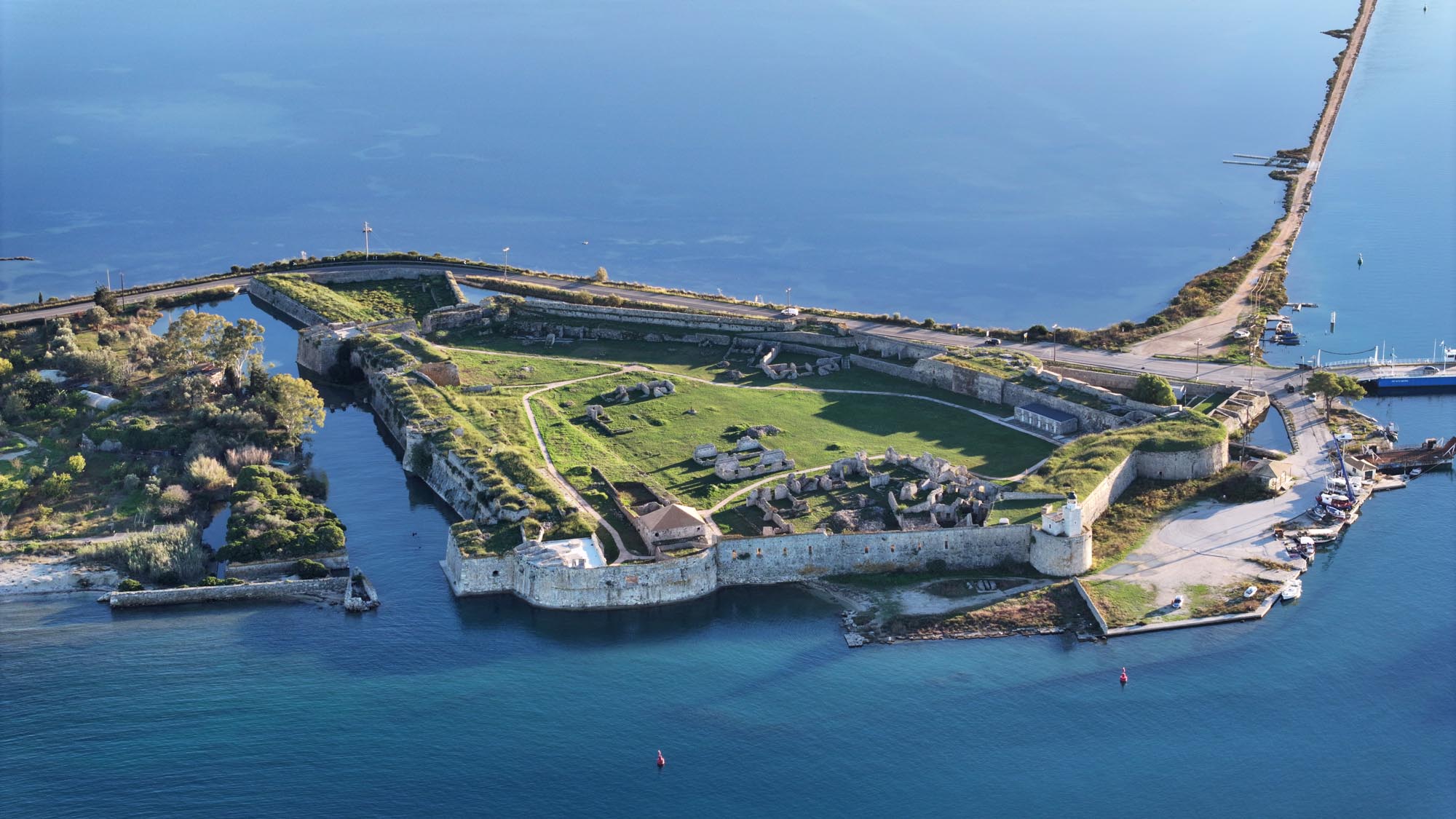
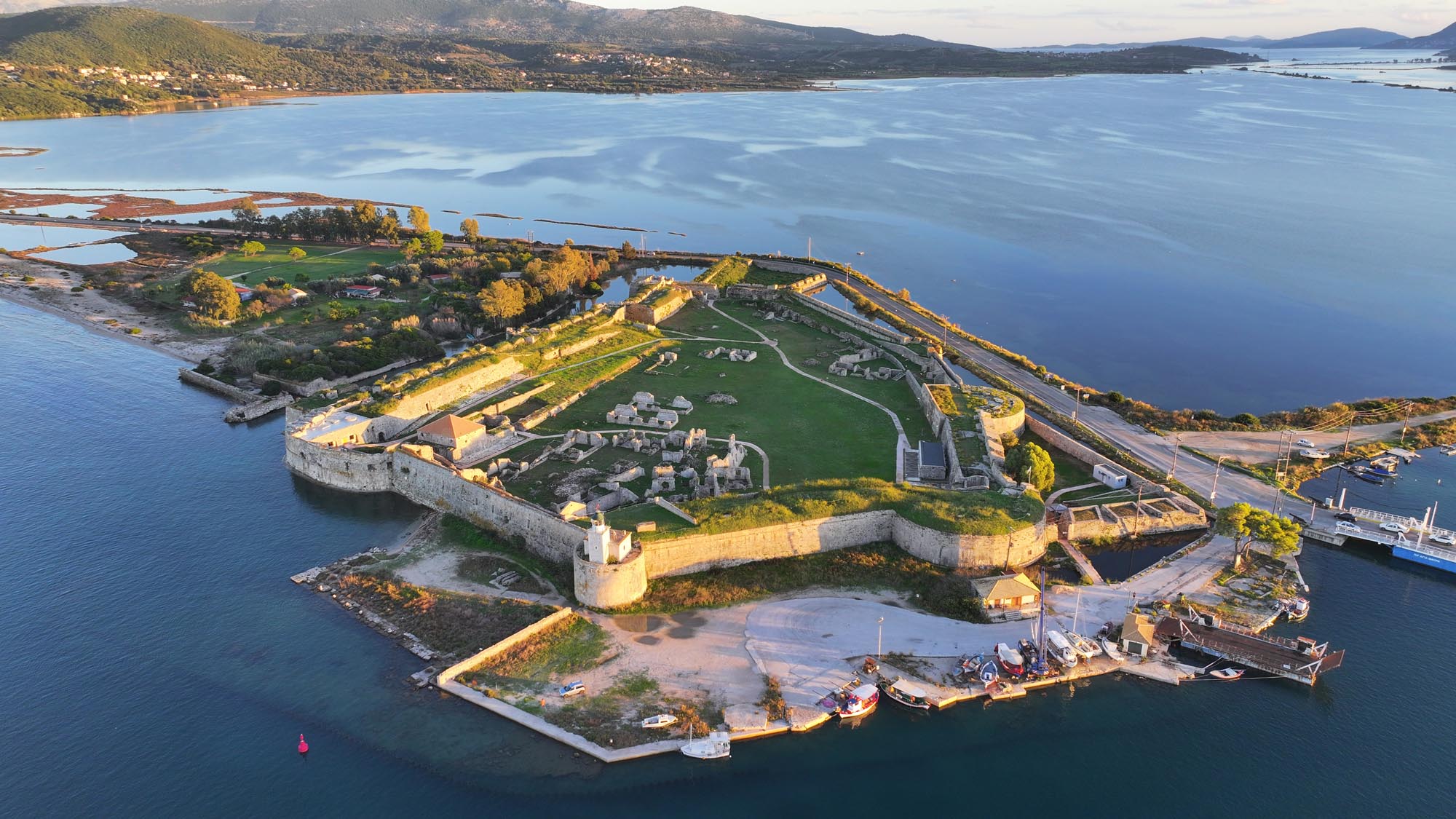
The coastal castle of Agia Mavra is situated at the land entrance to the island of Lefkada, 1.2 km northwest of the modern city. Its strategic location was of particular importance, as it controlled access to the Ambracian Gulf, the sea routes to the Adriatic as well as the island’s land connection with mainland Greece. Originally founded by the Franks around 1300 as a small fortress, it soon expanded and developed into a fortified settlement, becoming the island’s first capital. The castle’s present form is the result of extensive later interventions, carried out mainly during the periods of Ottoman and Venetian rule.
The name Agia Mavra, which in medieval times referred to both the castle and the island, is presumed to derive from the 14th-century church of the same name within the walls.
ΑΠΟ ΤΟ ΠΑΡΕΛΘΟΝ ΣΤΟ ΠΑΡΟΝ
The original castle was established around 1300 by John I Orsini, count palatine of Kefalonia and Zakynthos, to strengthen the island’s defence. According to 17th-century sources, it was a small, rectangular structure with towers in the corners that later served as the castle’s citadel. It remained intact until the late 17th century, when it was gradually demolished, leaving no visible traces today.
In 1331, the island and castle were captured by Walter VI of Brienne, heir to the Duchy of Athens, before briefly passing to the Angevin kings of Naples and subsequently being ceded to the Venetian Graziano Zorzi. In 1362, Lefkada became part of the County Palatine of Kefalonia, Zakynthos and Ithaca, initially under the administration of Leonardo I Tocco and then his son, Carlo I Tocco. During this period, the population increased through the settlement of mercenaries, Latin nobles, merchants and other professionals, and a thriving society quickly developed. According to the Chronicle of the Tocco, significant improvements and reinforcements were carried out on the castle, which now included a settlement around the original small fortress, which seems to have been walled during this period. Thus, in 1420, a map by the Italian traveller Cristoforo Buondelmonti depicts it as a fortified town (“Oppidum Sancta Maura”) around a citadel.
During the first period of Ottoman rule of the castle (1479–1502), it appears that few interventions were made. During the brief period of Venetian rule that followed (1502–1503), Admiral Benedetto Pesaro undertook extensive work to modernise the fortifications, adapting them to the new reality of firearms. The main ones included the construction of a new bastion with a portico in the southeast and another in the north.
During the second period of Ottoman rule (1503–1684), extensive modifications were made to the castle to adapt to advances in military technology and withstand repeated Venetian attacks (1572, 1604, 1658, 1667, 1684). The original small Frankish fortress was transformed into a well-fortified citadel, while the fortifications of the surrounding settlement were bolstered with sloping batters and enlarged bastions. By the end of the 16th century, the castle had acquired the basic form it retains today, with its irregular heptagonal plan and robust bastions. Numerous buildings were constructed, including mosques, a madrassa, a hammam, a khan, warehouses and water supply systems. A major aqueduct was also constructed to supply the settlement with water, spanning the lagoon on 360 arches and running almost parallel to the present-day sea road connecting the city of Lefkada with the castle. These works made Agia Mavra a formidable Ottoman fortress, which proved impregnable during the Venetian attack of 1572.
During the 16th and 17th centuries, the castle also gained notoriety as a haven for pirates, as noted by the Ottoman traveller Evliya Çelebi, who visited in 1688. According to his account, Agia Mavra had evolved into a large settlement. The old fortress functioned as a citadel, with 200 houses lining the main road, inhabited by Ottoman officials and the garrison. Outside the walls, two Christian settlements had formed: Chora (or Bourgo) to the west, located in the area of the current canal, and Alli Meria to the east
In 1684, due to the persistent pirate activity from Agia Mavra, the castle was besieged and captured by the Venetian fleet under Francesco Morosini. The Venetians undertook extensive modifications and repairs to the walls. Within the castle, mosques were converted into Christian churches, and many houses, both within and outside the walls, were demolished to make way for new buildings to serve the needs to the Venetian administration, military and clergy. Following these changes, the settlement was relocated to the suburb of Amaxiki, the site of the present-day city.
In 1715, the castle was briefly captured by the Ottomans but returned to Venetian control the following year. In 1718, the Venetians commissioned General von der Schulenburg, a German in their service, with reinforcing the walls and improving the castle’s defences, primarily on the most vulnerable eastern and western sides. The works included widening the walls, creating vaulted porticos with emplacements at key points, reshaping the bastions and constructing triangular bulwarks and moats to surround the castle to form a first line of defence. During this period, the castle reached its most extensive form, while a key development was the gradual demolition of the citadel, the castle’s historic core.
Beginning in 1797, Lefkada came under brief French control and then joint Russian-Ottoman administration. In 1800, it became part of the new Septinsular Republic, which passed to the sovereignty of the French Empire in 1807. The French proceeded to enhance the fortification of the castle and reinforce its defences with artillery and other military equipment.
Under British rule, from 1810 until the union of the Ionian Islands with the Greek state in 1864, the fortress functioned as the island’s military centre. Extensive works were carried out, focusing on the development of infrastructure inside and outside the castle. Existing buildings were renovated and new structures, including barracks, a hospital, prisons and a lighthouse, were constructed, while a cemetery was demarcated. In addition, the wooden bridges linking the castle to Acarnania and Lefkada were replaced with stone structures, and a canal was excavated to facilitate navigation. A sea road was also created to connect the castle with the capital of the island.
In the early 20th century, the castle was used successively as a prison, a refugee shelter and a sports venue. In 1938, despite having already been declared an archaeological site, the Army Pension Fund sold parts of the castle as building material, resulting in significant damage to the site’s monuments.
Following extensive recent restoration and enhancement works by the local Ephorate of Antiquities, the castle now serves as an archaeological site, open to the public and featuring visitor infrastructure and routes, exhibition areas and information materials.
THE CASTLE
The castle acquired its basic form – still largely preserved today – at the end of the 16th century, during Ottoman rule, despite the significant later interventions by the Venetians and modifications under the British. It features an irregular heptagonal shape, surrounded by bastions, retaining walls and external strongholds, some of which are now privately owned and have been altered, dismantled or buried under sand. The eastern (facing Acarnania) and western (facing Lefkada) sides of the walls, which were protected by moats, bore the main burden of the defence. Sections of these walls are up to 20 m wide and include ground-level transverse porticos with cannon embrasures. The walls, up to 10 m. in height, are vertical or sloped in places, while their masonry varies due to the continuous interventions made to reinforce and modernise the castle.
The fortification is strengthened by nine bastions, which vary in form, size and construction method. Most were built by the Ottomans and then modified by the Venetians, while the Pisani and Agios Markos bastions, located in the northeastern and southeastern corners, respectively, were exclusively Venetian. The Pantokratoras bastion, situated on the northern side of the walls, houses the lighthouse, which was erected under British rule. Now fully restored, it constitutes one of the best-preserved Greek lighthouses. The most striking of the bastions, however, is the crescent-shaped Saint Francis bastion, which was initially built during the Tocci era (15th c.) and later reinforced and reshaped by the Ottomans, Venetians and British. It now hosts a museum.
THE GATES
Two main gates, on the eastern and western sides, provided access to Acarnania and the Lefkada hinterland. They were accessed by wooden bridges spanning the moats, which were later replaced by stone structures during British rule.
The eastern gate, built by the Ottomans in the second half of the 16th century, underwent substantial alterations by the Venetians and later the British, ultimately falling out of use after World War II. Set within a recess in the wall for added protection, it was reinforced by the bastion that now houses the church of Agia Mavra. In front of this gate, the stone foundations of the bridge over the moat are still preserved today.
The western gate, which now serves as the entrance to the castle, was also built by the Ottomans and later remodelled by the Venetians, who gave it a monumental form. It was defended by the large Agios Antonios bastion. The gate comprises two vaulted sections, separated by an open central part resembling a small atrium. This space was protected by the gun slits of the adjacent right wall and a guardhouse located slightly above.
THE INTERIOR
The fortified complex is structured internally on two levels. In the northeast, on the upper level, stood the castle’s medieval citadel, which was demolished in the 18th century. In the remaining area, which extended to the old city of Agia Mavra, preserved remnants include religious and administrative buildings, prisons and barracks that supported the needs of the Venetians and, later, the British.
Among the Venetian buildings in the northern part, notable examples include the church of San Salvator, built on the site of a mosque; the cells and monastery of the Franciscans; the residence of the regular proveditore; and the gunpowder storeroom, which has now been transformed into a space for the projection of audiovisual material.
Constructions from the British period are scattered throughout the area and include the remains of various military and administrative buildings such as prisons, barracks, an officers’ mess and a hospital. The cemetery to the south, which was already used as a burial ground during the Ottoman period, was later converted by the Venetians into a defensive bulwark. Under British rule, it served a dual purpose as both a defensive structure and a burial site.
The first church of Agia Mavra, which gave the castle its name, was erected by the Angevins in the 14th century. Another church dedicated to the same saint was built in the mid-15th century by Helena Palaiologina, daughter of the despot of Mistras. The Ottomans converted it into a mosque, while later, during Venetian rule, it reverted to a Christian church. Located near the eastern gate and next to the powder magazine, this church suffered severe damage in later times, only to be destroyed in the 19th century. In 1889, it was transferred to its present location within the southeastern Agios Markos bastion.