
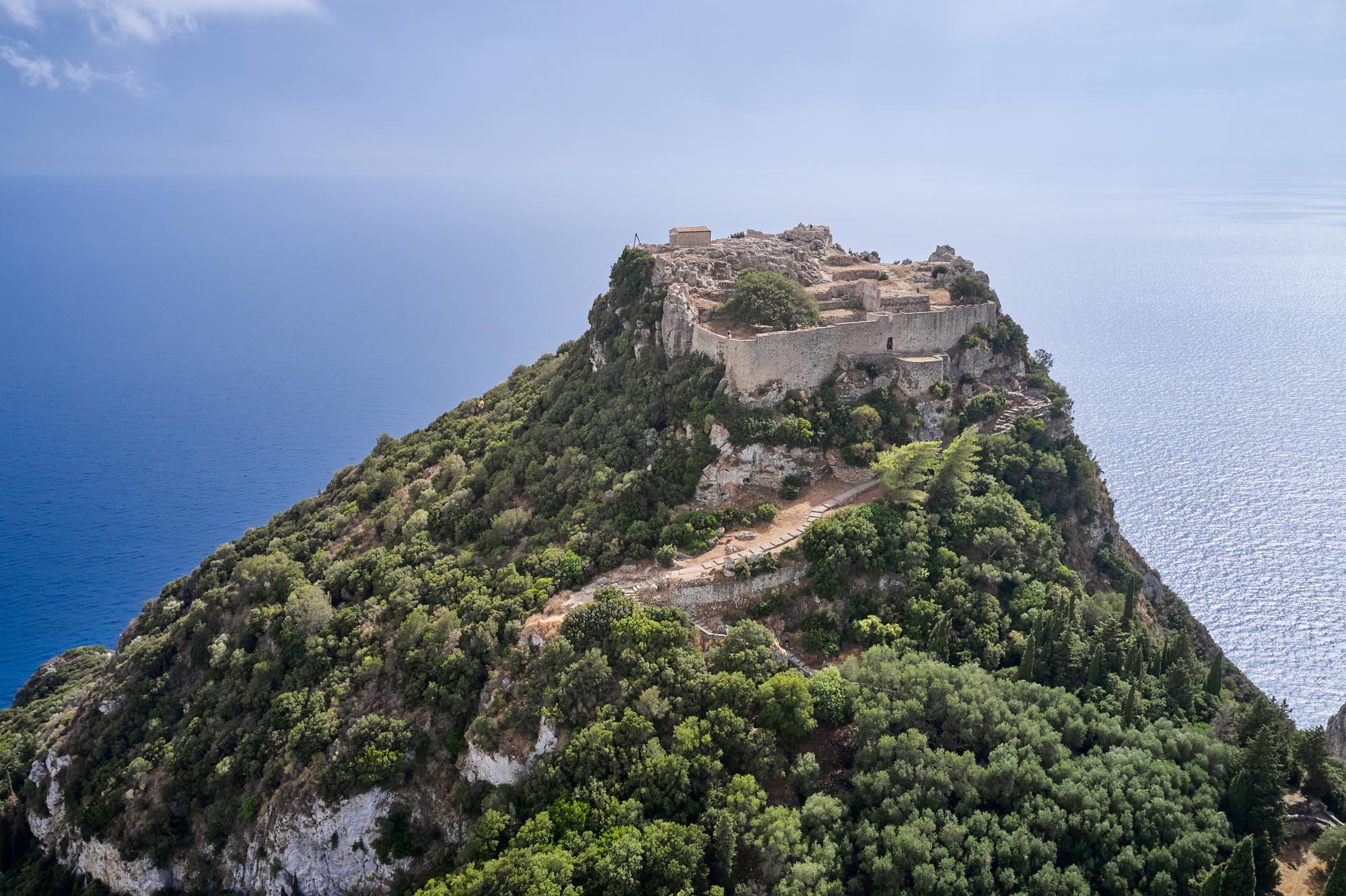
Aggelokastro
Perched atop the highest peak of a steep hill on the west coast of northern Corfu, Aggelokastro was one of the island’s most important fortresses. Along with Kassiopi and Gardiki, it is one of three surviving Byzantine castles in the countryside. Its strategic location allowed it to control part of the southern Adriatic.
ΑΠΟ ΤΟ ΠΑΡΕΛΘΟΝ ΣΤΟ ΠΑΡΟΝ
Archaeological remains testify to the use of the area as early as the 5th and 6th centuries. The establishment of the fortress is placed in the 12th or 13th century, however, there is no evidence in written sources to confirm this dating. In the 12th century, after the loss of the Byzantine possessions in Italy in 1071, Corfu became a border region of the Byzantine Empire. The island was under constant threat from the Normans, the new rulers of the southern Italian area. The construction of Aggelokastro has been associated with Emperor Manuel I Komnenos, who recaptured the island from the Normans in 1149. According to another view, the castle was built after 1214, during the period when the island belonged to the independent state of Epirus, more widely known today as the Despotate of Epirus. In 1259, Corfu was granted as a dowry to King Manfred of Sicily upon his marriage to Helena, the daughter of Michael II Komnenos Doukas, despot of Epirus. In 1267, the Angevin rulers of Naples occupied the island, and five years later Aggelokastro came into their hands after the Italian Giordano di San Felice took possession of it. The first written mention of the castle appears in the castle handover report, where it is referred to as Castrum Sancti Angeli.
In 1386, Aggelokastro, along with the rest of Corfu, passed to the Venetians. While it remained in use throughout Venetian rule due to its strategic importance for the island’s defence, its significance gradually declined with the development of Corfu’s Old and New Fortresses.
Throughout the Venetian period, Aggelokastro played a crucial role during the Ottoman raids of 1537, 1571 and 1716, repelling attacks and offering refuge to the inhabitants of the wider region. Venetian historian Marco Guazzo records four failed Ottoman attempts to capture it. After the French occupation of Corfu in 1797, the castle probably served as an observatory, while during the early part of British rule (1814–1864) it fell into disuse.
THE CASTLE
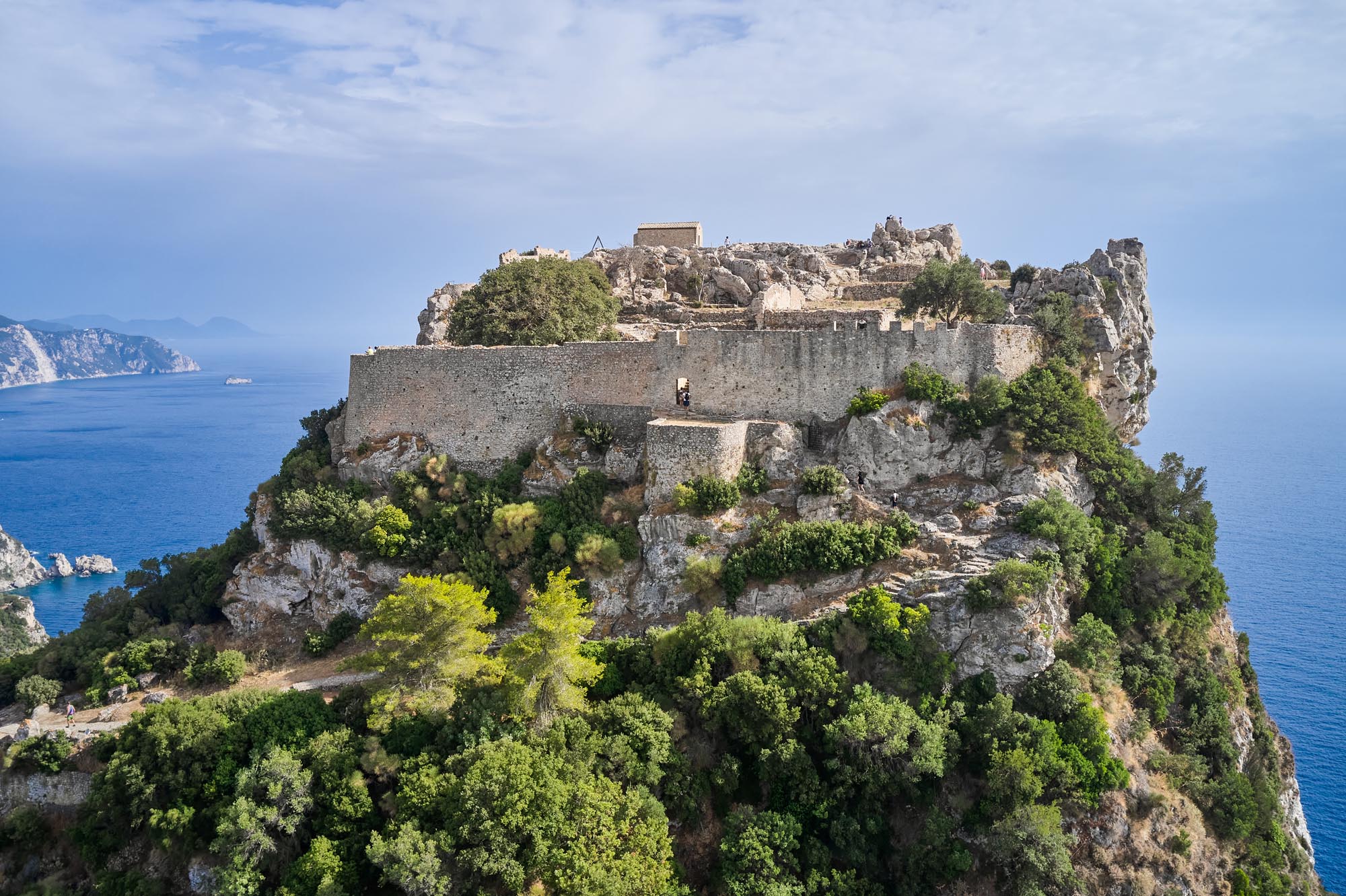
The walls of the castle, which in some parts are built directly on the edge of the cliff, bear remnants of its entire history. The west side, however, remained unwalled, as the particularly steep terrain provided natural protection. At the highest point stands the citadel. A bulwark built lower down on the slopes of the hill protects the vulnerable sides of the castle. An uphill stepped stone path leads to the main gate.
THE GATE
Reinforced by a semicircular tower, the main gate, located on the north side of the castle, leads inside through a barrel-vaulted corridor. A small postern gate was positioned on the south side of the fortification.
THE INTERIOR
Inside the castle, in front of the main gate, stand the ruins of the garrison quarters and its administration as well as three underground water cisterns. At the eastern limits of the site lies the church of Agia Kyriaki, which is hewn out of the rock. At the highest point of the citadel is the restored aisleless timber-roofed church of the Archangel Michael, built on the remains of an earlier building, probably a three-aisled basilica with a narthex from the Early Byzantine period.