
Acronauplia
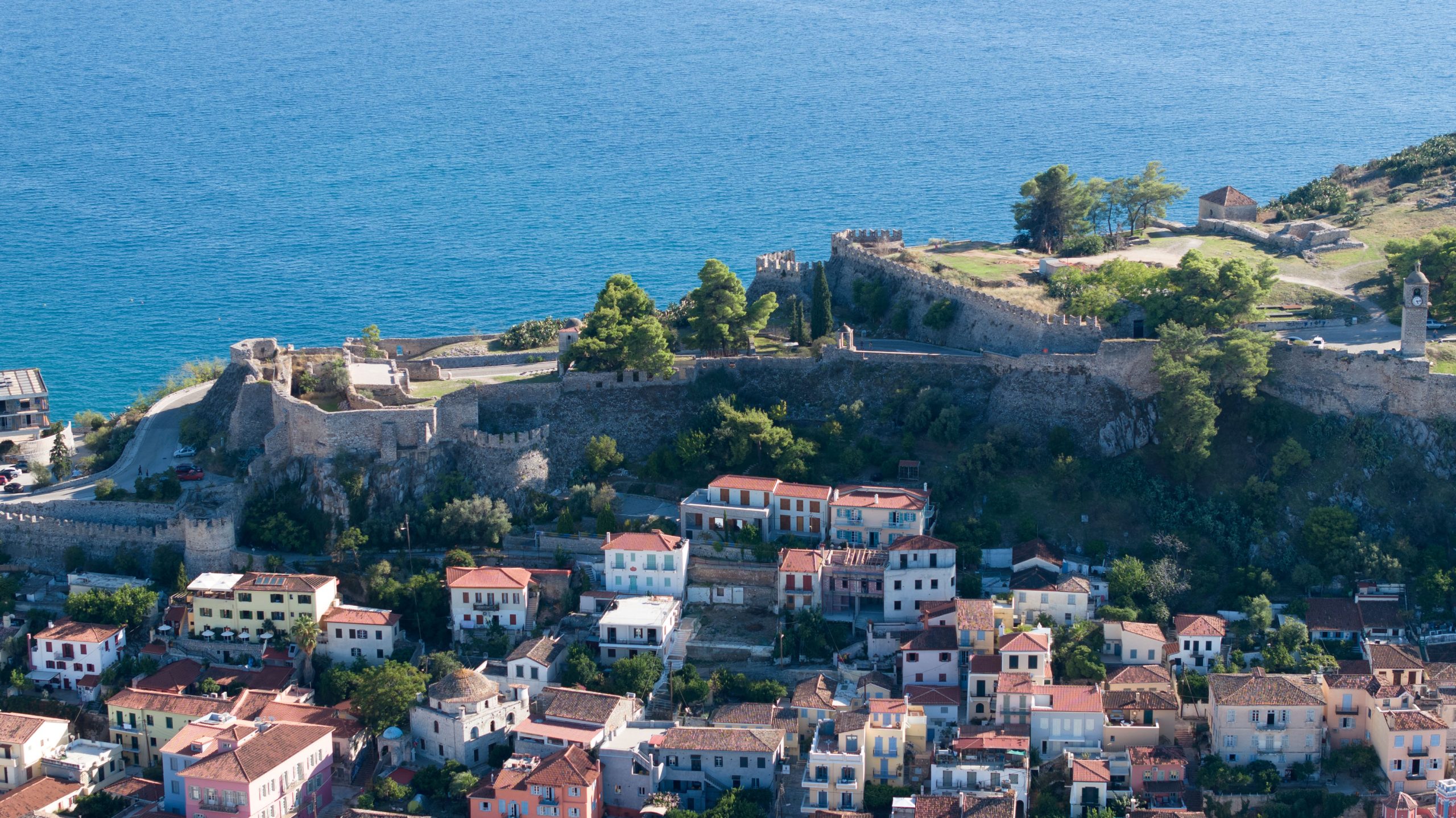
The castle walls on the rocky peninsula of Acronauplia enclosed the settlement of Nafplio and protected its natural harbour, one of the most important in the Peloponnese. The elevation of the castle provided strategic oversight of the Argolic Gulf and much of the Argolic Plain. Naturally fortified, Acronauplia features steep rocky slopes to the south and southwest, with its only land access via an isthmus connecting it to Palamidi Hill to the east. On its northern side it had a natural harbour, and until the 15th century the coastline lay very close to the steep slopes of the hill. To the northwest, marshlands and a narrow strip of land along the relatively steep slopes complemented the natural fortification of the peninsula.
ΑΠΟ ΤΟ ΠΑΡΕΛΘΟΝ ΣΤΟ ΠΑΡΟΝ
Inhabited since prehistoric times, Acronauplia was fortified by at least the late 4th century BCE, when Nafplio served as the harbour of the neighbouring powerful city of Argos. In the following centuries, the small settlement of Nafplio remained in Argos’ shadow, functioning as its seaport. After the 10th century, Nafplio began to gain in prominence, becoming a trading post for the Venetians and gradually obtaining the same significance as Argos. The 12th century was a period of prosperity, as shown by the establishment of a new administrative unit, the Frontier of Corinth, Nafplio and Argos, which has been associated, among other things, with fortification works at the three castles. In 1180, Byzantine Emperor Manuel Komnenos appointed Theodoros Sgouros as lord of Nafplio. Around 1200, he was succeeded by his son Leon who expanded his power from Nafplio a far north as Thessaly. Leon’s brief rule ended when the knights of the Fourth Crusade occupied Acronauplia from 1210 to 1212.
Geoffrey of Villehardouin, the conquering Frankish ruler of Achaia, ceded Nafplio to Otto de la Roche, the duke of Athens. The heirs of the latter, initially from the de la Roche family and then from the houses of Brienne and later Enghien, retained sovereign rights over the castle of Nafplio until 1389, when they sold them to the Republic of Venice.
The growing threat of the Ottomans, who occupied the Venetian castles of Argos in 1467 and Chalkida in 1470, made it imperative to adapt Nafplio’s defences to the new firearms technology. The now dominant Venetians carried out extensive works in the late 15th century to modernise and strengthen the defence of the city, which they called Napoli di Romania.
At the same time, population growth prompted the expansion of the city into the marshy area north of the peninsula, now the flat part of Nafplio’s Old Town. The new extension, the “Lower Town”, was protected by a coastal defensive wall constructed during the same period. It was built on artificial alluvium and wooden pile foundations, techniques also used in Venice. Gradually, the administrative centre and officials’ residences were transferred from Acronauplia to the new part of the city.
In 1540, after a three-year siege, Nafplio surrendered to the Ottomans, who designated it the capital of the Sanjak of the Peloponnese. During this period, they constructed large public and private buildings, mosques, fountains and baths. However, the Ottomans made no new additions to the city’s fortification, undertaking only minor interventions and changes. Acronauplia became known as Iç Kale (“inner castle” or “citadel”), in contrast to the Lower Town.
In 1686, during the Sixth Venetian-Οttoman War and the campaign to recapture the Peloponnese, the Venetians, under the command of Francesco Morosini, besieged and captured the city, causing extensive damage to both the walls of Acronauplia and the Lower Town, as well as to buildings and districts. Nafplio became the seat of the Venetian Kingdom of the Morea and an extensive programme to reinforce its fortifications was undertaken in anticipation of future Ottoman attacks and sieges.
Immediately after capturing the city, the Venetians prohibited habitation within the castle, parts of which were levelled to make way for powerful artillery batteries, and its function became exclusively military. A large barracks and a gunpowder storeroom were built under the direction of Proveditore Antonio Grimani on the site where a hotel now stands. In 1711, construction began on the Palamidi Fortress on the hill dominating the east of the city, marking the decline in the military importance of Acronauplia for the defence of Nafplio.
The second Venetian occupation, a period of prosperity for the city, was abruptly interrupted in 1715, when the Ottomans recaptured Nafplio after a siege lasting only two weeks. In the years that followed, the city’s administrative structure declined, particularly after the Ottomans relocated their headquarters to Tripolitsa (modern Tripoli), contributing to its economic decline. Acronauplia Castle remained in military use and housed an Ottoman garrison. In 1822, following the capture of Palamidi by Greek revolutionaries, the city and its castle were handed over to Theodoros Kolokotronis.
During the Greek Revolution, the newly established Greek state designated Nafplio as its administrative centre and capital. The state’s first governor, Ioannis Kapodistrias, oversaw the reconstruction of the castle’s ruined Grimani Barracks, which became known as Kapodistrias Barracks, and established a military hospital with a church dedicated to the Holy Unmercenaries. Acronauplia was also cleared of piles of ruins.
In 1834, Athens was declared the capital of the Greek state, while Nafplio remained a military centre. In 1884, a military prison was established in Kapodistrias Barracks, which was turned into a civilian prison in 1937. During World War II, the highest point of the Acronauplia rock was levelled to accommodate anti-aircraft emplacements. In 1960, the castle was designated as a Tourism Public Property and in 1961, the Xenia hotel, managed by the Greek National Tourism Organisation, opened on a significant part of Tori Castle. Acronauplia’s prisons were abandoned in 1966 and demolished in 1970. In their place, construction began in 1971 of the Xenia Pallas hotel complex, which continues to operate on the site.
THE CASTLE
The walls of Acronauplia followed the natural contours of the rocky outcrop on the edge of the oblong peninsula. The southern side of the castle required no fortification, as the steep, almost vertical cliffs descending into the sea offered natural defence. Initially, only the western and central sections of the rock, the two highest of its three levels, were fortified and inhabited. The castle’s present appearance is the result of the significant alterations caused by the construction of the hotel complexes in the second half of the 20th century.
The remains of the ancient fortifications, featuring large polygonal stones, are visible on the western side of the hill, at the base of the later wall. The Byzantine fortification likely followed the course of the ancient one, enclosing the western and central sections of the hill. In the early 13th century, after the capture of Nafplio by the Franks, the castle was divided into two parts by a transverse wall. The western part was granted to the Greeks of the city to reside in and became known as the Castle of the Greeks. The eastern part, called the Castle of the Franks, served as the administrative and military centre of the new rulers as well as the residence of their officials. A robust square tower on the transverse wall controlled the access of the Greeks to the Frankish Castle.
In 1470, the Venetians undertook extensive works to strengthen Acronauplia’s fortifications. As part of this effort, the castle was extended eastwards towards the lower and vulnerable landward side of the peninsula. A new enclosure was constructed that became known as Tori Castle, probably on account of the strong double circular bastion tower (“torrione” in Italian) at its eastern end. At the same time, the fortifications of the Greek and Frankish castles were reinforced to withstand an armed siege. In this context, the engineer Antonio Gambello created a new line of defence in the middle of the Frankish Castle: a transverse wall and earthwork known as the Traversa Gambello.
During the second period of Venetian rule, the vulnerable eastern side of the castle, accessible from the land, was reinforced with the Grimani bastion. The entire eastern stretch of the walls was further protected by a sea moat, as the sea at this point penetrated inland, forming a small bay that reached the base of Tori Castle. The wall of the Lower Town was also reconstructed and reinforced, particularly along the coastal front. Most of these fortification works, including almost the entire wall of the Lower Town, have not survived, except for the Five Brothers bastion in the northwest, named after the five-cannon battery once positioned there. Some sections of the wall have been excavated, such as the Land Gate, the central gate to the Lower Town, which has been reconstructed in front of Staikopoulos Park.
THE GATES
The main gate of Acronauplia was located on the eastern wall of the Byzantine castle. In the late 13th century, a vaulted passage was constructed in front of it, which is preserved to this day bearing murals of Orthodox and Catholic saints, coats of arms of Frankish rulers as well as possible scenes from the Roman d’Alexandre. The decorative programme, believed to have been commissioned by Hugh, count of Brienne and suzerain of Nafplio, dates to the period after 1290/91, when the armistice between the Franks of the Principality of Achaia and the Byzantines. The representations have been interpreted as a symbolic call for peaceful coexistence and religious tolerance, which is why the gate is now known as the Gate of Peace. During the first period of Venetian rule, the old eastern wall was reinforced, and the Gate of Peace was sealed and backfilled. A new gate was created further south.
The gate of Tori Castle, located in the southeastern end of the castle, takes the form of a vaulted passage, adorned externally with the symbol of Venice, the Lion of Saint Mark. From the 15th century onwards, it was one of the two main gates connecting Acronauplia with the Lower Town and harbour. A second access gate was created in the northern wall of the Castle of the Greeks, but this gate was abandoned in 1713, when Agostin Sagredo, proveditore of the sea, built the gate that now bears his name on the north wall of Acronauplia. This gate served as the main entrance to the castle until 1966. Its construction was intended to facilitate communication between the military facilities of Acronauplia and the city of Nafplio, as evidenced by the immured inscription above the gate.
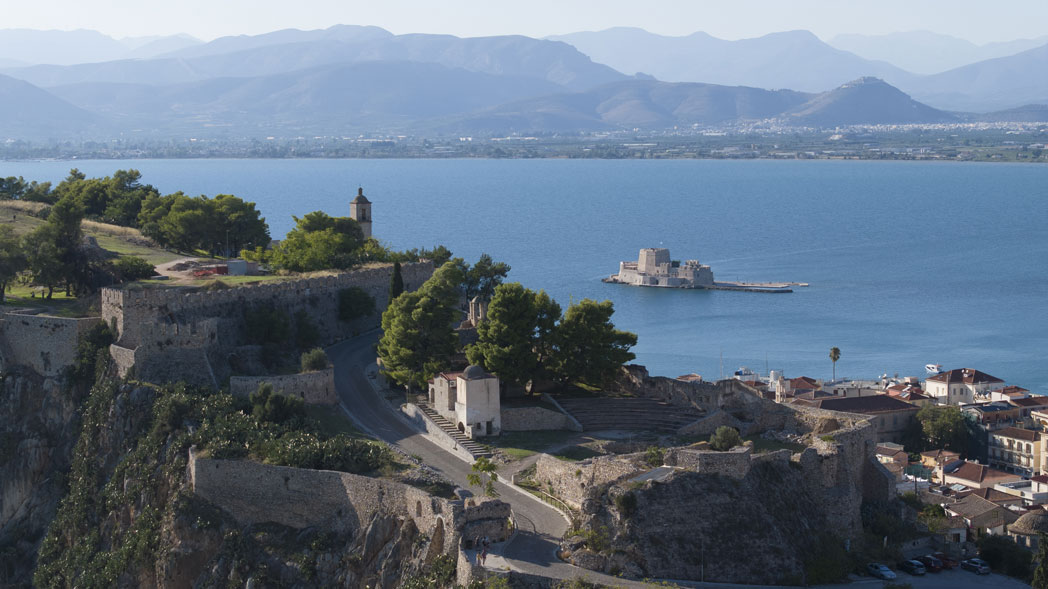
Today, Acronauplia can be accessed from Nafplio’s Old Town via the asphalt road that begins at the backfilled moat surrounding the Grimani bastion, as well as from the staircase of the Catholic church, which leads to the gate to Tori Castle.
THE INTERIOR
To a large extent, the castle’s interior took its present form in the 20th century, shaped by efforts to develop it for tourism. During the same period (1960s–1970s), municipal water tanks for the city of Nafplio were constructed in the section adjacent to Arvanitia beach.
The site of Tori Castle is occupied by the abandoned Xenia hotel and its facilities. The castle gate and the prominent circular bastion facing Arvanitia, along with the postern-gate that facilitated supplies from the sea, remain visible.
Within the Castle of the Franks, the remains of the Kapodistrias military hospital are preserved. Also located here is the chapel of Agioi Anargyroi, a modern building dating to the late 20th century. In the same area, the Ministry of Culture has constructed a small open-air theatre, which hosts events organised by the Municipality of Nafplio. The theatre is part of a broader initiative to promote Acronauplia, which was implemented by the competent Ephorates of Antiquities (initially the 25th Ephorate of Byzantine Antiquities and later the Ephorate of Antiquities of Argolis).
The modern hotel occupies a significant part of the Castle of the Greeks. At the highest point of the hill lie the remains of the church of Agioi Theodoroi, the original construction of which dates to the 11th century. Next to the wall separating the castles of the Greeks and the Franks lies the castle’s gunpowder storeroom, a structure dating to the second period of Venetian rule.