
Acrocorinth
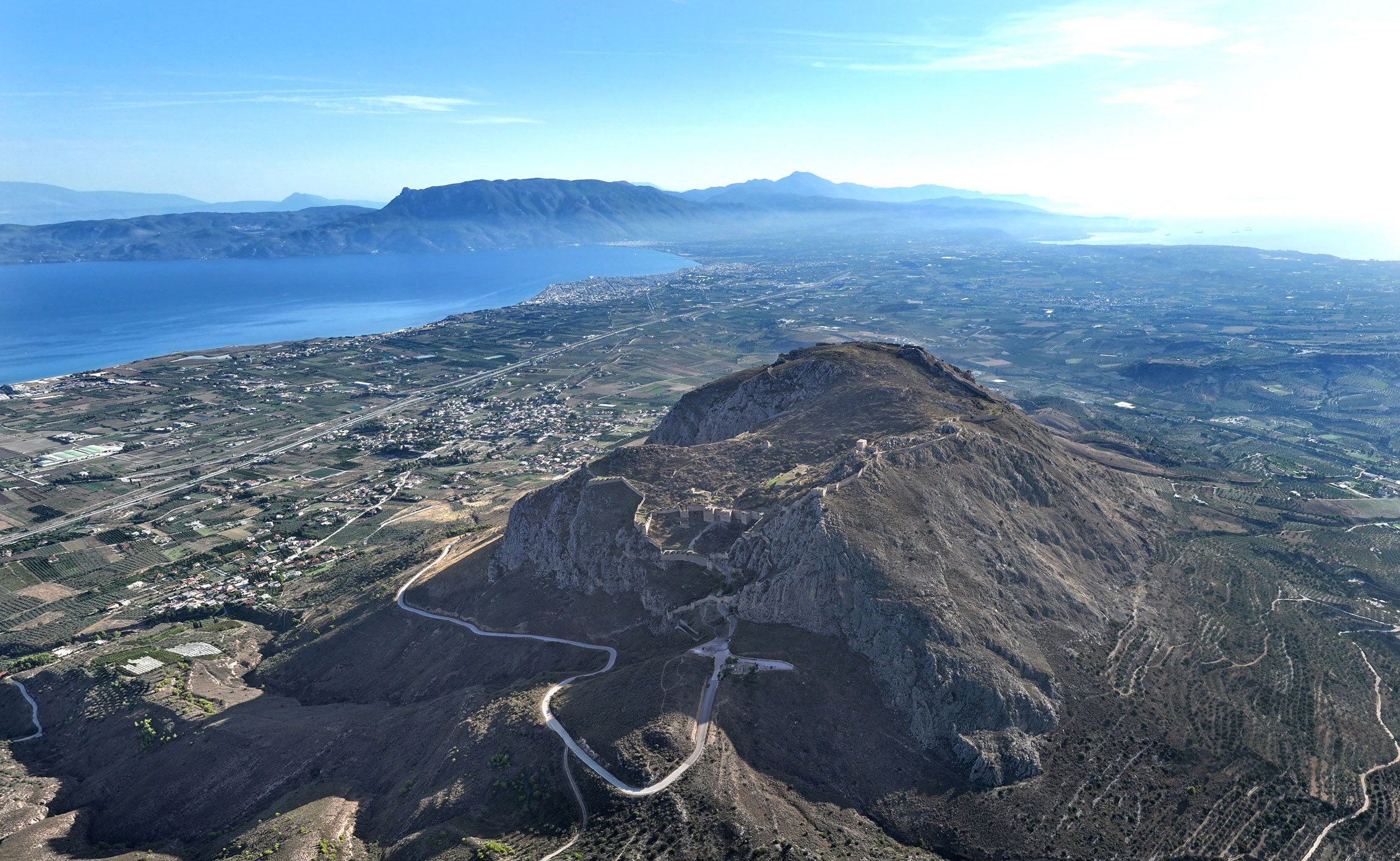
Acrocorinth castle is located atop the hill of the same name, overlooking Ancient Corinth at an altitude of about 550 m. From this naturally fortified location, it ensured the control of the Corinthian Gulf to the north and the Saronic Gulf to the east. In addition, through a network of visually connected fortresses extending to Arcadia, it also controlled the Peloponnesian hinterland. Its strategic position, the flat formation of the hilltop and the presence of freshwater springs within the fortification contributed to its continuous use from ancient times until the 1821 Greek Revolution. It was most densely inhabited during the Late Byzantine and Ottoman periods.
ΑΠΟ ΤΟ ΠΑΡΕΛΘΟΝ ΣΤΟ ΠΑΡΟΝ
The hill’s earliest fortifications date to the Archaic period, during the reign of the tyrants of Corinth (7th–6th c. BC). In ancient times, it was a walled acropolis integrated into a wider fortification, which included Ancient Corinth and Lechaion harbour. In 338 BC, the Macedonians occupied the city of Corinth, which in 243 BC joined the Achaean League. Its walls were torn down after the Roman occupation and the city’s complete destruction in 146 BC. In 44 BC, Corinth was refounded as a Roman colony by Julius Caesar and its defensive wall was rebuilt using the same ancient material. It was also designated as the seat of the proconsul of the Province of Achaea during this period.
In the Early Byzantine period (4th–5th c.), Corinth flourished as it was the seat of the imperial administration and its church became a metropolitan see. The city was fortified again in the 5th or 6th century, when emperors Theodosius II and Justinian, fearing impending barbarian raids, carried out a fortification programme that included the construction of the Hexamilion fortification wall on the Isthmus and the new defensive enclosure of Corinth. Acrocorinth was then cut off from the city but remained inhabited.
In the transitional period (7th c.–842 AD), Corinth became the capital of the Theme of Greece (687–694) and later the capital of the Theme of the Peloponnese (786–788).
In the Middle Byzantine period (842–1204), Corinth became a major commercial and administrative centre. Acrocorinth castle gained greater significance and its walls took on their final, present-day layout. A distinction was now made between the lower city of Corinth, referred to in the sources as “Emporion” or “Chora”, and Acrocorinth, referred to as “Kastro” (Castle). In 1147, the Normans plundered Corinth. The fall of the city led to the reinforcement of the defensive walls of Acrocorinth, which probably also served as the headquarters of the administrative and ecclesiastical authorities.
In 1203, Leon Sgouros, lord of Nafplio, seized Corinth and used the castle to mount a prolonged resistance against the crusader army of Geoffrey of Villehardouin. The castle never fell; however, after a five-year siege and the death of Sgouros, who according to a later legend took his own life by jumping from the walls on horseback, the Corinthians capitulated to the Franks in 1210. Corinth was then incorporated into the Frankish Principality of Achaea and became the seat of the Latin archbishop. Especially from the mid-13th century, the city underwent significant development as a major economic and military centre. However, during the 14th century, natural disasters, enemy raids and the general instability due to the conflicts between the Byzantines of Mistras and the Franks, resulted in the gradual decline of the area until 1358, when it passed into the hands of the Florentine Acciaioli family. In 1395, Acrocorinth Castle, now identified with Corinth, was given as a dowry to Theodoros Palaiologos, despot of Mistras, and five years later it was sold to the Knights Hospitallers of Rhodes, who held it for a short period (1400–1404). From 1404 until the Ottoman conquest of Corinth in 1458, it was controlled by the Byzantines.
During both periods of Ottoman (1458–1678 and 1715–1823) as well as Venetian (1678–1715) rule, Acrocorinth retained its significance. A large part of Corinth’s population had settled in Acrocorinth in the 14th century and remained there throughout the 15th and 16th centuries, while the Ottomans engaged in extensive construction activity. In fact, during the 17th century, the population was divided: Muslims lived in the inner castle and Christians in the lower area, between the middle and inner lines of the fortifications.
During the short period of Venetian rule, Acrocorinth was called Fortezza di Corinto, while according to Grimani’s census, in 1700, it was inhabited by eighty families.
After the Ottoman reconquest (1715) and while Acrocorinth was still inhabited, the lower settlement of Corinth began to develop. On 26 October 1823, Greek troops, led by Theodoros Kolokotronis, liberated the castle after three sieges (April 1821, January 1822, January 1823). Acrocorinth remained inhabited after 1823.
THE CASTLE
Acrocorinth Castle’s present form is the result of successive interventions, reinforcements and reconstructions over its long history.
Its perimeter walls follow the natural terrain. With a total length of 3,000 m, they enclose an area of about 24 hectares, making the castle one of the largest in the Peloponnese. They are reinforced with bulwarks to the east, northeast, southeast and northwest that protect the corresponding entrances to the castle.
The main defensive point is located on the western side of the hill, its flattest and most vulnerable. Here lies the main entrance to the castle’s interior, formed by three successive gates corresponding to the triple fortification lines on this side. The first (outer) fortification line is the most recent, constructed in the first half of the 15th century, either during Knights Hospitallers period or the Paleologan era.
The second (middle) fortification coincides with the main outer entrance of the Middle Byzantine castle. The third (inner) western fortification, also dating to the Middle Byzantine period, follows the course of the ancient walls and is reinforced by six towers. It is C-shaped, with two strong bastions at each end. The medieval settlement was located behind this last inner fortification line, within the inner castle. During Ottoman rule, this settlement expanded, and in the 17th century it was divided: the Ottomans lived in the inner castle, and the Christians lived in the area between the middle and inner fortifications.
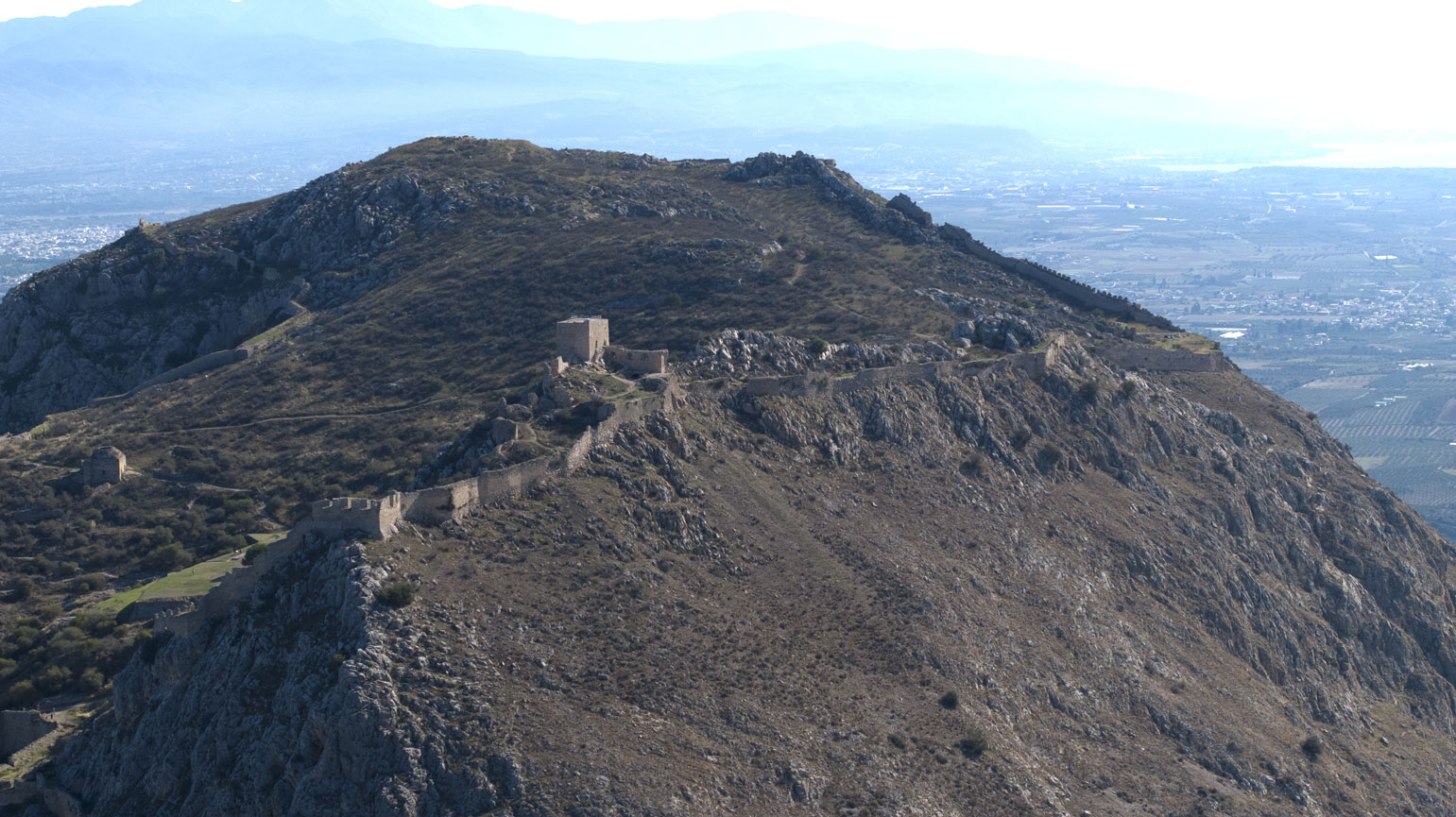
Two towers stood on the northeastern and southwestern peaks of Acrocorinth, providing oversight of the castle’s interior and a large part of the Peloponnese as well as the Corinthian and Saronic gulfs. Of the northeastern tower, which dates to the Middle Byzantine period, only the foundations remain. The tower on the southwestern hilltop is protected by a small fortress, which constitutes the castle citadel. It is called the “Frankish Tower” as, according to written sources, Prince William II of Villehardouin repaired the castle in the mid-13th century and built a palace inside it. However, in its present form, the tower dates to the Ottoman period. It has an underground cistern, a main room and a roof terrace.
THE GATES
The main access to the castle, located on the flatter, western side of the hill, consists of three monumental gates corresponding to the three fortification lines on this side. The first gate, corresponding to the outer fortification line and dating to the first half of the 15th century, is arched and topped with a blind arch, within which a reused Byzantine marble slab is preserved. In front of the gate, there was a moat with a wooden drawbridge. The second gate of the middle fortification line, dating to the Middle Byzantine period, opened into the base of a tower with at least two levels, the upper one of which functioned as a chapel. Two more towers, to the south and west of the second gate, reinforced its security. The third gate, also Middle Byzantine, which corresponds to the last inner fortification line and leads to the inner castle, stands between two towers. Ancient building material was used in its construction and it is decorated with a blind, U-shaped arch.
Gates providing access to the castle are located at all four bulwarks on the eastern and northern sides of the perimeter defensive wall, while four more gates, two reinforced with bulwarks, are located on the northeast and southwest sides.
Finally, two successive gates open into the citadel to the southwest of the castle. One leads through the outer walls to the citadel, while the second leads from the citadel to the inner castle.
THE INTERIOR
Today, Acrocorinth Castle contains the remains of buildings from all the historical periods during which it was in use. On the western side of the castle, in the area between the middle and inner fortifications, the foundations of the Ottoman-era Christian settlement houses can be seen. In the inner castle, there are ruins of houses and other buildings of the medieval and Ottoman settlement: mosques, baths, fountains and a large Byzantine cistern, above which is a terrace that, during the Byzantine period, hosted public buildings. Here stands also the aisleless post-Byzantine church of Agios Dimitrios, which remains in use.
On the eastern side of the castle, close to the tower on the northeastern hilltop, remains of the ancient sanctuary of Aphrodite are preserved. A three-aisled basilica was built here during the Byzantine period. After the Ottoman conquest of Corinth, a funerary monument was erected in the same place.
The castle had incredible water sufficiency. Many natural cavities, wells and cisterns allowed residents to remain in it for long periods without facing water shortages. In the middle of the castle’s southern side lies the most important of these cisterns, the Upper Peirene Fountain. Built in a natural rock cavity, it is a hydraulic work of the Classical period that remains intact. Its existence is linked to myths, as it was given as a gift to the king of Corinth, Sisyphus, by the river of Corinth, Asopus, or sprang from the blow of Pegasus’ foot when Bellerophon captured him. Northwest of the fountain are barracks from the Venetian period.
Visitors to Acrocorinth can tour all the sites on the hill along landscaped paths.